
Today’s content doesn’t travel. It crosses borders, cultures, and audience expectations at lightning speed.


Mahnoor Shahid
Content & Growth, Echo9.ai
Last updated on September 2026.
Quick answer
Media localization is the process of adapting audiovisual content – dialogue, subtitles, on-screen text, and cultural references – so it feels native to viewers in a different language or region. It goes beyond translation to cover tone, pacing, visuals, and platform-specific formatting, delivered through subtitling, dubbing, voice-over, or a mix of methods depending on the content and audience.
Today’s content doesn’t travel. It crosses borders, cultures, and audience expectations at lightning speed. A YouTube video filmed in Karachi can trend in São Paulo overnight. A Netflix series produced in Seoul can dominate watchlists in Europe within days. But here’s the catch: global reach doesn’t mean global understanding.
That’s where media localization comes in.
Media localization is no longer a “nice-to-have” for large enterprises. For creators, platforms, marketers, educators, and brands, dubbing goes beyond being helpful. It has become a vital tool for engaging global audiences. It’s now a strategic necessity in today’s global content landscape. Viewers expect content that feels native. They don’t want it translated or adapted. They want it made for them. And video localization plays a major role in meeting that expectation.
In this guide, we’ll explain what media localization really means. We’ll cover how it works, why it matters, and how content creators can approach it effectively. All this is in the context of global audiences and AI-powered workflows.
Media localization is the process of adapting audiovisual content. The makes the content suitable for different languages, cultures, and regions. This includes videos, films, podcasts, ads, e-learning modules, and social media clips. The aim is to ensure content feels natural. So that it resonates with the audience, and respects cultural norms.
Unlike simple translation, media localization takes more into account. It considers context, tone, cultural references, visuals, and even timing.. It goes beyond replacing words and focuses on preserving meaning, emotion, and intent.
At its core, media localization answers one question. How would this content be created if it were originally made for this audience?
Video localization is a key form of media localization. It covers adapting dialogue, on-screen text, subtitles, captions, and other audio elements. This helps viewers understand the video. It lets them connect with the content in their own language and culture.
Localization isn’t a single task. It’s a coordinated workflow that spans creative, linguistic, and technical disciplines. While the tools and team structures vary by scale, most professional localization processes follow a consistent path from content intake to regional launch.
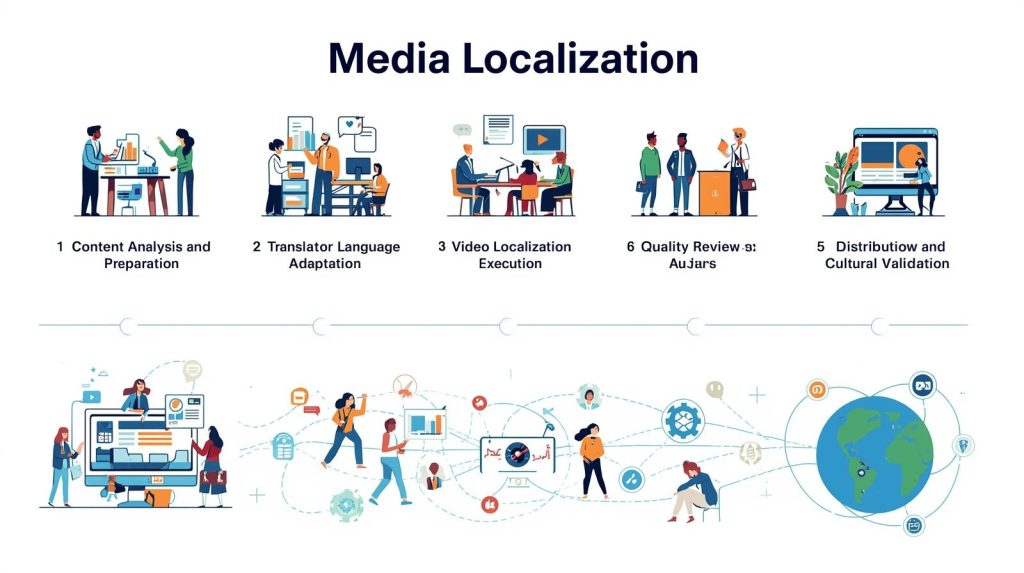
Before a single word is translated, the content itself needs to be fully understood. This first stage is about discovery: identifying all the elements that will need adaptation, spoken dialogue, on-screen text, cultural references, idiomatic expressions, and even background visuals that might carry unintended meaning in certain markets.
Teams also assess technical constraints at this stage. How long is each subtitle line? Are there timing limitations from the original audio? Is the video format compatible with dubbing? These decisions shape every step that follows, which is why getting this stage right matters more than most people realize.
Finally, scope is defined: which languages and markets to target, and what level of localization each requires. A global streaming release might demand full dubbing in six languages. A product demo might only need subtitles in two.
This is where translation ends and localization begins. For a deeper breakdown of how the two differ, see media translation vs. media localization.
Skilled linguists, ideally native speakers with subject matter familiarity, don’t just convert words from one language to another. They rebuild meaning. Humor gets recontextualized. Idioms get swapped for local equivalents. Tone is carefully preserved so a character who sounds authoritative in English still sounds authoritative in Portuguese, not robotic or overly formal.
Literal accuracy is a starting point, not a finish line. A line that translates perfectly word-for-word often falls completely flat when spoken aloud or read in context. Good language adaptation prioritizes how something lands, not just what it says.
With adapted scripts in hand, the actual localization is produced. The method chosen here has significant implications for cost, turnaround time, and how audiences receive the content.
The most common approaches include:
Many productions use a combination, opting for dubbing in primary markets and subtitles in secondary ones, depending on budget and audience expectations.
Localized content goes through multiple review layers before it’s cleared for release. Linguists check for translation accuracy and natural-sounding dialogue. Cultural consultants flag anything that might be offensive, confusing, or simply out of place for local audiences.
For dubbed content, this stage also includes technical QC: lip-sync accuracy, audio levels, and timing alignment. For subtitles, reviewers check readability, including line breaks, reading speed, and positioning relative to on-screen elements.
This step is what separates localization that works from localization that embarrasses the brand.
Releasing localized content isn’t just uploading a new file. For each market, metadata needs to be adapted too. Titles, descriptions, tags, and thumbnails all play a role in discoverability and first impressions.
A title that resonates in the US might be unfamiliar or even off-putting in Southeast Asia. A thumbnail featuring text needs to be recreated, not just translated. Localized SEO metadata helps content surface organically in each region, extending reach far beyond what subtitles alone can achieve.
Done well, this final stage turns a single piece of content into a market-ready asset, one that feels like it was made for that audience, not just adapted for them.
A fillable worksheet that puts studio, vendor and Echo9 costs side by side for one season.
Not all localization methods serve the same purpose, and choosing the wrong one for your content can hurt both engagement and budget. The right approach depends on a combination of factors: content type, audience expectations, regional norms, and available resources.
Subtitling is the most widely used localization method, and for good reason. It’s fast, cost-effective, and non-destructive, meaning the original audio stays completely intact. Subtitles work particularly well for social media content, short-form videos, educational material, and any content where preserving the speaker’s authentic voice matters. They also carry a quiet SEO advantage since platforms can index subtitle text, making content more discoverable across regions.
Often confused with subtitles, closed captions serve a broader purpose. While subtitles assume the viewer can hear but doesn’t understand the language, captions are designed for viewers who cannot hear the audio at all. They include not just dialogue but also sound descriptions, music cues, and speaker identifiers. Beyond accessibility, closed captions support compliance with regional broadcasting and digital content regulations, making them a practical necessity for brands operating across multiple markets.
Voice-over sits between subtitling and full dubbing in terms of effort and immersion. A narrator reads a localized script over the original audio, which is typically lowered in the background rather than removed entirely. This approach is common in documentaries, corporate training videos, news segments, and e-learning content. It’s quicker and less expensive than dubbing while still giving audiences a more natural viewing experience than reading subtitles.
Dubbing replaces the original audio entirely with voice performances recorded in the target language. When done well, it creates the most immersive experience for viewers, since there’s nothing to read and no foreign-language audio competing for attention. It’s the standard for major film and television releases in markets like Germany, France, Italy, and Spain, where audiences have long expected localized audio rather than subtitles. The tradeoff is cost and time: dubbing requires voice casting, studio recording, and precise lip-sync alignment, which makes it significantly more resource-intensive than other methods.
Global audiences don’t just want access, they want connection. Media localization helps creators build trust, engagement, and emotional resonance across regions.

Here’s why it matters more than ever:
Expanding Global Reach: Localized content removes language barriers. This allows creators to reach audiences who might otherwise skip or abandon content. By adding subtitles or dubbing, creators can expand their audience. All this happens while keeping the original creative vision unchanged.
Higher Engagement and Retention: When content feels natural and native, viewers engage more. They watch, share, and complete videos more often. Video localization improves watch time, reduces drop-offs, and increases audience loyalty.
Stronger Brand Credibility: Well-localized media signals professionalism and respect for the audience. Poor localization, on the other hand, can damage brand perception and reduce trust.
Better Monetization Opportunities: Localized content performs better in international markets. It opens doors to regional sponsorships, ad revenue, partnerships, and platform-specific growth.
Media localization works best when planned early rather than treated as an afterthought.
Some proven best practices include:
For video localization, syncing subtitles accurately is important. Maintaining a natural speech rhythm in dubbing also improves the viewer experience.
AI has transformed how media localization is executed at scale. Automated speech recognition, machine translation, and AI dubbing have significantly reduced turnaround times.
But, human expertise remains essential. The most effective localization strategies combine AI efficiency with human cultural insight. This is especially important for brand-critical or emotionally nuanced content.
This hybrid approach enables creators to localize more content, faster, without sacrificing quality.
As localization shifts from a one-time project to an ongoing content operation, most tools struggle to keep up. Echo9 is built differently, and two capabilities in particular set it apart for teams working at volume.
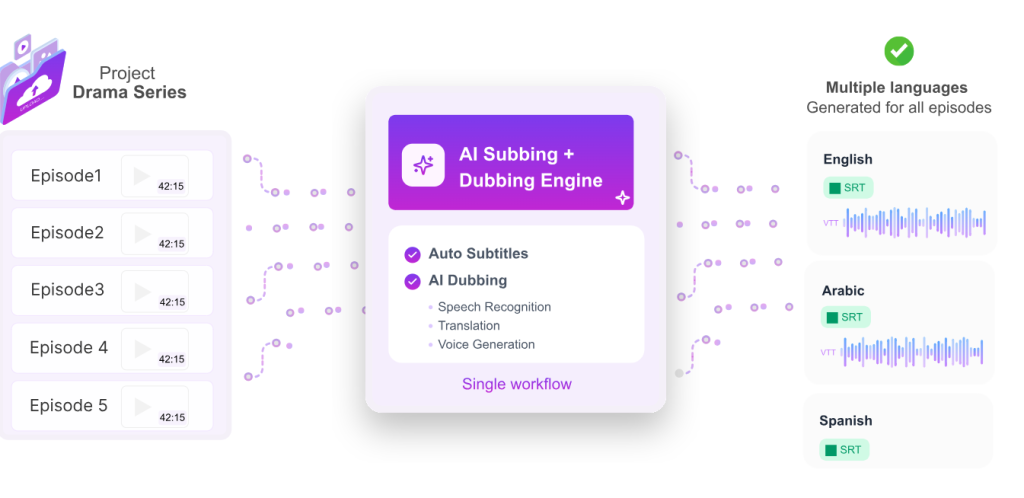
Most localization platforms treat every video as a standalone file. Echo9 is built around the reality that most professional content is episodic. Its Series Management capability lets teams organize entire shows, seasons, and episode libraries under a single project, processing multiple episodes simultaneously while maintaining voice consistency, character mapping, and glossary accuracy across every single episode. Whether you’re localizing a 10-episode drama or a 200-episode archive, the output stays coherent from start to finish, something manual workflows rarely achieve reliably at scale.
For enterprises that don’t want to manage localization in-house, Echo9 offers a fully managed service. Studios and platforms simply hand over their content, and Echo9’s expert team handles everything: transcription, translation, dubbing, quality review, and final delivery in broadcast-ready formats. With 50+ enterprise clients, 1.4 million episodes delivered, and a 99.8% on-time delivery rate, it’s designed for organizations where quality and reliability aren’t negotiable.
Together, these two offerings make Echo9 more than a tool. It’s a localization infrastructure that grows with your content output.
Media localization is no longer optional in a world where content is global by default. For creators, this approach allows authentic audience connection. It boosts engagement and extends the reach of their content. And it does so without requiring them to redo their creative work.
For creators who want to adopt this approach, AI-driven platforms like Echo9 can help. They simplify the entire process. They make it easy to integrate media and video localization into everyday workflows. This allows creators to reach global audiences without adding complexity.
By understanding how media localization platforms truly work, creators can make smarter decisions. It allows them to avoid common pitfalls. It also lets them build content that resonates across borders.
The future of content isn’t just global. It’s local. Everywhere!
Run the same benchmarks on your own catalogue and compare the output yourself.
No. Startups, educators, and creators can benefit just as much. Even adding subtitles can significantly expand your reach and engagement.
AI transcription combined with human-reviewed translation is the most effective. It balances speed, cost, and cultural accuracy.
Begin with markets where you already see traction. Let audience data guide your expansion.
Yes. Localized titles, descriptions, and metadata improve search visibility and platform discoverability.
It depends on your audience. Subtitles are cost-effective, while dubbing creates a more immersive local experience.
With AI-assisted workflows, subtitles can be ready in hours. Full dubbing and adaptation may take a few days depending on complexity.
Yes. Content in a viewer’s native language builds trust, improves retention, and drives higher engagement and conversions.