
Today, content crosses borders faster than ever. A single video, podcast, or campaign can now reach audiences worldwide in minutes.


Mahnoor Shahid
Product Marketer at Echo9 – 2 years of experience in video localization, evaluating dubbing and subtitling tools for streaming and e-learning clients.
Last updated on September 2026.
Quick answer
Media translation converts spoken or written content – dialogue, subtitles, on-screen text – from one language into another. Media localization goes further: it adapts tone, cultural references, idioms, pacing, and even visual elements so the content feels native to the target audience, not just translated. Most studios need both working together, especially for episodic content where consistency has to hold across an entire season.
Today, content crosses borders faster than ever. A single video, podcast, or campaign can now reach audiences worldwide in minutes. But as reach grows, new challenges emerge. Content must work across cultures. It must also work across languages and contexts.
This is where the debate around localization vs translation becomes critical.
Many content creators and EdTech businesses assume translation is enough. They believe it makes their content global. In reality, translation is only one piece of a much larger puzzle. This is especially true for video, audio, and multimedia content.
Understanding the difference between media translation and media localization matters. It determines whether content simply exists in another language. Or whether it truly connects with audiences.
This guide breaks down the true meaning of translation and localization. It explains how the two differ and when to use each. It also shows why media localization is now critical for global content strategies.
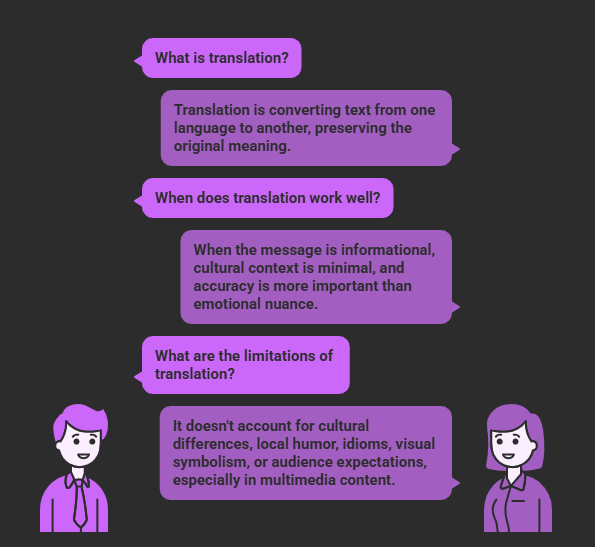
Translation is the process of converting text from one language into another. The goal is to preserve the original meaning as accurately as possible. Its primary focus is linguistic accuracy. This means ensuring the correct words are used. Sentences and grammar must also be accurately rendered in the target language.
When applied to media, translation usually focuses on the text itself. This includes scripts, subtitles, captions, and on-screen text. The underlying structure and cultural framing remain unchanged.
Translation works well when:
For example, some content requires strict accuracy. This includes legal disclaimers, product specifications, and internal training materials. This leaves little room for adaptation. The translated content must closely follow the source text.
That said, translation alone is not enough. It does not account for cultural differences. It misses local humor, idioms, visual symbolism, and audience expectations. This is where its limitations begin to show, especially in multimedia content.
Media localization goes far beyond translating words. It adapts content to fit the target audience. This includes cultural, social, and contextual expectations. While translation asks, “What does this mean in another language?” localization asks, “How should this be experienced by this audience?”
In media localization, language is just one layer. Others include tone, pacing, visuals, references, formats, and even platform preferences. The goal is to make the content feel as if it were originally created for that local audience.
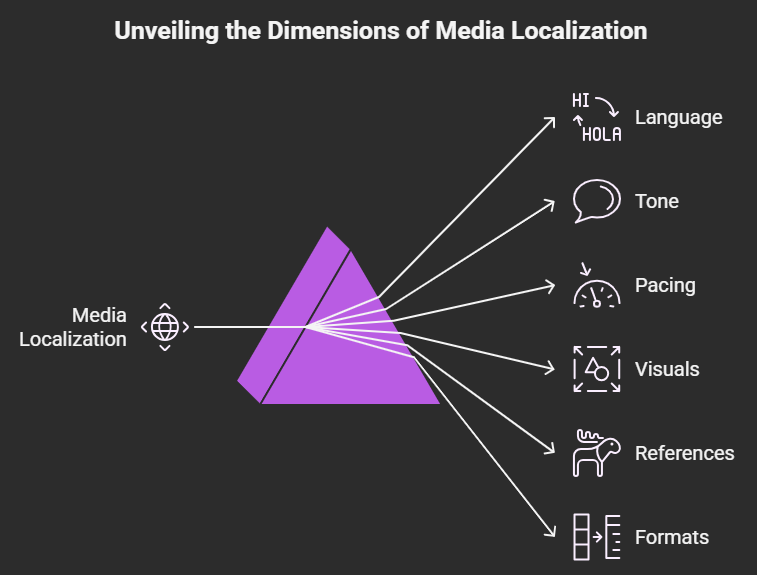
Media localization involves:
In short, localization prioritizes relevance and emotional resonance over literal accuracy.
Understanding localization versus translation is easier when you compare their intent. It helps to look at the outcomes they produce.
Translation focuses on language equivalence.
Localization focuses on audience experience.
Here’s how they differ at a fundamental level:
| Localization | Translation |
| Adapts meaning so it feels natural and familiar to the target audience | Preserves meaning word-for-word or sentence-for-sentence |
| Linguistic, cultural, and contextual | Primarily linguistic |
| Ensures viewers understand what is being said | Does not necessarily involve understanding |
| Ensures viewers feel the message was meant for them | Whether the message resonates emotionally is not guaranteed |
| Adapts on-screen text, graphics, colors, and imagery so they read correctly and carry the intended meaning in the target market | Converts on-screen text and captions into the target language without altering visuals or graphics |
| Rewrites jokes, idioms, and cultural references so they land the same way for the new audience | Renders the literal wording of jokes and references, even when the humor does not carry over |
| Adjusts content to meet local broadcast standards, content ratings, and platform guidelines | Focuses on language conversion only; does not address regional compliance requirements |
| Re-times subtitles and re-records dubbing so pacing and lip-sync match natural speech in the target language | Converts dialogue and captions without adjusting pacing or synchronization timing |
Take a comedy sketch as a case in point. Translation alone will keep the dialogue accurate but can lose the joke entirely. Media localization goes further: it rewrites the punchline so it lands with the new audience, adjusts any on-screen text or graphics that reference local culture, and re-times the subtitles or dubbing so the timing of the laugh still feels natural.
For example, a marketing slogan may be translated literally. It might be grammatically correct, but emotionally flat or confusing in another language. Localization would rework the slogan completely. The goal is to deliver the same impact, even if the words change.
All eight stages on your own content — upload to broadcast-ready audio. No credit card, no managed-service queue.
Text-based content like documents or manuals can often survive with simple translation. Media content cannot. Videos, ads, podcasts, and e-learning modules rely on more than words. They depend on emotion, timing, visuals, and tone. All of these elements are culturally sensitive.
When audiences consume media, they’re not just reading words. They interpret context, voice, humor, and intent. Poor localization can break immersion. It can reduce trust or make content feel foreign and out of touch.
This is why media translation alone often falls short for:
Media localization makes subtitles sound natural. It ensures dubbing feels human. It also aligns visuals with local norms. This creates a seamless viewing experience.
It’s important to note that translation is not the opposite of localization. It’s a component of it. Media localization typically starts with translation but does not end there.

A simplified workflow often looks like this:
In this sense, media translation provides the foundation. Localization builds the full experience on top of it.
Many global content teams overlook localization. Some even treat it as optional, rather than essential. This often leads to content that technically “works” but fails to perform.
Some frequent issues include:
These mistakes affect more than user experience. They can damage brand perception and reduce ROI on content efforts
There are scenarios where translation alone is sufficient. For example, internal documentation often requires precision. The same goes for compliance materials and highly technical content. Adaptation is less important in these cases.
However, localization becomes essential when:
If your media content is customer-facing, localization is almost always the better choice.
Investing in localization has measurable benefits. Brands that localize media content often see higher engagement. They also experience longer watch times. Conversion rates improve across global markets as well.
Localized media helps:
Related read: The complete guide to media localization
Effective localization requires planning and strategy. A purely tactical approach won’t achieve the best results.
Some proven best practices include:
Treat localization as a creative and strategic process, not just a technical task.
Advances in AI have made media translation faster and more accessible than ever. Automated subtitles, speech-to-text, and machine translation tools can significantly reduce turnaround times.
However, AI translation alone still struggles with nuance, emotion, and cultural context. The most effective workflows combine AI-driven translation with human-led localization. This balances speed with authenticity.
As global content demands scale, the hybrid approach is becoming a standard. It ensures high-quality media localization.
How Echo9 Supports Media Localization
Echo9 bridges the gap between media translation and full-scale media localization. It helps global teams move beyond basic word-for-word translation. The platform lets content creators localize subtitles and dubbing. This ensures they sound natural and culturally aligned for regional audiences. All of this happens without slowing down production.
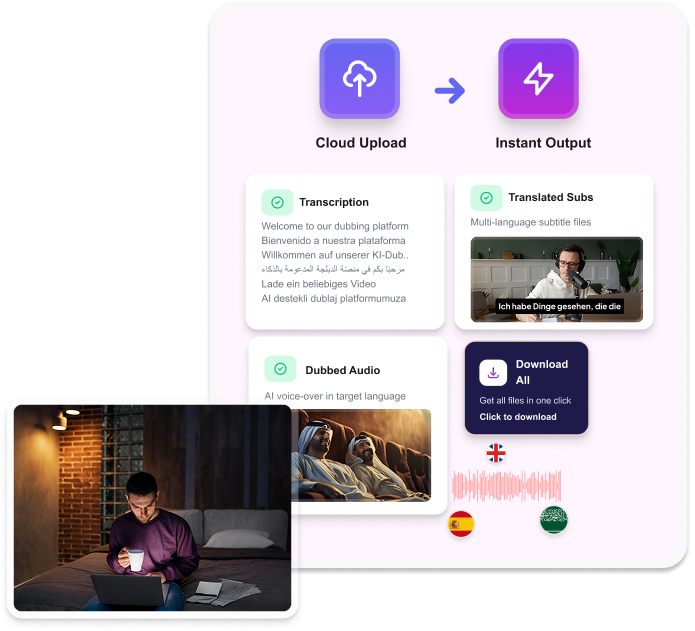
At its core, Echo9 combines AI efficiency with contextual accuracy by supporting:
Echo9 brings translation and localization together in a single platform. Teams can expand into new regions. They can do so while maintaining content consistency, quality, and cultural relevance.
The debate around localization versus translation isn’t about choosing one. The key is to understand what each does. And to know when to use one or the other.. Translation ensures comprehension, while localization ensures connection.
For modern content creators and brands, localization is no longer optional. This is especially true for those working with video and multimedia. Some content is just understood at face value. The best content goes further, it truly resonates.
As global audiences grow more diverse, expectations rise. Investing in thoughtful media localization isn’t just a best practice. It’s a competitive advantage.
Give us one source upload and your target languages. We’ll show you the parallel output.
Yes, localization usually costs more than translation. This is because it requires extra creative and cultural adaptation.
Not really. Translation is usually the first step. Localization builds on translation by adapting the content for the target audience.
Subtitle translation is one form of media translation. Media translation can also include scripts, captions, and voiceover text.
Media translation converts dialogue, subtitles, and on-screen text from one language into another while preserving the original meaning. Media localization goes further, adapting tone, humor, visuals, pacing, and cultural references so the content feels native to the target audience. Most media projects need translation first, then localization to make the result resonate.
Yes. Localized titles, descriptions, subtitles, and on-screen text all get indexed, which helps content surface in search and platform recommendations for each target market. Media translation alone, without adapting metadata and on-screen text, captures less of that benefit.
Media translation alone is usually cheaper since it only covers converting dialogue and text. Media localization costs more because it adds cultural adaptation, timing and lip-sync adjustments, and visual changes, but it typically pays back in higher engagement and retention from audiences who experience content that feels native.