
Video is now the dominant medium for communication, entertainment, and education. Reaching global audiences is no longer optional.

Video is now the dominant medium for communication, entertainment, and education. Reaching global audiences is no longer optional.
The real question content teams face today is not whether to localize, but how?
Choosing between subtitles and dubbing is more than a technical decision. It shapes audience perception, engagement levels, and scalability across regions.
Both are proven video localization methods. But they serve different goals. They also suit different audiences and content formats. Choosing the wrong approach can hurt viewer retention. It can also inflate costs or weaken emotional impact. Choosing the right approach does the opposite. It opens access to new markets. It keeps viewers watching longer. And it helps your content stay valuable over time.
This guide breaks down subtitling and dubbing in practical terms. It compares both approaches across real-world use cases. It explains how AI platforms like Echo9 enable strategic use of both. All without doubling effort or losing consistency.
Subtitling involves displaying translated text on screen while preserving the original audio. It remains one of the most widely used video localization options. This is especially true for digital-first content. And for multilingual audiences who are comfortable reading on screen.
At its core, subtitling focuses on accuracy, timing, and readability. A well-produced subtitle file balances linguistic precision with visual constraints. Text stays on screen long enough to be read. And it never distracts from the video itself.
Subtitles are especially effective for audiences that value authenticity. Hearing the original speaker’s voice preserves tone and emotion. It also maintains the performance. This is especially important for interviews, documentaries, and culturally rooted storytelling.
Subtitling is often preferred when speed and scale matter. It is commonly used for:
Subtitles don’t require voice production. This keeps turnaround times short. And costs remain lower. Because of this, subtitles are ideal for scale. They work well for teams localizing content at scale across multiple languages.
Dubbing replaces the original audio with a translated voice track. The new audio is synchronized to the video. Unlike subtitles, dubbing removes the language barrier entirely. Viewers can enjoy content without needing to read.
Dubbing is not just translation. It involves voice casting, performance matching, timing alignment, and emotional delivery. When done well, dubbing makes content feel original in the target language. It gives viewers the impression it was produced for them from the start.
This makes dubbing especially powerful for narrative-driven content where emotional engagement drives retention.
Dubbing is most effective when immersion matters more than speed. It is commonly used for:
Audiences in Latin America, the Middle East, and parts of Europe prefer dubbing. It’s their favored way to consume media. For these markets, dubbing is not a luxury but an expectation.
Choosing between subtitles and dubbing isn’t just black or white. It can get confusing at times. It’s better to evaluate them based on important decision factors.

Subtitles preserve the original performance but require active reading. Dubbing removes reading effort and feels more natural, especially for long-form viewing. Younger viewers and mobile audiences may be fine with subtitles. Mainstream TV audiences, however, often expect dubbing.
Subtitling is significantly more cost-effective and faster to produce. Dubbing requires voice generation, synchronization, and quality control, which increases production complexity. However, AI dubbing has narrowed this gap dramatically.
Hearing dialogue in a viewer’s native language strengthens emotional connection. This is especially important for drama and character-driven stories. It also applies to branded content that relies on tone and persuasion.
Subtitles support accessibility for hearing-impaired viewers and are often required for compliance. Dubbing improves accessibility for viewers who struggle with reading or multitasking.
When deciding between subtitles and dubbing, consider:
| Consider Subtitling If: | Consider Dubbing If: |
| You are localizing quickly across many languages | Emotional immersion drives engagement |
| Your audience is digitally native and subtitle-friendly | Content is long-form or episodic |
| Budget efficiency is a priority | Target markets prefer dubbed media |
| Authenticity of original voices matters | You want frictionless viewing |
| Content length is short or informational | Content is aimed at children or mass audiences |
Many global publishers use both. Subtitles can be used for global distribution. Dubbing is typically reserved for high-priority regions.
As content libraries grow, localization becomes harder to manage. The biggest challenge isn’t translation quality. It’s maintaining consistency across episodes, seasons, and formats.
Without proper systems, teams face issues such as:
This is where most traditional workflows break down.
Echo9 is built specifically for teams managing ongoing content, not one-off videos. It combines AI-powered subtitling and dubbing with Series Management. This enables structured, repeatable localization workflows.
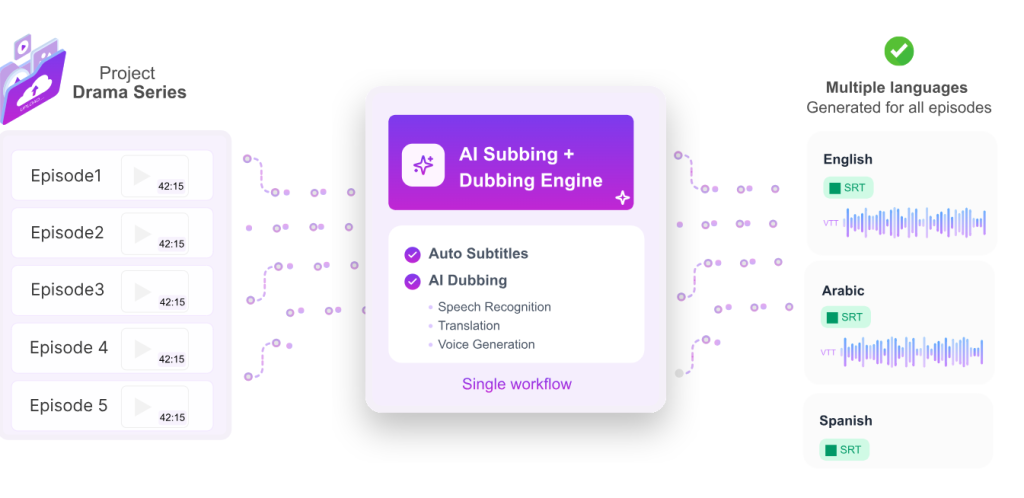
Instead of treating each video as an isolated task, Echo9 treats content as part of a larger system.
Echo9 generates accurate subtitles across 100+ languages while allowing human review and edits. Teams can manage timing, phrasing, and terminology centrally. This ensures subtitles remain consistent across a whole series or course.
Echo9 supports AI dubbing with voice consistency across episodes. Characters, narrators, or instructors keep the same voice identity. This eliminates mismatched audio between releases.
This is where Echo9 stands apart. Series Management allows teams to:
For OTT/streaming platforms, e-learning providers, and content networks, this structure is essential. It helps maintain quality at scale.
Different industries arrive at the subtitling vs dubbing question from different angles, but the underlying challenge is the same: content that needs to reach multiple audiences, in multiple formats, without multiplying the operational load. Here’s how teams across industries are solving it.
Streaming Platforms: Episodic content rarely gets a one-size-fits-all localization strategy. Streaming platforms like OTT typically dub for high-priority markets where viewer drop-off is highest without native audio, while applying subtitles for secondary regions to manage cost. Echo9 supports both within a single system, so teams aren’t toggling between tools as they expand their regional footprint.
E-Learning Providers: Training content has a dual requirement: subtitles for accessibility and compliance, dubbing for regional delivery where reading while learning creates friction. Echo9’s Series Management ensures consistent instructional language and terminology across every module – whether it’s subtitled, dubbed, or both.
Corporate Communications: Global organizations often subtitle internal communications for broad distribution, then dub the same content for frontline teams who need it in their native language. Echo9 handles both workflows in parallel, so the same source video doesn’t have to be processed twice.
Localization strategies evolve with your audience, your budget, and your growth stage. Most teams don’t launch with a fully dubbed library – they start lean, validate demand, and scale from there. That’s not a compromise; it’s a smart progression. But only if your tooling is built to support it.
The problem with most video localization platforms is that they’re optimized for one workflow or the other. Subtitle-first teams find that adding dubbing later means migrating to a new tool, reformatting assets, and rebuilding what already works. That friction slows down expansion right when momentum matters most.
Flexible video localization means your early decisions don’t box you in. You can market-test subtitles in a new region, measure engagement, and layer in dubbing once the audience is proven – all within the same platform, on the same content library.
Echo9 is built for this progression. Teams can begin with AI-generated subtitles to enter new markets quickly, then add dubbing as viewership grows, and scale both workflows without switching platforms or rebuilding from scratch. Whether you’re localizing a single series or an entire catalog, the path forward stays open.
The debate isn’t about which is universally better. It’s about which works best for your content, audience, and growth stage.
Subtitles offer speed and efficiency. Dubbing offers immersion and reach. The most successful teams use both subtitles and dubbing. They treat them as complementary video localization options.
With Echo9, subtitling and dubbing are no longer competing choices. They are part of a unified system. This system helps content reach global audiences consistently and at scale.
Yes. Subtitling generally requires less production effort since it focuses on transcription, translation, and timing rather than full voice recording. It’s typically more budget-friendly and allows faster deployment across multiple languages, making it ideal for wide international reach.
In many regions, dubbed content leads to higher completion rates because viewers can focus fully on visuals without reading subtitles. This reduces cognitive load and creates a more immersive experience, especially for entertainment-driven content.
Absolutely. Many content teams use subtitles for broad global distribution and reserve dubbing for priority markets where deeper engagement is needed. This hybrid approach balances cost efficiency with audience experience.
Echo9 uses structured Series Management to maintain consistent terminology, character voices, and emotional tone across episodes and seasons. This ensures continuity in long-form content, even when scaling into multiple languages.
Modern AI dubbing has reached a level where it performs effectively for many professional use cases, including streaming, training, and digital media. When paired with human quality oversight like Echo9 does, it delivers scalable results without compromising standards.
Drama series, children’s programming, training modules, and entertainment formats benefit significantly from dubbing. These formats rely heavily on emotional engagement and immersion, which dubbing helps preserve across languages.