Most conversations about the cost of dubbing a video start and end at the voice actor rate. A per-minute figure gets quoted, a budget gets approved and then the invoices start arriving; each one covering something nobody mentioned in the original conversation. Script adaptation. Studio time. Casting fees. Revision rounds. Project management overhead. And if you are dubbing a series, an entirely separate cost category most guides do not even address. The voice actor rate is real. But it is only the beginning. Here is what the full cost of dubbing a video actually looks like and why AI dubbing eliminates most of it. What Does Human Voice Actor Dubbing Actually Cost? The invoice most people receive when commissioning a dubbing project shows one number. What that number actually covers is the voice actor’s time in the studio and nothing else. Every other cost that makes a voiced performance into a finished, broadcast-ready dubbed video is billed separately, added later or absorbed quietly into a project budget that ends up looking nothing like the original quote. Before getting into the hidden costs, it helps to understand what that visible number actually represents. The “Visible” Cost: Per-Minute and Per-Language Rate Ranges Ask a dubbing studio for a quote and the first number you will see is the per-minute rate. For professional human voice actor dubbing, that rate typically ranges from $50 to $500 per finished minute, depending on language pair, quality tier, and talent. Broadcast-quality dubbing for television or film starts at around $50 to $60 per minute at the lower end, with high-profile productions and union talent pushing rates significantly higher. Studio time alone runs $100 to $400 per hour and that is before a single line is recorded. Multiply that across multiple languages. A one-hour corporate video dubbed into just two languages can reach $18,000. The same video in four languages? The math scales linearly, and it gets uncomfortable fast. Why This Number Is Only the Starting Point The per-minute rate is what gets quoted. What gets charged is something else entirely. Every professional dubbing project involves a production chain that extends well beyond the voice actor session. Translation, script adaptation, studio booking, casting, engineering, quality assurance and project coordination are all separate billable services and in most quotes, they are either bundled invisibly or added later as line items. The sections below break down each of those hidden costs individually. The 7 Hidden Costs of Human Voice Actor Dubbing The per-minute rate is the number that gets approved in budget meetings. What actually gets paid is that number plus seven others; each one a legitimate, necessary part of producing professional dubbed content and each one rarely mentioned until the invoice arrives. Some appear as separate line items. Others get bundled into a final project fee without explanation. A few never show up on paper at all, but show up in timelines, missed deadlines and re-booking costs. Here is what they are. #1 Script Adaptation and Localization Word-for-word translation does not work for dubbing. Scripts must be adapted so that the translated dialogue matches the original speaker’s lip movements, fits the natural rhythm of the target language, and preserves the meaning and tone of the source material. This is called lip-sync adaptation or dubbing localization, and it is a specialist service charged separately from translation. For content with cultural nuance, humor or idiomatic language, adaptation can take as long as the original translation itself. Depending on the language pair and content complexity, script adaptation adds $15 to $40 per minute to the project cost, a line item that rarely appears in a headline quote. #2 Studio Rental and Sound Engineering Voice actors do not record from home for professional dubbing projects. They record in a professional studio with a sound engineer present to monitor quality, manage lip-sync timing, and handle the technical post-production. Studio rental typically runs $100 to $400 per hour. A 30-minute video may require two to four hours of studio time per language, factoring in setup, direction, retakes and editing. Add mixing and mastering fees on top of that, and studio costs alone can exceed the voice actor rate for shorter content. Each language requires its own dedicated session. Five languages means five separate bookings, five sets of engineering hours and five individual post-production processes. #3 Casting, Auditions, and Talent Coordination Finding the right voice actor for each character in each target language requires a casting process. Casting calls go out, auditions come in, shortlists get reviewed and then availability has to be negotiated across time zones and schedules. In union markets, common in the US, UK, Germany, France and Japan, this also triggers guild minimums, session fees and in some cases residual structures that add ongoing cost after the project is delivered. For a project covering five languages with three speaking roles each, casting and coordination can represent a substantial hidden line item, particularly when scheduling conflicts push timelines out and studio bookings have to be rescheduled. #4 Revisions and Re-Records No dubbing project makes it through without at least one revision round. A script change, a tone correction, a lip-sync adjustment or a client feedback note all mean the same thing: rebooking the studio and calling the voice actor back. Each revision round carries the full cost of a new session: studio time, engineering, talent fees and coordination. On projects with multiple stakeholders or complex content, two or three revision rounds are not unusual. This is one of the most underestimated costs in any dubbing budget. The original quote covers the first pass. Everything after that is incremental. #5 Project Management and Coordination Overhead Managing a dubbing project across five languages means managing five separate vendor relationships, five timelines, five quality review processes and five delivery formats. That coordination does not happen automatically. Many content teams hire a dedicated localization project manager to handle vendor communication, track deliverables and manage feedback loops. Others absorb the overhead internally, which rarely shows up as a
Table of Contents
Most conversations about the cost of dubbing a video start and end at the voice actor rate. A per-minute figure gets quoted, a budget gets approved and then the invoices start arriving; each one covering something nobody mentioned in the original conversation.
Script adaptation. Studio time. Casting fees. Revision rounds. Project management overhead. And if you are dubbing a series, an entirely separate cost category most guides do not even address.
The voice actor rate is real. But it is only the beginning.
Here is what the full cost of dubbing a video actually looks like and why AI dubbing eliminates most of it.
What Does Human Voice Actor Dubbing Actually Cost?
The invoice most people receive when commissioning a dubbing project shows one number. What that number actually covers is the voice actor’s time in the studio and nothing else. Every other cost that makes a voiced performance into a finished, broadcast-ready dubbed video is billed separately, added later or absorbed quietly into a project budget that ends up looking nothing like the original quote. Before getting into the hidden costs, it helps to understand what that visible number actually represents.
The “Visible” Cost: Per-Minute and Per-Language Rate Ranges
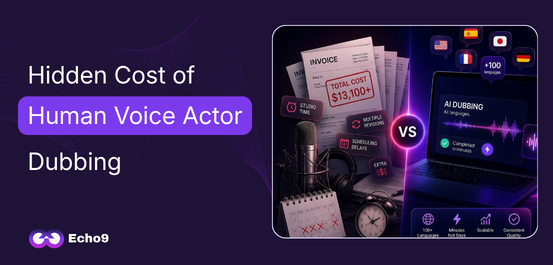
Ask a dubbing studio for a quote and the first number you will see is the per-minute rate. For professional human voice actor dubbing, that rate typically ranges from $50 to $500 per finished minute, depending on language pair, quality tier, and talent.
Broadcast-quality dubbing for television or film starts at around $50 to $60 per minute at the lower end, with high-profile productions and union talent pushing rates significantly higher. Studio time alone runs $100 to $400 per hour and that is before a single line is recorded.
Multiply that across multiple languages. A one-hour corporate video dubbed into just two languages can reach $18,000. The same video in four languages? The math scales linearly, and it gets uncomfortable fast.
Why This Number Is Only the Starting Point
The per-minute rate is what gets quoted. What gets charged is something else entirely.
Every professional dubbing project involves a production chain that extends well beyond the voice actor session. Translation, script adaptation, studio booking, casting, engineering, quality assurance and project coordination are all separate billable services and in most quotes, they are either bundled invisibly or added later as line items.
The sections below break down each of those hidden costs individually.
The 7 Hidden Costs of Human Voice Actor Dubbing
The per-minute rate is the number that gets approved in budget meetings. What actually gets paid is that number plus seven others; each one a legitimate, necessary part of producing professional dubbed content and each one rarely mentioned until the invoice arrives. Some appear as separate line items. Others get bundled into a final project fee without explanation. A few never show up on paper at all, but show up in timelines, missed deadlines and re-booking costs. Here is what they are.
#1 Script Adaptation and Localization
Word-for-word translation does not work for dubbing. Scripts must be adapted so that the translated dialogue matches the original speaker’s lip movements, fits the natural rhythm of the target language, and preserves the meaning and tone of the source material.
This is called lip-sync adaptation or dubbing localization, and it is a specialist service charged separately from translation. For content with cultural nuance, humor or idiomatic language, adaptation can take as long as the original translation itself.
Depending on the language pair and content complexity, script adaptation adds $15 to $40 per minute to the project cost, a line item that rarely appears in a headline quote.
#2 Studio Rental and Sound Engineering
Voice actors do not record from home for professional dubbing projects. They record in a professional studio with a sound engineer present to monitor quality, manage lip-sync timing, and handle the technical post-production.
Studio rental typically runs $100 to $400 per hour. A 30-minute video may require two to four hours of studio time per language, factoring in setup, direction, retakes and editing. Add mixing and mastering fees on top of that, and studio costs alone can exceed the voice actor rate for shorter content.
Each language requires its own dedicated session. Five languages means five separate bookings, five sets of engineering hours and five individual post-production processes.
#3 Casting, Auditions, and Talent Coordination
Finding the right voice actor for each character in each target language requires a casting process. Casting calls go out, auditions come in, shortlists get reviewed and then availability has to be negotiated across time zones and schedules.
In union markets, common in the US, UK, Germany, France and Japan, this also triggers guild minimums, session fees and in some cases residual structures that add ongoing cost after the project is delivered.
For a project covering five languages with three speaking roles each, casting and coordination can represent a substantial hidden line item, particularly when scheduling conflicts push timelines out and studio bookings have to be rescheduled.
#4 Revisions and Re-Records
No dubbing project makes it through without at least one revision round. A script change, a tone correction, a lip-sync adjustment or a client feedback note all mean the same thing: rebooking the studio and calling the voice actor back.
Each revision round carries the full cost of a new session: studio time, engineering, talent fees and coordination. On projects with multiple stakeholders or complex content, two or three revision rounds are not unusual.
This is one of the most underestimated costs in any dubbing budget. The original quote covers the first pass. Everything after that is incremental.
#5 Project Management and Coordination Overhead
Managing a dubbing project across five languages means managing five separate vendor relationships, five timelines, five quality review processes and five delivery formats. That coordination does not happen automatically.
Many content teams hire a dedicated localization project manager to handle vendor communication, track deliverables and manage feedback loops. Others absorb the overhead internally, which rarely shows up as a budget line but represents real hours and real cost.
For teams scaling to ten or more languages, project management becomes one of the largest hidden costs in the entire operation and one of the hardest to quantify upfront.
#6 Timeline Delays and Missed Launch Windows
A standard human dubbing turnaround is two to eight weeks per language, depending on content length, language pair and studio availability. That timeline is not always predictable and delays are common.
This cost never appears on an invoice, but it is real. Missing a product launch, a content release window, or a campaign go-live date because dubbing is still in production has a direct revenue and commercial impact. For streaming platforms and e-learning providers releasing on a schedule, timeline delays are a budget issue in everything but name.
#7 The Series Multiplier: How Costs Compound Across Episodes
Single-video dubbing is expensive. Series dubbing is where the cost structure becomes genuinely difficult to manage.
Every episode requires its own casting confirmation, studio booking, script adaptation, and quality review. There is no guarantee the same voice actor will be available for episode three that recorded episode one. Scheduling conflicts are common. Availability gaps create continuity problems.
A 10-episode series does not cost 10 times what a single episode costs. It often costs more, because of re-casting fees, continuity reviews and the coordination overhead that multiplies with each additional episode. The longer the series, the less predictable the total cost becomes.
What AI Dubbing Costs And Which of These 7 It Eliminates
Seven hidden costs. Seven separate budget lines that inflate every human dubbing project beyond its original quote. AI dubbing does not reduce most of them. It removes them. There is no studio to book, no casting process to run, no re-record session to schedule when a client requests a change. The cost structure is different at the foundation, not just at the surface. Here is what that looks like in practice.
AI Dubbing Pricing Models: Per-Minute, Subscription and Per-Language
AI dubbing operates on a fundamentally different cost structure. Most platforms charge on a per-minute, subscription or usage-credit basis, with rates typically ranging from $1 to $30 per minute. Enterprise platforms and higher-quality tiers generally fall in the $5 to $10 per minute range.
The same one-hour video that costs $18,000 to dub into two languages with a human workflow can cost $600 to $1,200 with AI dubbing, a reduction of over 90%, a figure widely reported across the industry.
What drives that reduction is not just a lower talent rate. It is the elimination of the hidden costs in the list above. There is no studio to rent, no casting process to manage, no engineering session to book and no revision round that requires a new recording session. Script adaptation and translation are handled within the platform. Changes can be made and re-exported in minutes, not weeks.
The Cost Comparison at a Glance: One Video vs a Full Series
Before comparing human dubbing and AI dubbing, it helps to look beyond the headline per-minute rate. The real difference is not only the cost of recording a voice. It is the entire production structure around that voice: adaptation, studio time, casting, revisions, coordination, timelines and scalability across episodes and languages.
The 8th Hidden Cost Nobody Talks About: Series Inconsistency
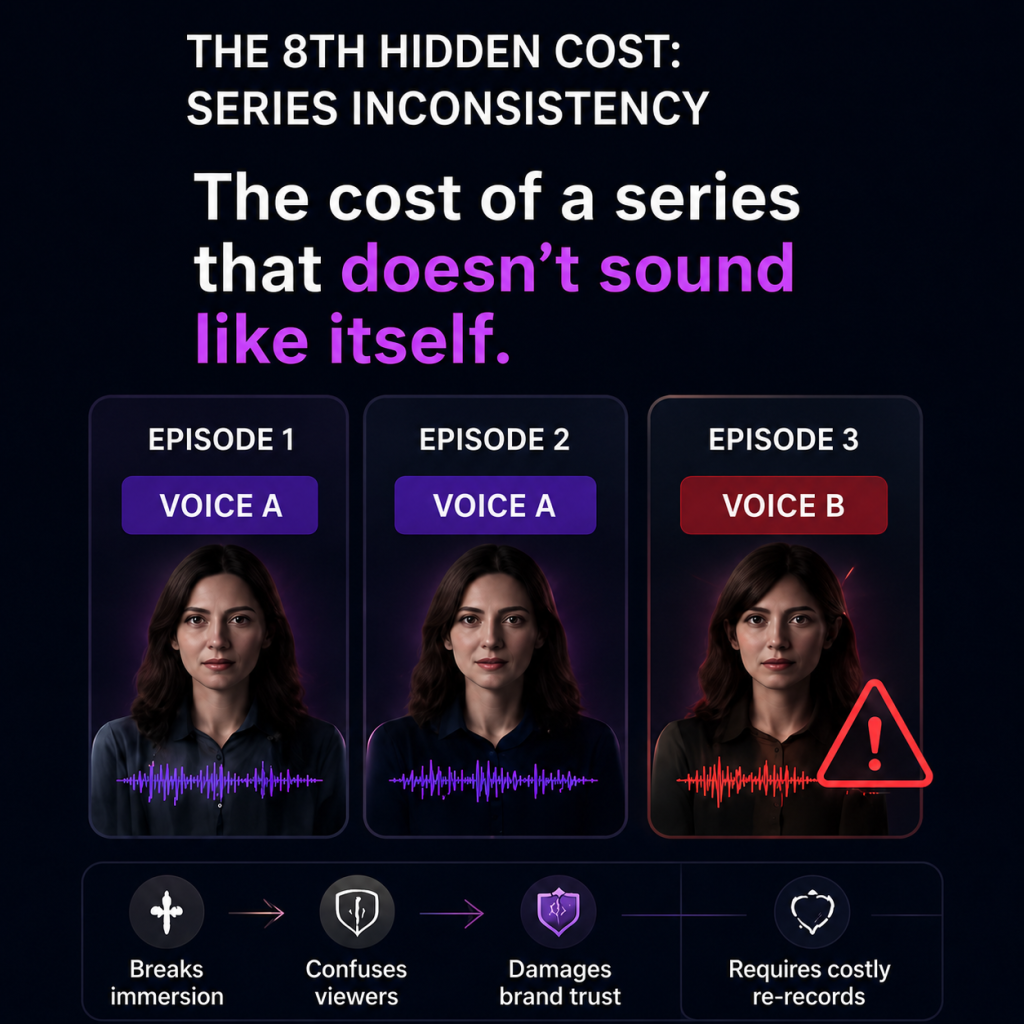
The seven costs above, all appear somewhere on an invoice, in a timeline, in a vendor quote. They are painful, but they are at least visible. The eighth hidden cost is different. It never shows up on a bill. It builds quietly across episodes, surfaces during quality review and by the time it becomes a problem it has already affected multiple episodes in multiple languages. It is the cost of a series that does not sound like itself.
Why Voice Consistency Across Episodes Is a Real Production Cost
Every hidden cost in the list above gets worse when you are producing a series. But there is one cost that does not appear anywhere on a human dubbing invoice and still represents a real production expense: voice inconsistency across episodes.
When a voice actor is unavailable for a later episode, a replacement has to be found. Even with the same actor, subtle differences in session conditions, direction, and audio environment can create inconsistency in tone, pacing, and character voice between episodes. For audiences watching a series in their native language, these differences are noticeable. Correcting them requires additional quality review, re-recording, and in some cases, full episode re-dubs.
For platforms and creators building long-running series, inconsistency is not just a quality problem. It is a cost that compounds silently across every season.
How Echo9’s Series Management Eliminates This Cost Entirely
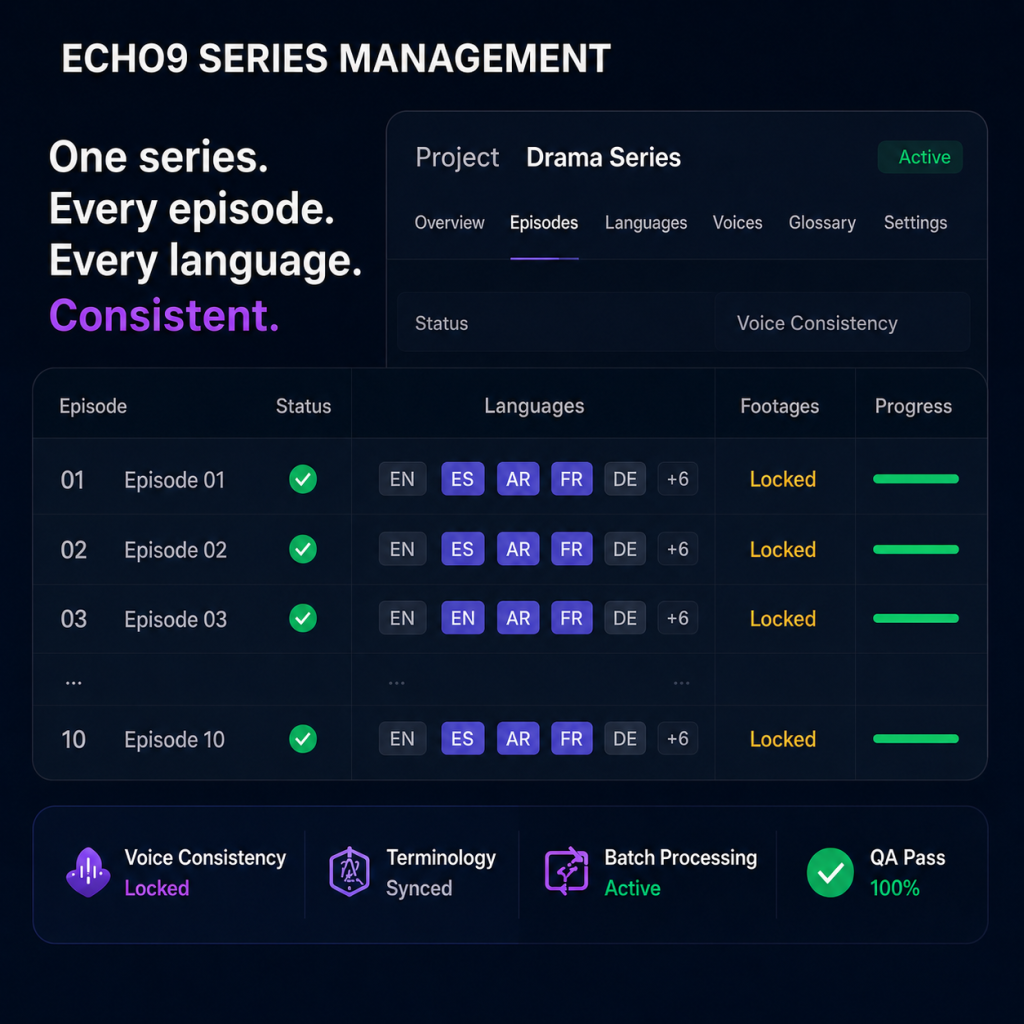
Echo9’s Series Management feature is built specifically for this problem. It handles multi-episode and multi-season content as a single, unified project, maintaining consistent voice, terminology and style across every episode from the first to the last.
Batch processing means all episodes can be dubbed in parallel rather than sequentially. Voice cloning ensures the same character voice is preserved across every episode without relying on a human actor’s availability. Terminology management keeps language consistent across an entire series, and team collaboration tools allow QA to happen within the platform rather than across disconnected vendor chains.
For streaming platforms, e-learning providers and content creators scaling internationally, Series Management removes the 8th hidden cost entirely, not just reducing it, but eliminating the conditions that create it.
So When Is Human Voice Actor Dubbing Still Worth It?
The honest answer is that it sometimes is. AI dubbing has closed the quality gap significantly, but it has not closed it entirely for every content type. The goal of this blog is not to dismiss human dubbing as a category, it is to make the full cost of it visible so the decision can be made on accurate information rather than a headline rate. For certain content, the premium is real and the case for paying it holds. For most professional video content, it does not.
Content Types Where Human Dubbing Still Leads
Human voice actors still deliver something AI cannot fully replicate for specific content types. The additional cost is justifiable when the audience is paying for a premium, immersive experience and the production itself depends on it:
Prestige theatrical releases where voice performance is part of the artistic identity of the film
High-budget animated features where named voice talent is a commercial selling point
Content with complex comedic timing that relies on precise cultural delivery to land
Highly stylized dialogue where rhythm and tone are inseparable from the writing
For these content types, the emotional depth and cultural fluency that experienced actors bring remains difficult to replicate at the same level. The human element is not overhead, it is the product.
Content Types Where the Hidden Costs Make AI the Clear Choice
For the majority of professional content, the hidden costs of human dubbing create a budget structure that does not scale. This is especially true for:
When the requirement is to reach audiences in five, ten, or twenty languages; when the content is episodic or produced at volume; when turnaround time affects revenue; or when the budget does not support an $18,000 two-language project, AI dubbing is not a compromise. It is the rational choice.
The question is not whether AI dubbing is good enough. For the vast majority of professional video content in 2025, it is. The question is whether the hidden costs of human dubbing are justifiable for your specific content type. In most cases, they are not.
Stop Paying for Costs That Do Not Need to Exist
The per-minute rate is the number that gets quoted. Studio time, casting, adaptation, revisions, coordination, timeline delays and series inconsistency are the costs that get paid.
What are the hidden costs of dubbing a video with human voice actors?
Beyond the voice actor rate, human dubbing projects typically include costs for script adaptation and localization, professional studio rental ($100–$400/hr), casting and talent coordination, revision and re-record sessions, project management overhead, and timeline delays. For series content, costs also compound across episodes due to scheduling conflicts and consistency requirements. These hidden costs can double or triple the original per-minute quote.
How much does human voice actor dubbing cost per minute?
Professional human voice actor dubbing typically costs $50 to $500 per finished minute, depending on language pair, quality tier, and talent. Broadcast-quality dubbing starts at around $50 to $60 per minute, while premium productions with union talent can run significantly higher. Studio time adds $100 to $400 per hour on top of talent rates.
How much cheaper is AI dubbing than human dubbing?
AI dubbing typically costs $1 to $30 per minute, compared to $50 to $500 per minute for human dubbing. Companies using AI dubbing report cost savings of around 90% compared to traditional studio workflows. A one-hour video dubbed into two languages costs approximately $18,000 with human dubbing and $600 to $1,200 with AI dubbing.
Why does dubbing a series cost more than a single video?
Series dubbing compounds costs across episodes. Each episode requires its own casting confirmation, studio session, script adaptation, and quality review. Voice actor availability is not guaranteed between episodes, which can trigger re-casting fees and continuity correction costs. Project management overhead also scales with episode count, making a 10-episode series significantly more expensive per episode than a single standalone video.
Can AI dubbing maintain voice consistency across a full series?
Yes. AI dubbing platforms that use voice cloning technology maintain consistent character voices across every episode of a series without depending on a human actor’s availability. Echo9’s Series Management feature is specifically designed for this, handling batch processing, voice consistency, terminology management, and team collaboration across entire seasons from a single unified workflow.
What languages does Echo9 support for AI dubbing?
Echo9 supports AI dubbing in 100+ languages, with voice cloning, subtitle generation, and series-wide terminology management available across all supported languages. This makes it practical to launch multilingual content simultaneously rather than sequentially, removing the per-language timeline bottleneck that affects human dubbing workflows.