
Best AI Dubbing Software for OTT and Streaming Platforms 2027
An OTT platform doesn’t buy dubbing one video at a time. It buys it by the season: 10 to 12 episodes, eight or more target languages, and a launch date that marketing has already announced. That changes what “best” means when you evaluate AI dubbing for streaming. This guide ranks the AI dubbing software that streaming and OTT teams most often shortlist in 2027, including Echo9, DeepDub, ZOO Digital, Dubformer, CAMB.AI, and ElevenLabs. Every tool is scored on the same criteria: whether it holds up across a full season, in many languages, at the quality a paying subscriber expects. What OTT Platforms Need From AI Dubbing Software Streaming localization has a different shape than creator or corporate dubbing. Echo9’s own OTT solutions page describes a typical release as one season of 10 to 12 episodes in 8 to 10 target languages, with episodes processed in parallel. We ranked each AI dubbing platform on six criteria that follow from that reality: If you are still building the business case, our overview of how AI dubbing for OTT platforms is changing global streaming covers the market side. Free Trial Run one episode through the full pipeline. All eight stages on your own content — upload to broadcast-ready audio. No credit card, no managed-service queue. Start a Free TrialBook a Consultation The Best AI Dubbing Software for OTT and Streaming, Ranked Each entry uses the same format. Competitor descriptions cover general positioning only, so confirm current features, languages, and pricing directly with each vendor. 1. Echo9: Best for Episodic OTT Catalogs and Simultaneous Launches Echo9 is a dubbing and subtitling platform built for studios localizing episodic content at scale. Its eight-stage pipeline runs from season setup and upload through translation, dubbing, timing fixes, review, and a post-dubbing QA pass. 2. DeepDub: Best for High-Budget, Long-Lead Productions DeepDub is an AI dubbing company positioned toward studio-grade entertainment localization for film and TV. It suits productions where the release window is measured in weeks, not days. 3. ZOO Digital: Best Managed Service for Studio Supply Chains ZOO Digital is an established localization and media services provider that works with studios and streamers. It combines human dubbing and subtitling services with its own cloud production tools. 4. Dubformer: Best for Broadcasters Exploring AI Voice-Over Dubformer is an AI dubbing provider aimed at media companies and broadcasters, with a focus on voice-over style localization. 5. CAMB.AI: Best for Live and Event Content CAMB.AI positions itself around AI dubbing and translation for media and entertainment, including live sports and event content. 6. ElevenLabs: Best General Voice AI Toolkit ElevenLabs is a broad voice AI platform used by creators and developers, with dubbing as one part of a larger text-to-speech and voice product line. AI Dubbing for Streaming: Comparison Table Factor Echo9 DeepDub ZOO Digital Dubformer CAMB.AI ElevenLabs Primary focus Episodic dubbing and subtitling Studio-grade entertainment dubbing Managed localization services AI voice-over for media Media and live event dubbing General voice AI Model AI pipeline with human review, self-serve or managed AI-led Services-led AI-led AI-led Self-serve platform Season / series structure Built in No (per Echo9 comparison) Varies Varies Varies Project-based Lip-sync approach Rewrites lines to fit timing Per Echo9 comparison, cuts words to fit Human adaptation Varies Varies Varies Post-dubbing QA report Yes, AI QA Agent No (per Echo9 comparison) Service QC Varies Varies Manual Best for Media houses, OTT, broadcasters, LSPs Premium films Studio supply chains Factual and library Sports and live Creators and developers Features and plans change often, so confirm details with each vendor before you sign. How Echo9’s Series Management Keeps a Full Season Consistent The biggest hidden cost in streaming dubbing is drift. By episode 12, a lead character can sound different, a nickname can be translated two ways, and nobody notices until viewers do. Echo9’s Series Management is built to stop that at the setup stage. Our deep dive on how series management in video localization works covers the concept; here is how it runs in the product. Configure once per season. Character voices, vocabulary rules, and target languages are set at the project and season level and applied to every episode automatically. Speakers are defined once and carried across the series, instead of being rebuilt for each upload. New episodes inherit everything. When episode 13 lands, it picks up the same target languages and settings without anyone re-entering them. That is what makes simultaneous launches across 8 to 10 languages realistic. Status per episode and per language. Echo9’s project dashboard tracks each episode through every pipeline stage, and each target language runs as its own pipeline. One delayed language does not hide the rest, and production leads can see every active project from one view. On the subtitle side, teams track “Ready” versus “Completed” per episode. Quality checks built into the season. The Rephrase-Fit Engine flags any segment more than 200 milliseconds out of sync and offers three rewrites that fit the source timing, with no speed change and no word cutting. A post-dubbing QA Agent then compares the source and dubbed video and reports lip-sync issues, wrong character voices, emotion mismatches, and missing dialogue with exact segment IDs. Echo9 reports a human review score of 8 to 9 out of 10 against human dubs and 3 to 4 reviewed episodes delivered per day. Exports include dubbed video, vocals-only audio, and a localized CSV. Multi-Language Delivery Scale one episode into your next six markets. Give us one source upload and your target languages. We’ll show you the parallel output. Book a ConsultationStart a Free Trial Platform Specs Still Apply to AI Dubs AI changes how a dub is made, not what a platform accepts. Netflix’s Localization, Accessibility, and Dubbing Delivery Specifications accept lectern-style dubbing, one narrator for every character, only for Polish or Vietnamese audio unless otherwise requested. Other languages need lip-sync or voice-over dubbing. The same spec sets a dialogue loudness target of -27 LKFS (plus or minus 2 LU) for dubbed mixes and asks that translations not harshen
Best AI Dubbing Tools for YouTube Creators (2027)
YouTube creators are no longer limited to audiences who speak the language of their original videos. With AI dubbing, a creator can turn an English-language tutorial, product review, educational video, or long-form discussion into versions that viewers can understand in other languages. But choosing the right AI dubbing tool involves more than translating a script and generating a voice. The final result needs to sound natural, preserve the creator’s intended meaning, and stay synchronized with the original video. For creators building an international audience, these details can make the difference between a useful localized video and one that feels automated. The best tool depends on your content format, publishing frequency, target languages, budget, and quality expectations. Some platforms focus on quick creator-friendly dubbing, while others are designed for professional localization, voice consistency, and larger video libraries. In this guide, we compare six AI dubbing options for YouTube creators in 2027, explain where each fits best, and outline what to check before publishing a dubbed video. What Is AI Dubbing for YouTube? AI dubbing uses artificial intelligence to translate spoken content and generate audio in another language. Depending on the tool, the workflow may include transcription, translation, voice generation, speaker identification, timing adjustments, and lip-sync features. For YouTube creators, the main advantage is the ability to make existing content accessible to people who prefer a different language without recording every version from scratch. For example, an English-language tutorial could be dubbed into Spanish or Hindi, allowing viewers to follow the explanation in their preferred language. A creator with a growing video library can also explore localizing older videos instead of producing separate content for every market. However, AI dubbing is not the same as simply replacing the original audio with translated speech. A reliable workflow must consider several factors. Natural-Sounding Voices The generated voice should sound clear and appropriate for the content. Flat delivery, unnatural pauses, or incorrect pronunciation can make an otherwise accurate translation difficult to enjoy. Translation Accuracy The dubbed audio should preserve the original meaning, including jokes, examples, product names, and technical terminology. Literal translations can sound awkward or change the intended message. Timing and Lip Sync The translated speech should fit the video’s pacing. Some tools offer lip-sync features, but availability and results vary. Creators should check whether the audio and visible mouth movements feel natural together. Language and Voice Options A tool may advertise support for many languages, but that does not guarantee equal quality in every language pair. Check the specific languages you need and listen to sample output before committing to a workflow. Editing and Quality Assurance Creators should be able to identify mistakes, correct translations, review pronunciation, and approve the final audio before publishing. These steps become especially important for educational videos, product demonstrations, and recurring series. Check the QA Engine Checklist before posting a video Best AI Dubbing Tools for YouTube Creators in 2027: The following comparison highlights the general strengths and use cases of six tools. It is a practical shortlist, not a verified performance ranking based on a standardized test of every product. AI dubbing tools Best suited for Main consideration Echo9 Professional video localization and recurring content Review workflow, voice consistency, and project requirements ElevenLabs Voice generation and audio-focused workflows Dubbing needs, voice controls, and available language features Rask AI Video translation and multilingual content production Language coverage, synchronization, and editing needs HeyGen AI-generated videos and presenter-led content Fit for existing-video dubbing and avatar-based workflows VEED Browser-based video editing and creator content Editing convenience and available dubbing features CapCut Short-form social videos and creator editing Feature availability and suitability for longer projects Before selecting a tool, verify its current language support, plan limits, export options, and review features. Product capabilities can change, and the most suitable option depends on how you create and publish videos. Free Trial Run one episode through the full pipeline. All eight stages on your own content — upload to broadcast-ready audio. No credit card, no managed-service queue. Start a Free TrialBook a Consultation The 6 Best AI Dubbing Tools Reviewed Choosing an AI dubbing tool depends on your content type, target audience, and localization goals. Some platforms focus on natural-sounding voice generation, while others offer broader video translation and editing workflows. For YouTube creators, the ideal tool should preserve the original message, deliver clear and natural audio, and support the languages their audiences speak. Ease of use, voice quality, synchronization, and editing options are also important factors to consider. Below, we review six AI dubbing tools and explain what each offers, who it suits best, and what to consider before choosing one. 1. Echo9: Best for Professional Video Localization Workflows Echo9 is built for video localization workflows that extend beyond generating translated audio. It is particularly relevant to teams and creators who manage recurring content, multiple languages, or larger video libraries and need consistency across releases. For a YouTube creator publishing a series, localization can become more complicated over time. Character names, recurring phrases, terminology, and voice choices need to remain consistent from one video to the next. Reviewing every video as an isolated project can create unnecessary work. Echo9 focuses on professional dubbing workflows, including series management and quality review. Its approach is relevant when creators need to coordinate localization across multiple videos rather than process only occasional clips. Key strengths What to consider Creators who publish occasional short clips may not need a workflow designed for larger localization projects. Compare the platform’s current features and pricing with your actual publishing volume before choosing a plan. Verdict: Echo9 is worth evaluating first when YouTube content is part of a recurring, multilingual production workflow where consistency and quality control matter. 2. ElevenLabs: Best for Voice Generation and Audio-Focused Workflows ElevenLabs is known for AI voice generation, voice cloning, and speech-related tools. These capabilities make it relevant to creators who want to produce natural-sounding audio or explore multilingual voice workflows. For creators, voice quality can strongly influence how a dubbed video feels. Even when
Multilingual Voice AI for Global Content in 2027
Global content is becoming more multilingual, but simply translating words is no longer enough. Audiences expect videos, courses, campaigns, and entertainment to sound natural in their own language while still preserving the voice, emotion, and meaning of the original. That shift is putting multilingual voice AI at the center of modern content localization. Advances in AI dubbing, voice cloning, neural voice synthesis, and context-aware localization are making it easier to create voice content for multiple markets without rebuilding the entire production process for every language. For creators, streaming platforms, studios, and global brands, the bigger question is no longer whether voice AI can generate another language. The focus is moving toward how naturally, consistently, and efficiently that content can reach audiences around the world. What Is Multilingual Voice AI? Multilingual voice AI refers to AI-powered technology that can generate, translate, adapt, or transform spoken content across multiple languages. It can include text-to-speech, voice cloning, speech translation, AI dubbing, and other voice technologies used to create localized audio. While voice cloning can preserve the characteristics of a particular speaker, text-to-speech can generate spoken audio from written text. AI dubbing brings several parts of the workflow together by translating dialogue, generating the target-language voice, and aligning the result with the original video. The difference becomes especially important when content needs to work across many languages. A translated script may communicate the basic meaning, but the final voice also needs to match the speaker, scene, emotion, timing, and audience. For a deeper look at how these technologies differ, see Echo9’s guide to TTS vs Voice Cloning vs AI Dubbing. Multi-Language Delivery Scale one episode into your next six markets. Give us one source upload and your target languages. We’ll show you the parallel output. Book a ConsultationStart a Free Trial Why Multilingual Voice AI Matters in 2026 Global distribution has changed the way content is produced. A single video can now be released across several markets, creating demand for localized versions without adding a completely separate production process for every language. AI is helping teams respond to that demand by shortening parts of the localization workflow. Current industry research tracking professional dubbing projects shows activity across dozens of target languages, while advances in speech synthesis are improving multilingual pronunciation and expressiveness. Still, speed alone does not define successful localization. Viewers can notice when a voice sounds unnatural, a character’s personality changes, or a translated line loses its intended meaning. That is why modern multilingual voice workflows are increasingly focused on context, consistency, quality, and human review alongside automation. 6 Multilingual Voice AI Trends Shaping Global Content The latest multilingual voice AI trends are not limited to generating speech in another language. They are also influencing how teams handle voice identity, context, emotion, production scale, and quality. 1. Voice AI Is Moving Beyond Basic Text-to-Speech Text-to-speech remains one of the foundations of synthetic voice technology, but the expectations around AI-generated speech are becoming much higher. Earlier use cases often focused on converting written text into understandable audio. Today’s systems are increasingly expected to produce speech with natural pacing, pronunciation, tone, and expressive delivery across different languages. That development matters for global content because a technically correct voice can still feel unnatural to its audience. A successful localized version needs to sound appropriate for the language and the situation in which it is being used. Echo9’s AI dubbing workflow reflects this broader shift by treating voice generation as part of a larger localization process rather than as an isolated audio task. 2. Voice Identity Is Becoming More Important When audiences move from one language to another, the voice itself can be part of what makes a character, narrator, or brand recognizable. Voice cloning is helping address this challenge by allowing a particular speaker’s vocal characteristics to be carried into localized dialogue. For episodic content, that can help maintain a recognizable character voice across multiple episodes and languages instead of creating a completely different vocal identity for every version. The value becomes clearer in long-form content. A character who sounds consistent throughout a season creates a stronger sense of continuity, while changing voices between episodes can make the localized version feel disconnected. Echo9’s Series Management is designed around this type of recurring content workflow, where voice consistency and terminology need to remain stable as localization expands across episodes. 3. Context and Emotion Are Shaping Better Localization A sentence does not exist in isolation. Who is speaking, who they are speaking to, what happened before the scene, and how the line is delivered can all change the way it should be localized. That is why context-aware localization is becoming a major part of multilingual voice AI. Modern systems are moving toward understanding relationships, emotional intent, cultural references, and scene-level meaning instead of treating every dialogue line as an independent translation task. Echo9 specifically describes its localization workflow around episode-level context, relationship, cultural adaptation, and emotion. Consider a character speaking respectfully to a senior family member. A direct translation may communicate the words correctly, yet the target-language version could sound too casual or too formal if the relationship is ignored. Anger, sarcasm, excitement, fear, or hesitation can also completely change how a line should sound. Echo9’s approach to context-aware localization connects these elements before the final voice is generated. 4. Multilingual Content Is Moving Toward Greater Scale Producing one localized video is very different from managing an entire multilingual content library. A streaming platform may need several languages for every episode in a season. A creator may want to expand a large video archive into new markets. An enterprise could have hundreds of training videos that need localization over time. In each case, repeating the same process manually can create delays and consistency problems. AI is making larger localization operations more practical by automating parts of transcription, translation, voice generation, timing, and quality workflows. Deloitte’s research on Generative AI autolocalization highlights the potential for AI-powered localization to reduce scalability problems and support content across languages and regions.
How Neural Voice Synthesis Powers AI Dubbing Technology
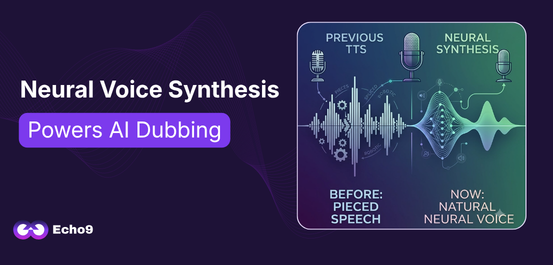
Every AI dubbing platform depends on one core technology to generate the voice you actually hear: neural voice synthesis. It’s the reason a dubbed voice today can sound like a real person pausing, breathing, and shifting tone mid-sentence, instead of the flat, evenly metered speech that used to be the giveaway sign of machine-generated audio. Understanding how neural voice synthesis actually works, rather than treating it as an unexplainable black box, makes it much easier to evaluate whether a given AI dubbing platform’s output will hold up on your content, not just on a polished demo clip. What Neural Voice Synthesis Actually Is Neural voice synthesis is speech generation powered by deep neural networks trained on large datasets of recorded human speech. Instead of playing back or recombining pre-recorded audio clips, the model learns statistical patterns in how humans produce sound, then generates new audio, sample by sample or frame by frame, that follows those learned patterns. This is a meaningfully different approach than voice cloning required a decade ago, when older systems recorded a voice actor saying thousands of short phrases, then reassembled new sentences by splicing those fragments together. The results were intelligible but often sounded stitched together, with audible seams where fragments joined. Neural synthesis removes that seam entirely because it isn’t assembling anything; it’s generating a continuous waveform from a learned model of speech itself. How the Technology Actually Works Neural voice synthesis breaks down into three connected stages, and understanding each one explains why some systems sound more natural than others. Each stage introduces its own quality ceiling. A weak acoustic model produces flat, monotone speech regardless of how good the vocoder is. A weak vocoder introduces buzzing or metallic artifacts even when the underlying prosody prediction is excellent. Evaluating a platform’s voice quality means recognizing that both stages have to perform well together, not just one of them. From Old TTS to Neural Synthesis: What Actually Changed Before neural approaches became standard, most commercial text-to-speech systems used one of two methods. Concatenative synthesis recorded a voice actor reading an enormous script covering nearly every sound combination in a language, then stitched together the closest matching fragments for new sentences. Formant synthesis generated speech algorithmically from acoustic rules without any recorded human voice at all, which made it flexible but distinctly robotic. Both approaches hit a hard ceiling on naturalness because neither one modeled speech as a continuous, learnable pattern. Concatenative systems could only sound as natural as their fragment library allowed, and any sentence structure the original recording script didn’t anticipate would produce awkward joins. Formant systems never sounded human because they weren’t built from human recordings in the first place. The shift became concrete with models like WaveNet, which showed a neural network generating raw audio waveforms directly could sound dramatically more natural than either older method. Neural models solve this differently. Because they learn statistical patterns directly from real speech data rather than working from a fixed fragment library or a fixed rule set, they can generate prosody, pacing, and pitch variation for sentence structures they’ve never seen before, extending naturally to new content rather than being limited to a pre-recorded phrase bank. That’s a structural difference, not just an incremental improvement in audio quality. How Echo9 Keeps Voice Delivery Consistent Across a Series Neural voice synthesis only solves half the problem for episodic content. Generating one natural-sounding line is one thing; making sure a character’s voice, pacing, and delivery stay consistent across dozens of episodes and multiple seasons is a separate engineering challenge, and it’s the one most single-video tools aren’t built to solve. Echo9’s Series Management locks each character’s chosen voice profile to the project once, so every batch-processed episode automatically pulls from the same locked profile instead of the platform re-generating a slightly different approximation from scratch each time. Combined with Terminology Control keeping names and phrasing consistent, the result is a character who sounds like themselves in episode 40 the same way they did in episode 1, which is a much harder engineering problem than generating one good line of dialogue. Book a Consultation Bring us your hardest scene. Send one episode and one target language. We walk you through the output, line by line, with your team on the call. Book a ConsultationStart a Free Trial 30 minutes · with an engineer, not a sales pitch On the call A real scene from your catalogue, dubbed end to end Timing, emotion and lip-sync reviewed against the source Cost and turnaround modelled on your episode volume Your QA checklist, run against the output Why This Matters More for Dubbing Than for Generic TTS A voice assistant or GPS narration only needs to sound clear and pleasant. Dubbing has a harder requirement: the generated voice has to convincingly stand in for a specific person’s performance, often carrying emotional weight, timing constraints tied to the original video, and consistency demands across hours of content. This is why the quality bar for AI dubbing sits above the quality bar for general-purpose TTS. A synthesis model that sounds perfectly natural reading a weather report can still fall short reproducing a specific actor’s cadence across an emotional scene, because the task has shifted from “sound like a competent generic speaker” to “sound like this exact person, under these exact circumstances.” Where Neural Synthesis Still Falls Short Neural voice synthesis has closed most of the gap with human speech, but it isn’t uniformly solved across every use case. The failure points worth knowing before evaluating a platform: None of these are reasons to dismiss neural synthesis as unreliable. They’re reasons to test a platform against your actual content, including the hard cases, rather than assuming a strong demo clip generalizes automatically. How This Fits Into Evaluating an AI Dubbing Platform Neural voice synthesis quality is one input into the broader question of whether an AI dubbing platform is ready for production use, alongside translation accuracy and timing. A model can generate a beautifully
Echo9 vs ElevenLabs: Which AI Dubbing Platform Is Right for You?
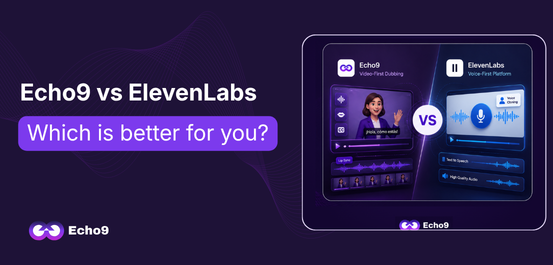
Choosing the best AI dubbing software in 2026 is not as straightforward as comparing feature lists. Both Echo9 and ElevenLabs appear on every shortlist. Both offer AI-powered dubbing, voice cloning, and multi-language support. On a feature comparison page, moreover, they can look similar enough to make the decision feel like a coin toss. In practice, however, they are built for completely different jobs. Choosing the wrong platform for your production type will cost you time, budget, and output quality that no amount of post-production can recover. ElevenLabs is a voice AI platform. Its dubbing capability sits within a broader product built around audio generation, voice cloning, text-to-speech, and conversational AI agents. Echo9, by contrast, is a video localization platform built specifically for professional dubbing with lip sync, series management, and managed human review at the centre of how it operates. If you are dubbing a podcast, a short-form creator video, or audio-only content, that distinction may not matter much. For on-camera video, a multi-episode series, or broadcast content, however, it is the only distinction that matters. Here is how the two best AI dubbing software options compare across every dimension that affects real production decisions. Echo9 and ElevenLabs: What Each Platform Is Actually Built For Before comparing these two best AI dubbing software options, it helps to understand what each platform was designed to do. A platform optimised for one job rarely performs equally well at another. ElevenLabs: A Voice AI Platform With a Dubbing Feature ElevenLabs launched in 2023 as a text-to-speech and voice cloning platform. Since then, it has expanded into a broad audio AI product covering conversational agents, sound effects generation, and a dubbing studio. Disney, Cocomelon, and NBC all use the platform for voice generation, a testament to the quality of its core voice synthesis technology. Its dubbing product works by translating video content into a target language and re-voicing it using a clone of the original speaker. The voice quality is genuinely strong. For audio-first content where the speaker is not on camera, ElevenLabs dubbing produces professional-grade output. The platform is also developer-first. Its API is well-documented, widely integrated, and designed for teams that want to build custom workflows on top of voice generation capabilities. For a full comparison of AI vs traditional dubbing workflows, see Echo9’s guide to traditional dubbing vs AI. Echo9: A Video Localization Platform Built for Series Production Echo9 addresses a different core problem: how to produce broadcast-ready dubbed video, with accurate lip sync, consistent voice across episodes, and human-verified quality, at the speed and scale that modern content production demands. Where ElevenLabs processes audio, Echo9 processes the full audiovisual unit. Its rephrasal tool adapts translated scripts so dubbed audio fits the original video timeline naturally, without compressing or stretching either. Its lip sync engine adjusts mouth movements frame by frame. Furthermore, its Series Management feature maintains voice profiles, terminology, and quality standards across entire seasons as a single unified project. Echo9 targets OTT platforms, streaming services, e-learning providers, and content studios that produce episodic or long-form content for international audiences, teams for whom consistency, lip sync accuracy, and managed delivery are production requirements, not optional features. As the best AI dubbing software for series content, Echo9 is purpose-built for this category. Lip Sync: Where the Two Platforms Take Fundamentally Different Approaches This is the most consequential technical difference between the two platforms, and it is one that is easy to miss when reading a feature list. ElevenLabs: High-Quality Audio Dubbing Without Visual Lip Sync ElevenLabs’ own documentation states it clearly: the platform does not offer lip syncing as part of its dubbing product. Mouth movements are not reanimated or resynced to match the translated speech. Instead, the dubbed audio is kept roughly aligned to the original timing, which means the speaker’s mouth movements on screen reflect the source language, not the target language. For content where the speaker is off-camera, voiceover narration, podcast audio, animated content with non-realistic characters, this limitation does not affect output quality. For on-camera content, however, it is a visible and immediate problem. Viewers watching a dubbed video where the speaker’s mouth movements do not match what they are hearing experience the same audiovisual mismatch that traditional badly-dubbed content produces. The voice quality may be excellent. The experience, consequently, is not. Echo9: Frame-by-Frame Lip Sync With the Rephrasal Tool Echo9’s approach starts at the script level. Rather than generating audio and then attempting to fit it to the existing video timeline, Echo9’s rephrasal tool adapts the translated script so the phoneme length and character count of the target language matches the source. The dubbed audio therefore fits the original timeline naturally, without the speed adjustments that flatten emotional delivery and produce rushed or diluted output. With the audio fitting the timeline, Echo9’s lip sync engine then adjusts the speaker’s mouth movements frame by frame to match the phonemes of the target language. The result is dubbed video where what the viewer hears and what they see are in agreement, not approximately, but at the frame level. For on-camera content, presenter-led video, and any production where the speaker’s face is clearly visible, this difference in approach produces a fundamentally different viewer experience. Pricing: What You Actually Pay at Scale Both platforms offer tiered pricing. The structure of those tiers, however, produces very different cost outcomes when you move from a single video to multi-language or episodic production. ElevenLabs: A Credit System That Compounds Across Languages ElevenLabs operates on a credit-based model. Dubbing credits are tracked separately from text-to-speech credits, which means your monthly plan allocation covers two separate usage pools. The Creator plan at $22 per month includes approximately 50 dubbing minutes. The Pro plan at $99 per month includes approximately 250 dubbing minutes, with an overage rate of $0.24 per minute. The compounding factor is per-language billing. Every language dubbed into is charged separately. A 45-minute episode dubbed into three languages therefore consumes three separate credit allocations. For a 10-episode series in five languages, the
5 Reasons OTT Platforms Are Turning to AI Dubbing in 2026
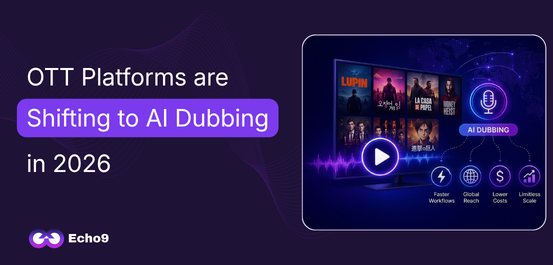
More than one-third of all Netflix viewing in the first half of 2025 came from non-English language titles. Ten of the platform’s twenty-five most-watched series in that same period were non-English. For the first time in the platform’s history, over half of its Original TV season releases were produced in languages other than English. The audience has made its position clear. Language is no longer a barrier to global viewership but only for platforms that have removed it. For OTT platforms still relying on traditional dubbing workflows, that removal is slow, expensive, and operationally fragile. AI dubbing changes the equation entirely. In 2026, it is not an experiment. It is the infrastructure that allows platforms to move at the speed their audiences expect. Here is why OTT platforms are making the switch and why the ones that have not yet done so are already behind. The Global Demand OTT Platforms Can No Longer Ignore The numbers that matter here are not forecasts. They are already on the scoreboard. How Viewing Habits Have Shifted Toward Non-English Content The shift toward non-English content is not a trend that is coming, it has arrived. In 2025, 52% of Netflix’s Original TV season releases were non-English language, the first time non-English productions have held the majority. Korean and Spanish content alone account for over 16% of all global Netflix viewing hours, representing billions of hours watched. Non-English viewing in English-speaking countries has grown 24% since 2020, driven by algorithmic recommendation engines that increasingly surface international content to audiences who had never actively sought it. The global OTT streaming market is growing from $221 billion in 2025 to $264 billion in 2026 at a 19.8% compound annual growth rate. The platforms capturing that growth are not the ones with the most content, they are the ones whose content is accessible to the widest audience in their own language. Why Traditional Dubbing Workflows Cannot Keep Pace With Demand A traditional dubbing workflow for a single episode moves through script translation, cultural adaptation, voice actor casting, studio session scheduling, segmented dialogue recording, audio editing, lip-sync alignment, and at least one round of quality review, in sequence, not in parallel. Every stage depends on the previous one completing first. That process takes two to eight weeks per language. For a platform releasing a 10-episode series in five languages, the coordination overhead alone represents tens of thousands of dollars and months of production time before a single subtitle or audio track reaches a viewer. The demand exists. The content exists. The bottleneck is the workflow. 5 Reasons OTT Platforms Are Choosing AI Dubbing in 2026 Five reasons. Each one a separate argument for the same conclusion: the traditional dubbing workflow was not built for the speed, scale, or economics of modern streaming. For OTT platforms carrying content libraries in the hundreds of titles across dozens of languages, every one of these reasons compounds the one before it. #1 Cost: AI Dubbing Reduces Localization Spend by Up to 90% The per-episode cost of traditional dubbing sits between $10,000 and $40,000 depending on language pair, content length, and quality tier. That figure covers voice talent, studio time, cultural adaptation, engineering, and project management none of which disappears between episodes. AI dubbing changes the cost structure at the foundation. Where traditional dubbing charges separately for every stage of the production chain, Echo9 consolidates the entire workflow into a single platform, eliminating studio rental, casting coordination, re-record sessions, and multi-vendor project management in one move. Studios consistently report cost reductions of 90% or above when switching from traditional dubbing to AI workflows. The voice generation itself is only part of the saving. The hidden production costs that inflate every traditional project are what drive most of the reduction. For platforms managing libraries of hundreds of titles across dozens of languages, this is not a marginal efficiency gain. It is a structural change in what global distribution costs. #2 Speed: Same-Day Global Releases Are Now Operationally Possible A 45-minute episode fully dubbed using AI, including transcription, translation, voice generation, and subtitle creation, takes under 60 minutes to process. For series with multiple target languages, the same episode in five languages takes 90 to 120 minutes. The AI processes 24/7. Traditional dubbing: two to eight weeks per language, sequentially. AI dubbing: one to two hours across multiple languages, simultaneously. The commercial implication is significant. OTT platforms that dub with traditional workflows release multilingual versions weeks or months after the original. During that window, international audiences either wait, find the content elsewhere, or lose interest. Platforms using AI dubbing can release multilingual versions on the same day as the original, maintaining global momentum, preventing audience fragmentation, and giving recommendation algorithms a complete content set to surface across all markets from day one. #3 Scale: Dubbing Back Catalogs and Long-Tail Content That Was Never Localized This is the advantage most cost comparisons miss entirely, and the one with the largest untapped commercial value for OTT platforms. Traditional dubbing made back-catalog localization economically impossible. The per-episode cost structure meant that older titles, niche shows, regional content, and mid-tier library titles could never justify the investment required to dub them for new markets. Platforms sat on libraries of content that was invisible to non-English-speaking audiences, not because there was no audience for it, but because reaching them cost too much. AI dubbing removes that constraint. At $50 to $200 per episode, a 30-episode back-catalog series can be fully dubbed into three languages for a fraction of what a single episode would cost with a traditional studio. Dormant content becomes accessible content. Accessible content drives viewing hours. Viewing hours drive subscriber retention. For platforms competing for subscriber loyalty in a crowded market, the back catalog is an underutilized asset and AI dubbing is the tool that unlocks it. #4 Consistency: Maintaining Voice and Terminology Across Full Seasons This is where traditional dubbing breaks down most visibly for OTT platforms, and where the cost compounds most unpredictably. Human voice actors
The 7 Hidden Costs of Human Voice Actor Dubbing
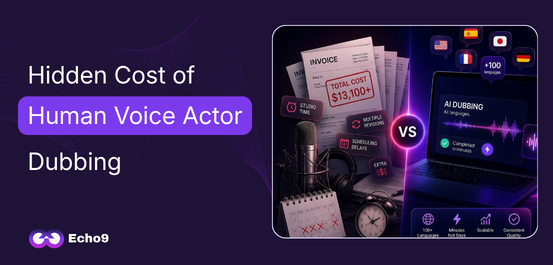
Most conversations about the cost of dubbing a video start and end at the voice actor rate. A per-minute figure gets quoted, a budget gets approved and then the invoices start arriving; each one covering something nobody mentioned in the original conversation. Script adaptation. Studio time. Casting fees. Revision rounds. Project management overhead. And if you are dubbing a series, an entirely separate cost category most guides do not even address. The voice actor rate is real. But it is only the beginning. Here is what the full cost of dubbing a video actually looks like and why AI dubbing eliminates most of it. What Does Human Voice Actor Dubbing Actually Cost? The invoice most people receive when commissioning a dubbing project shows one number. What that number actually covers is the voice actor’s time in the studio and nothing else. Every other cost that makes a voiced performance into a finished, broadcast-ready dubbed video is billed separately, added later or absorbed quietly into a project budget that ends up looking nothing like the original quote. Before getting into the hidden costs, it helps to understand what that visible number actually represents. The “Visible” Cost: Per-Minute and Per-Language Rate Ranges Ask a dubbing studio for a quote and the first number you will see is the per-minute rate. For professional human voice actor dubbing, that rate typically ranges from $50 to $500 per finished minute, depending on language pair, quality tier, and talent. Broadcast-quality dubbing for television or film starts at around $50 to $60 per minute at the lower end, with high-profile productions and union talent pushing rates significantly higher. Studio time alone runs $100 to $400 per hour and that is before a single line is recorded. Multiply that across multiple languages. A one-hour corporate video dubbed into just two languages can reach $18,000. The same video in four languages? The math scales linearly, and it gets uncomfortable fast. Why This Number Is Only the Starting Point The per-minute rate is what gets quoted. What gets charged is something else entirely. Every professional dubbing project involves a production chain that extends well beyond the voice actor session. Translation, script adaptation, studio booking, casting, engineering, quality assurance and project coordination are all separate billable services and in most quotes, they are either bundled invisibly or added later as line items. The sections below break down each of those hidden costs individually. The 7 Hidden Costs of Human Voice Actor Dubbing The per-minute rate is the number that gets approved in budget meetings. What actually gets paid is that number plus seven others; each one a legitimate, necessary part of producing professional dubbed content and each one rarely mentioned until the invoice arrives. Some appear as separate line items. Others get bundled into a final project fee without explanation. A few never show up on paper at all, but show up in timelines, missed deadlines and re-booking costs. Here is what they are. #1 Script Adaptation and Localization Word-for-word translation does not work for dubbing. Scripts must be adapted so that the translated dialogue matches the original speaker’s lip movements, fits the natural rhythm of the target language, and preserves the meaning and tone of the source material. This is called lip-sync adaptation or dubbing localization, and it is a specialist service charged separately from translation. For content with cultural nuance, humor or idiomatic language, adaptation can take as long as the original translation itself. Depending on the language pair and content complexity, script adaptation adds $15 to $40 per minute to the project cost, a line item that rarely appears in a headline quote. #2 Studio Rental and Sound Engineering Voice actors do not record from home for professional dubbing projects. They record in a professional studio with a sound engineer present to monitor quality, manage lip-sync timing, and handle the technical post-production. Studio rental typically runs $100 to $400 per hour. A 30-minute video may require two to four hours of studio time per language, factoring in setup, direction, retakes and editing. Add mixing and mastering fees on top of that, and studio costs alone can exceed the voice actor rate for shorter content. Each language requires its own dedicated session. Five languages means five separate bookings, five sets of engineering hours and five individual post-production processes. #3 Casting, Auditions, and Talent Coordination Finding the right voice actor for each character in each target language requires a casting process. Casting calls go out, auditions come in, shortlists get reviewed and then availability has to be negotiated across time zones and schedules. In union markets, common in the US, UK, Germany, France and Japan, this also triggers guild minimums, session fees and in some cases residual structures that add ongoing cost after the project is delivered. For a project covering five languages with three speaking roles each, casting and coordination can represent a substantial hidden line item, particularly when scheduling conflicts push timelines out and studio bookings have to be rescheduled. #4 Revisions and Re-Records No dubbing project makes it through without at least one revision round. A script change, a tone correction, a lip-sync adjustment or a client feedback note all mean the same thing: rebooking the studio and calling the voice actor back. Each revision round carries the full cost of a new session: studio time, engineering, talent fees and coordination. On projects with multiple stakeholders or complex content, two or three revision rounds are not unusual. This is one of the most underestimated costs in any dubbing budget. The original quote covers the first pass. Everything after that is incremental. #5 Project Management and Coordination Overhead Managing a dubbing project across five languages means managing five separate vendor relationships, five timelines, five quality review processes and five delivery formats. That coordination does not happen automatically. Many content teams hire a dedicated localization project manager to handle vendor communication, track deliverables and manage feedback loops. Others absorb the overhead internally, which rarely shows up as a
How to Localize YouTube Content for Global Markets
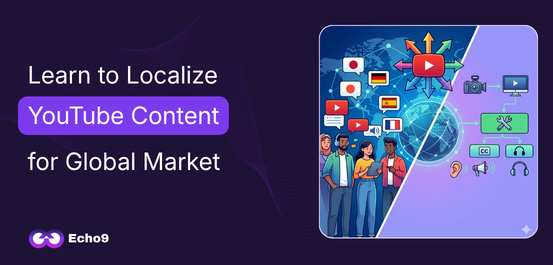
YouTube is no longer limited by geography. A single video can reach audiences across multiple countries, but global reach does not automatically mean global connection. In 2026, video localization is about more than translating subtitles. Viewers expect titles, descriptions, captions, thumbnails, and dubbed audio to feel natural in their own language, culture, and viewing context. For creators, brands, and media teams, this creates a major growth opportunity. With the right video localization workflow, YouTube content can reach new markets, improve engagement, and turn one video into a multilingual asset built for global audiences. This guide explains how creators can use YouTube’s subtitle and dubbing features to reach global audiences, where those features may fall short, and how Echo9 can help subtitle, dub, and adapt content into 100+ languages with more flexibility. What YouTube Localization Means for Global Growth YouTube localization in 2026 is no longer just about translating a video into another language. It is about adapting the complete viewing experience so the content feels natural, relevant, and easy to understand for audiences in different regions. A video may perform well in one market, but fail to connect in another if the subtitles feel unnatural, the dubbing misses the emotion, or the title does not match how people search in that region. Effective YouTube localization includes: This is why localization has become directly connected to global growth. Subtitles, dubbed audio, and localized metadata can help improve watch time, retention, engagement, and search visibility across international markets. When content feels native to the audience, viewers are more likely to trust it, stay engaged, and return for more. As YouTube becomes more personalized and region-focused, localization is no longer just an optional step. It is becoming a competitive advantage for creators and brands that want to grow globally. Step-by-Step Guide to Localizing YouTube Content for Global Markets Before you start localizing YouTube content, it is important to understand that translation and localization are not the same. Translation changes the language, while localization adapts the full viewing experience so the content feels natural, relevant and easy to understand for a specific audience. As creators scale across regions, subtitles, dubbing, metadata, tone, dialects, reviews and publishing need to work together. The following steps explain how to use YouTube’s built-in subtitle and dubbing features, where their limitations appear and how Echo9 can help create more flexible and region-ready localized content. Step 1: Start with YouTube’s subtitle feature The first step in YouTube localization is adding subtitles or captions to your video. YouTube allows creators to add subtitles directly through YouTube Studio. To do this, creators can sign in to YouTube Studio, select Subtitles from the left menu, choose the video they want to edit, click Add Language, select the language, and then click Add under the subtitles section. YouTube also allows creators to add subtitles during the upload process. Creators can add subtitles in different ways. They can upload a subtitle or caption file with timing, upload a file without timing, use Auto-sync by entering or uploading a transcript, or type subtitles manually while watching the video. With manual subtitles, YouTube can help set the timing automatically. If automatic captions are available, YouTube may also publish them automatically in the video’s default language. This is useful for creators who want to make their content easier to understand for international viewers, deaf or hard-of-hearing viewers, and people who speak another language. However, subtitles are only the first layer of localization. They help viewers understand the message, but they do not fully recreate the experience of watching content in a native or region-specific way. Step 2: Review and clean the subtitles before publishing Before publishing subtitles, creators should review them carefully. Auto-generated captions, manually added subtitles, and synced transcripts can still contain issues in names, technical terms, cultural phrases, jokes, emotional expressions, or regional wording. YouTube also notes that transcript auto-sync works only when the transcript is in a language supported by its speech recognition technology and in the same language spoken in the video. It is also not recommended for videos over an hour long or videos with poor audio quality. Before publishing, creators should check: This matters because localization is not only about making words visible in another language. It is about making sure viewers can follow the content naturally, clearly, and without confusion. Step 3: Use YouTube’s multi-language audio feature for dubbing YouTube allows creators to add dubbed audio tracks to a single video or Short through its multi-language audio feature. This means creators do not need to upload separate videos or create separate channels for each language. Instead, viewers can watch the same video and choose their preferred audio language from the video player settings. In some cases, YouTube may also automatically play the audio track that matches the viewer’s preferred language based on their settings and watch history. To add a dub on YouTube, creators need to sign in to YouTube Studio on desktop, go to Languages, select the video they want to edit, click Add Language, choose the language, and then click Add next to Dub. After that, they can upload an audio-only file that is roughly the same length as the video and publish it when ready. However, YouTube’s multi-language audio feature does not automatically create the dubbed track. Creators must first record, produce, or outsource the dubbed audio before uploading it. This feature is useful because it helps creators make their content more accessible to international viewers while keeping all language versions connected to one video. It also makes performance tracking easier, since creators can review views and watch time by audio language inside YouTube Analytics. Step 4: Understand the limitations of YouTube’s built-in dubbing YouTube’s dubbing feature is helpful, but it has limitations. In 2026, YouTube announced Expressive Speech for auto dubbing in eight languages: English, French, German, Hindi, Indonesian, Italian, Portuguese, and Spanish. The goal is to better capture the creator’s original emotion and energy. This is useful, but creators should understand that language coverage is
10 Video Translation Tools Reviewed: Features and Hidden Costs
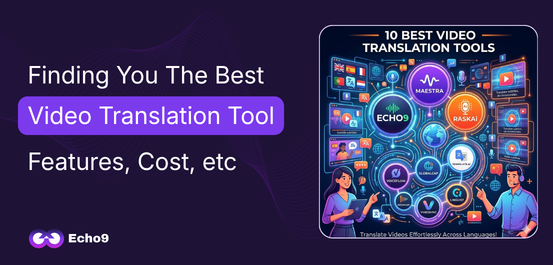
Mahnoor Shahid Product Marketer at Echo9 – 2 years of experience in video localization, evaluating dubbing and subtitling tools for streaming and e-learning clients. Last updated on September 2026. Video translation tools have become a practical need for anyone creating content for more than one audience. Whether it is a product demo, training video, online course, webinar, social video or entertainment clip, language can decide how far that content travels and how well it connects with viewers. Today’s best AI video translator tools go beyond basic subtitles – combining automatic translation, voice cloning, and lip-sync to produce a dubbed video that feels native in any language. But as the sections below show, very few are built to keep that quality consistent once you move from a single video to a full season or course. In this guide, we review 10 video translation tools based on what they offer, who they are best for and the hidden costs that may not appear on the pricing page. Quick answer If you need to localize a single video or a short one-off campaign, budget-friendly tools like HeyGen, Dubverse, or Maestra can get you a translated, subtitled, or dubbed video fast. If you’re managing a recurring show, course, or multi-episode series where voices, terminology, and quality need to stay consistent episode after episode, Echo9’s Series Management is built specifically for that – most tools on this list, including strong single-video options like Rask AI and ElevenLabs, are built around one file at a time rather than an ongoing series. Why Video Translation Tools Are Becoming Essential Video translation tools are becoming essential because video is no longer created for one language, one region or one audience. A product demo, training video, YouTube episode, online course, webinar or entertainment clip can now reach viewers across different countries, but only if the language barrier is handled properly. For many teams, this starts with a simple need: translate one video quickly. They may need subtitles in another language, a dubbed voiceover or a version that feels easier for international viewers to understand. This is where video translation tools can help. They make it faster to convert spoken content into subtitles, translated scripts and in some cases, AI-generated dubbing. The challenge is that speed alone is not enough. A translated video still needs accurate meaning, readable subtitles, natural voices, correct timing and consistent terminology. For recurring content, such as a series, course, campaign or multi-episode show, the workflow becomes even more important. That is why the conversation around video translation tools is shifting from “Which tool is fastest?” to “Which tool protects quality, consistency and cost as content grows?” This is also where hidden costs begin to appear, especially when teams rely on separate tools for translation, dubbing, review and version control. What to Look For in a Video Translation Tool The best video translation tool should do more than convert speech from one language to another. It should support the full localization workflow, from subtitles and dubbing to review, editing and final delivery. Before choosing a tool, teams should look at how well it handles quality, scale and long-term content needs. Translation, Subtitling and Dubbing Support: The tool should support accurate translation, subtitle generation and dubbing in multiple languages. Some tools only handle subtitles, while others offer AI dubbing, voiceover or translated captions. For recurring content, it should also help maintain consistent terminology, speaker names and style across videos. Voice Quality, Lip-Sync, and Editing Control: Translated videos need to sound natural, not just accurate. Look for clear AI voices, speaker matching, voice cloning and lip-sync support where needed. Teams should also be able to edit subtitles, refine timing, review scripts and correct dubbing before final delivery. Pricing, Scalability, and Workflow Fit: The listed price is not always the full cost. Extra time spent moving files, checking versions, repeating reviews or fixing errors can add up quickly. A simple tool may work for occasional videos, but recurring or episodic content needs stronger collaboration, QA, version control and consistency. How We Compared These Video Translation Tools We evaluated each AI video translator on seven criteria: translation accuracy, voice cloning quality, lip-sync precision, editing controls, language support, ease of use, and pricing – the same factors that matter most once you move from a demo to real production use. Here is the quick comparison built from the pricing and positioning already stated in each tool’s section further down the page – nothing new invented here, just pulled to the top where it’s scannable. Pricing and feature availability accurate as of September 2026 – always confirm current rates directly with each provider before deciding. Tool Best For Lip-Sync Voice Cloning Starting Price Echo9 Episodic & recurring content Yes Yes Custom HeyGen Creators, single-video projects Yes Yes Free / $29/mo Rask AI Broad language coverage, fast dubbing Yes Yes Free trial / $60/mo Maestra Transcription & subtitle-first Paid plans only Not specified $12/mo ElevenLabs Dubbing Studio Voice-quality-first dubbing No Yes Free / $6/mo VEED.io Social & short-form editing Yes Yes $10/mo per editor DeepDub Film/TV & professional dubbing Yes Yes Custom Dubverse Quick dubbing & subtitles Yes Not specified $18/mo Synthesia Corporate training, avatars Yes Yes Free / $29/mo Murf AI Voiceover-led narration No Not specified Free / $19/mo What we found was that many tools solve one part of the problem well, but most are not built for the full localization workflow. A tool may translate a video quickly, but teams still need to manage subtitle review, dubbing corrections, version changes, approvals, quality checks, and consistency across languages. That gap is why Echo9 was built differently. Instead of treating every video as a separate file, Echo9 is designed for recurring localization workflows where quality, consistency, review, and delivery need to stay connected across multiple videos and languages. 10 Video Translation Tools Reviewed Below is a practical review of 10 video translation tools teams commonly consider for subtitles, dubbing, voiceover and multilingual video workflows. Each tool is reviewed by what it
Why Episode-by-Episode Localization is Costing You More Money
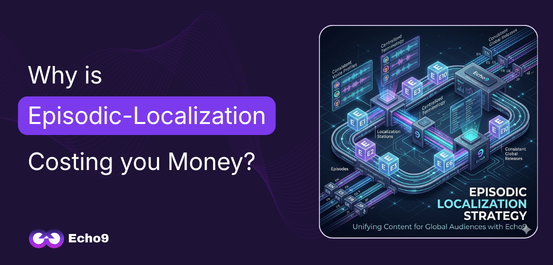
The global content ecosystem has shifted toward serialized storytelling. Streaming platforms release full seasons in multiple languages. YouTube creators produce episodic content for international audiences. Corporate training is structured in modules that run across weeks or months. Yet many teams still treat localization as a one-off task. They process each episode separately, assign different vendors, and stitch everything together at the end. This approach does not scale. And for episodic content, it actively breaks things. Series localization is not the same as translating a single video. It requires consistency across time, coordination across teams, and systems that hold up across an entire season or multiple seasons. This article breaks down exactly why episodic localization demands a different strategy, what that strategy looks like in practice, and how platforms like Echo9 are built to handle it at scale. What is Episodic Localization? Episodic localization is the process of adapting multi-episode content into different languages while maintaining consistency across every episode. This includes TV series, training modules, web series, documentary seasons, and any content structured as a continuing narrative. The key word is consistency. It is not enough for each episode to be accurately translated in isolation. The voices, terminology, tone, and character identity must remain coherent from Episode 1 through to the finale. This is what separates series localization from standard video translation. A single corporate video needs accuracy. A 10-episode series needs accuracy plus continuity, and that continuity has to be managed deliberately, not left to chance. How Episodic Localization Differs from Single-Video Translation When you localize a single video, the workflow is relatively self-contained. A translator handles the script, a voice artist records the dub, a QA reviewer checks the output, and the file is delivered. Episodic content changes every variable. You are not localizing one script. You are localizing a connected narrative where characters evolve, terminology recurs, and audience expectations build over time. Consider how viewers engage with a series. They learn character voices. They notice when a name is pronounced differently in Episode 4 than it was in Episode 1. They catch inconsistencies in subtitle style because they have been reading them for hours. These inconsistencies are not minor annoyances. They actively disrupt the viewing experience and erode trust in the production. According to a dubbing and voice-over industry report, voice consistency issues arise in 21% of serialized content, and serialized productions require voice consistency across an average of 8 to 12 episodes per season. That is not a problem you can solve episode by episode. It requires a system. Why Traditional Localization Workflows Fail for Series Content Traditional localization was designed for isolated projects. Each asset is treated as its own job. The workflow resets with every new piece of content. This works fine for a single video. It fails for episodic content in four specific ways. Inconsistent terminology across episodes In a long-running series, specific terms, character names, product references, and branded language appear across every episode. When different translators work on different episodes without a shared glossary, the same concept gets translated differently depending on who handled that particular file. Viewers notice this more than production teams realize. In educational or corporate content, inconsistent terminology is not just a quality issue. It actively undermines the learning objectives the content was designed to achieve. A term introduced in Module 1 needs to appear identically in Module 7. When it does not, comprehension suffers and credibility takes a hit. The fix is not asking translators to be more careful. The fix is a centralized, versioned glossary that is embedded in the workflow and consulted automatically, not remembered manually. Voice and character drift between episodes In dubbing, character identity is built through the voice. Audiences associate specific vocal qualities, including tone, pacing, and emotional range, with specific characters. When those qualities shift between episodes, it pulls viewers out of the story. This happens more often than it should. Traditional workflows treat each episode as a separate dubbing job. Different recording sessions, different direction notes, sometimes different voice artists entirely. The result is character drift that accumulates across a season. Over 59% of TV series are dubbed into more than five languages, which means this problem multiplies across every market a production enters. Maintaining consistent voice identity across episodes and languages requires structured voice mapping, not ad hoc casting decisions made episode by episode. Fragmented workflows and rising costs When each episode is treated as a standalone project, every episode goes through its own briefing, scoping, and setup. Teams duplicate effort. Glossaries get recreated from scratch. Voice direction notes are not passed between sessions. This fragmentation adds time and cost at every stage. Turnaround timelines for individual episodes already average 7 to 10 days in traditional workflows. Without batch processing and shared project infrastructure, localizing a 10-episode season in five languages can stretch delivery timelines to months, well past any reasonable release window. The inefficiency compounds when corrections need to be made. A single terminology change in Episode 1 has to be manually propagated across every other episode in every other language. There is no centralized place to make the fix once and have it reflected everywhere. Quality control that does not scale Reviewing one episode for quality is manageable. Reviewing an entire season across multiple languages is not, at least not if QA is treated as a final manual check at the end of each asset. Traditional QA processes were not designed for volume. They slow down proportionally as the series grows. Quality control either becomes a bottleneck or gets compressed to meet deadlines. Both outcomes lead to errors reaching the final release. Effective series localization requires QA to be structured into the workflow itself, not added as a final step under time pressure. What Effective Series Localization Actually Requires Understanding what goes wrong in traditional workflows makes it easier to identify what a better system looks like. Effective series localization is built on four foundational elements. A centralized terminology system Every series needs a single,