
Loading...
Echo9's geographic-aware engine asks the question no other AI dubbing tool asks: who, exactly, is watching this? Same language, different audience, different vocabulary.
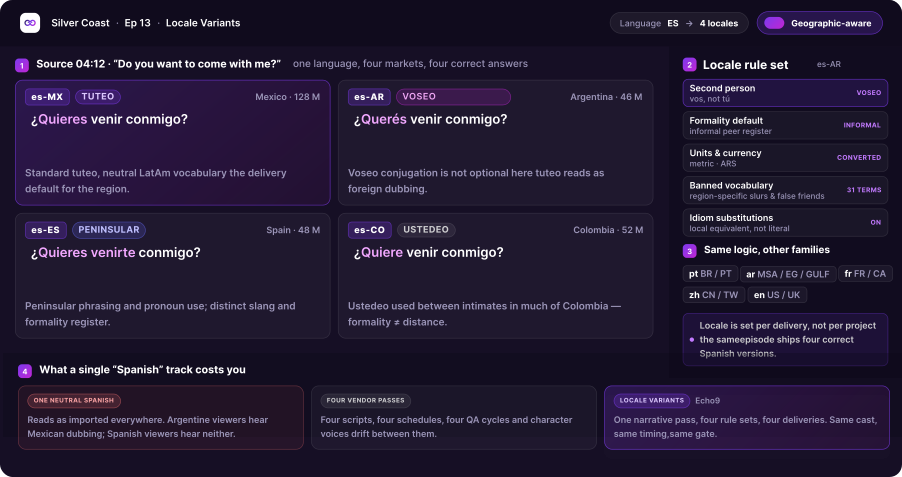
The numbers behind localizing for an audience, not just a language.
Where Standard Tools Fall Short
A viewer in São Paulo and a viewer in Lisbon technically share a language — they don't share the same slang, humor, or frame of reference. See how that plays out against a specific competitor in our Echo9 vs. HeyGen comparison.
Standard AI Dubbing Tools
Echo9
Geographic-awareness isn't a region dropdown — it's a set of checks that run before and during translation. Here's what's actually running.
Each release target gets an audience profile — region, generational tendencies, formality norms — attached before translation runs.
A phrase with no direct equivalent in the target audience's frame of reference is re-expressed with an equivalent local phrase, not dropped.
The same source line can generate two different, correct outputs for two audiences that technically share a language.
Built-in vocabulary variants per market — formal and informal registers, regional word choice — selectable per release.
References likely to need adapting are flagged automatically for reviewer attention instead of silently mistranslated.
A single episode upload can localize differently for different regional releases without a separate project per market.
SOURCE LINE
“That's a real tearjerker of a scene.”
— idiom, no direct equivalent
STANDARD (LITERAL)
Translated literally, idiom garbled
ECHO9 (AUDIENCE-AWARE)
Substituted with an equivalent expression, same emotional weight
SOURCE LINE
Reference to a locally-specific custom
STANDARD (LITERAL)
Translated literally, unfamiliar to Audience B
ECHO9 (AUDIENCE-AWARE)
Re-expressed using a reference familiar to Audience B
This is part of the same engine covered in The State of AI Video Localization 2026 — here's the short version for this one feature.
Identifies which cultural references need adapting for who's actually watching.
Even when the literal expression has no equivalent in the target culture.
Two audiences in the same language get two different, correct outputs.
The same episode can localize differently for different regional releases.