
Loading...
Echo9's video localization engine translates relationships, not just dialogue — so the way a character speaks to their mother, their boss, or a rival carries into every dubbed language.
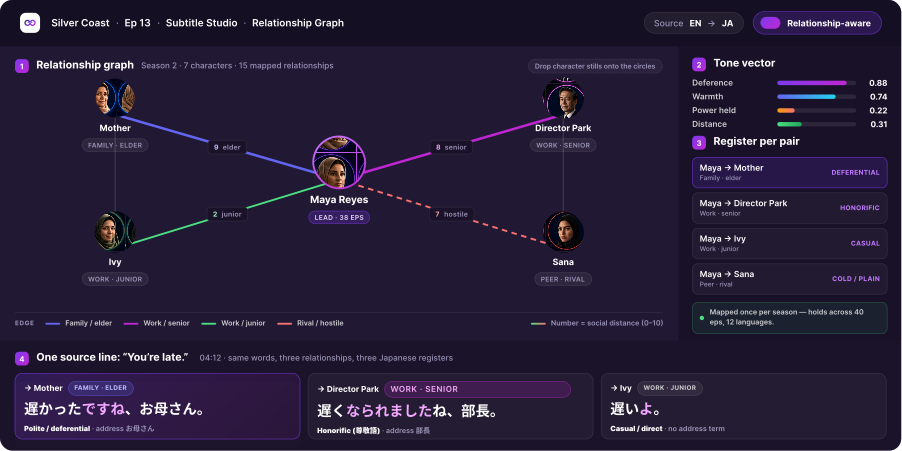
Three numbers that separate relationship-aware dubbing from a generic pass.
Where Standard Tools Fall Short
A line to a parent and a line to a rival shouldn't sound the same in any language. Here's how that gap plays out against a specific competitor in our Echo9 vs. ElevenLabs comparison.
Standard AI Dubbing Tools
Echo9
“Relationship-aware” isn't one setting — it's six things happening underneath, per line. Here's what's actually running.
Trust and tension between two characters aren't static — they shift scene to scene, episode to episode. Echo9 tracks the arc, not a single snapshot.
Each relationship gets its own tone profile, weighted per pair — and that vector feeds directly into voice pitch, pace, and delivery.
Every pair of characters in a scene is mapped for conflict intensity and emotional volatility — not just who's present, but how charged the exchange is.
Formality, privacy, and emotional intensity are tagged per scene before a single line is dubbed, so tone shifts with the moment, not just the character.
A relationship stated outright in dialogue is treated differently from one only implied — each gets its own confidence score, so reviewers know what to double check.
Family trees and power hierarchies build automatically from the dialogue itself, so the dub knows who defers to whom before an honorific is ever chosen.
SOURCE LINE
“Fine, I'll do it.”
— spoken to a parent
STANDARD (WORD-FOR-WORD)
“Fine, I'll do it.”
ECHO9 (RELATIONSHIP-AWARE)
“If that's what you wish, I'll do it.”
SOURCE LINE
“You don't get to decide that.”
— spoken to a rival
STANDARD (WORD-FOR-WORD)
“You don't get to decide that.”
ECHO9 (RELATIONSHIP-AWARE)
“That's not your call to make.”
The same logic is part of what we cover in The State of AI Video Localization 2026 — here's the short version for this one feature.
Every relationship is mapped once, up front — no re-tagging episode to episode.
Parent, boss, rival, peer — each relationship is explicit, not guessed at line by line.
Forms of address shift to match how the target language actually expresses hierarchy.
A relationship set in episode 1 still holds in episode 40 — no drift.