
Loading...
Echo9's subtext-aware engine reads what a character is actually feeling underneath the words, so that meaning survives video translation, not just the transcript.
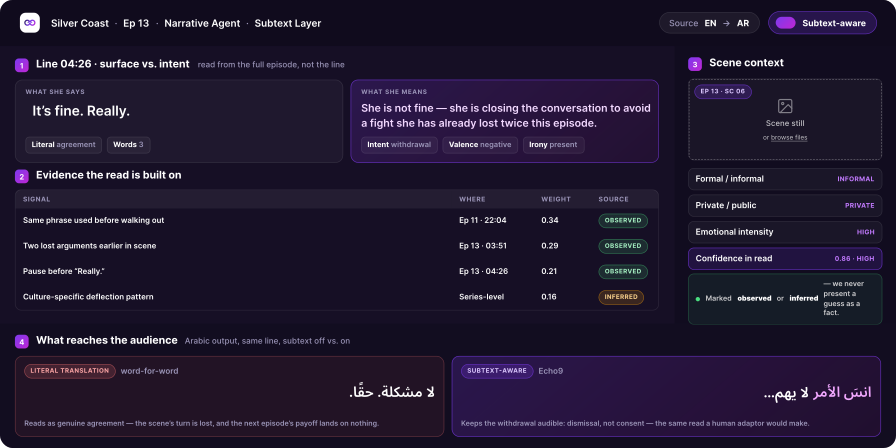
The numbers behind reading a line for what it actually means.
Where Standard Tools Fall Short
A generic translation engine treats a line as words to swap. See how that gap plays out against a specific competitor in our Echo9 vs. Rask AI comparison.
Standard AI Dubbing Tools
Echo9
Subtext isn't a single flag — it's a layer that runs alongside translation and feeds the performance. Here's what's actually running.
Every line gets both a literal translation and a “true intent” reading. When the two diverge, the intent version drives the dub.
Flags lines where tone flips the literal meaning, so the dub doesn't take the words at face value.
Subtext gets its own confidence score — directly implied by context, or ambiguous and flagged for human review.
A character's subtext pattern — say, deflecting with humor — is tracked so their style doesn't randomly flip scene to scene.
Benchmarked against 100K+ manually tagged lines, not a generic sentiment classifier built for product reviews.
The detected subtext — resigned, hopeful, deflecting — is passed as a tag straight to the voice performance layer.
SOURCE LINE
“It's not a big deal.”
— said through gritted teeth
STANDARD (WORD-FOR-WORD)
“It's not a big deal.”
ECHO9 (SUBTEXT-AWARE)
Same words — tagged [suppressed anger], delivered with tension in the voice
SOURCE LINE
“Sure, whatever you say.”
— said sarcastically
STANDARD (WORD-FOR-WORD)
“Sure, whatever you say.”
ECHO9 (SUBTEXT-AWARE)
Same words — tagged [sarcastic], delivered with a clipped, ironic tone
This sits alongside the emotional-tagging work covered in AI vs. Human Dubbing Is the Wrong Question — here's the short version for this one feature.
Every line is evaluated for what the character means beneath what they say.
The emotional read is tagged and passed through, not left to chance.
The same words said differently by different characters land differently, every time.
Reviewed against 100K+ manually tagged dialogues, not a generic sentiment model.