
Why Flat Translation Tools Fail at Multi-Episode Content
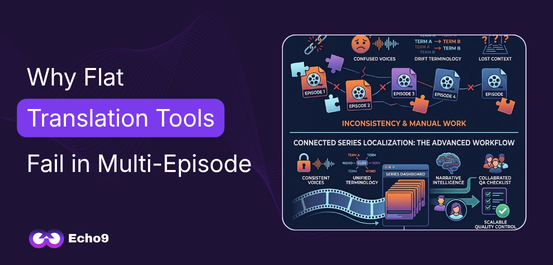
Translating a single video can be a simple task. Translating an entire series is a different challenge for flat translation tools. For one video, a tool may only need to understand the dialogue, translate it, and create subtitles or a dubbed version. But when content includes multiple episodes, the same characters, terms, storylines, and production rules need to remain consistent from one episode to the next. This is where flat translation tools can start to create problems. Most basic translation workflows are designed around individual files. Each episode is treated as a separate project, which can lead to repeated setup, inconsistent terminology, changing character voices, disconnected reviews, and more manual work. For OTT platforms, broadcasters, and teams managing large content libraries, the challenge is no longer simply translating a video. It is maintaining quality and consistency across the entire series. This article explains why flat translation tools struggle with multi-episode content and what teams can do to build a more scalable localization workflow. What are Flat Translation Tools Flat translation tools are built for projects, not catalogs. They operate on a simple, isolated workflow: you upload a single video file, translate the dialogue, burn in subtitles or generate an AI dub, and export the final asset. For a single standalone video, like a one-off product demo, a quick marketing clip, or an individual YouTube upload, this linear approach works perfectly fine. But the workflow completely breaks down when you need to scale across 10, 50, or hundreds of episodic videos. An entire series or course library is not just a fragmented collection of separate files; it is a unified ecosystem. Throughout a series, key elements must remain completely synchronous: When a translation tool lacks an intelligent memory system or a dedicated Series Management Dashboard, your team is forced to reinvent the wheel with every single episode. This creates an endless cycle of manual coordination overhead, massive workflow fragmentation, and glaring content inconsistencies. See this on your own episode. One scene, one language, 30 minutes with an engineer. Book a Consultation Why Single-Video Translation is Different from Series Localization Translating a single video is straightforward: you translate the dialogue, burn in subtitles or generate an AI dub, and export. But when you scale to an entire series, this file-by-file approach breaks down completely. True media localization demands absolute production consistency across dozens of connected files. When you treat a series like a collection of isolated videos, five critical elements break: Character Voices: Viewers build emotional connections with how a character sounds. If a voice shifts its pitch, tone, or emotional depth between Episode 1 and Episode 8, it instantly breaks audience immersion. Series localization requires locked, persistent speaker profiles that sound identical across full seasons. Echo9 solves this by locking character voice profiles across your entire catalog, ensuring absolute vocal consistency from the pilot to the finale. Centralized Terminology: Fictional locations, product names, titles, and technical vocabulary must remain uniform. While flat tools force teams to manually cross-reference past files, an episodic framework utilizes automated glossaries to apply the exact same translations from the first episode to the last. Echo9 handles this seamlessly by auto-applying your centralized glossary across all episodes, guaranteeing 100% brand and story uniformity. Narrative Intelligence: Dialogues do not exist in a vacuum; a line in Episode 10 often depends heavily on context established in Episode 2. Instead of translating line-by-line, an advanced series workflow retains full-season context to ensure that cultural adaptations and humor translate perfectly. Echo9 delivers this by using narrative intelligence to track story context across all episodes, ensuring every joke and cultural adaptation lands exactly as intended. Automated Quality Control (QA): Reviewing a single video for lip-sync and timing is easy. Manually tracking emotional delivery, pronunciation, and formatting across a 50-episode, multi-language run is a logistical nightmare. Episodic localization introduces centralized, automated QA to flag cross-episode errors instantly before a director reviews its results. Connected Workflows: Managing multiple languages, revisions, and translation teams across separate video files leads to massive coordination overhead. True series localization unifies your entire catalog into a single, connected pipeline, cutting delivery timelines from weeks to hours. Echo9 provides this structural backbone by syncing your entire production team and seasonal assets into one intuitive dashboard, eliminating manual management entirely. Amazon’s Prime Video Subtitling Guidelines make the same point: subtitlers must keep terminology, character names and recurring phrases consistent “to help viewers build understanding cumulatively.” What a Series-based Localization Workflow Should Include A professional media production doesn’t need another isolated file translator; it needs a repeatable, automated production line. To scale a catalog without losing quality, a true series-based localization workflow must integrate these core capabilities: Centralized Project and Workflow Management: Instead of managing scattered files across separate cloud folders, the entire series, seasons, and multi-language requirements must live in one workspace. This gives teams absolute visibility to assign tasks, track real-time progress, and eliminate coordination overhead. Character and Terminology Consistency: The system must lock in shared glossaries and character voice profiles across the entire asset library. By enforcing these global rules at the series level, translators and voice teams can ensure that specialized terms and vocal identities remain completely uniform from the pilot to the finale. Efficient Processing and Team Collaboration: Localizing a full series requires a balance between batch processing and frame-level control. The workflow must automate repetitive tasks like transcription, translation, and subtitle creation, while providing a collaborative pipeline where editors, managers, and reviewers can seamlessly communicate without delays. Version Tracking and Quality Control: Episodic content undergoes constant revisions. A scalable system must automatically track file versions, review states, and timeline adjustments. It pairs an automated Post-Dubbing QA Engine with native timeline tools to quickly identify errors in lip-sync, timing, and pronunciation before final delivery. Human Quality Review: While automated engines handle the bulk of translation, dubbing, and technical checks, the workflow must integrate human linguistic reviewers. Human judgment remains irreplaceable for locking in precise emotional delivery, cultural context, and storytelling nuances. How Echo9 Helps With Multi-Episode
AI Dubbing for OTT Platforms Is Changing How Streaming Content Scales Globally
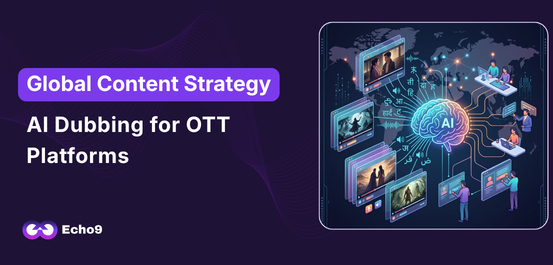
A hit series can travel across borders. Its localization often cannot move that fast. For OTT platforms, every new market means more dubbing, subtitles, reviews, versions, and delivery work. Multiply that across entire seasons and growing catalogs, and localization can quickly become a bottleneck. AI dubbing is changing that. It can accelerate the repetitive parts of localization while human teams focus on context, cultural accuracy, and quality. The bigger opportunity is not just faster voice production. It is building a scalable localization operation that can keep up with global content distribution. Localization Is Becoming an OTT Growth Lever For an OTT platform, localization determines how much of its catalog can actually reach international audiences. A platform may already have hundreds of hours of content that could perform well in another market. The challenge is preparing that content for local audiences without creating an equally large operational burden. Modern AI video localization can automate parts of transcription, translation, dubbing, subtitling, and quality control. The goal is not simply cheaper voice production. It is making localization repeatable. That matters when new episodes are released every week or an existing catalog needs to be opened up to new markets. Research around GenAI autolocalization is also highlighting how AI can make content localization more scalable. For OTT teams, that creates a shift from asking whether a title is affordable to localize toward asking which titles and markets should be prioritized. AI dubbing can help OTT teams localize more titles without adding another layer of manual operations. See how Echo9 fits your workflow AI Dubbing Changes the Economics of Global Content Traditional dubbing can involve translators, voice actors, studios, editors, reviewers, and delivery teams. That works for individual productions, but becomes harder to manage across hundreds of episodes and multiple languages. AI dubbing can automate much of the repetitive production work. Teams can generate initial dubbed versions quickly, then focus human attention on translation accuracy, cultural context, performance, and final quality. The difference becomes clearer when looking at traditional dubbing vs. AI dubbing. For OTT platforms, dubbing also should not exist in isolation. Subtitles are often part of the same release strategy, making subtitling and dubbing together increasingly important. This is where Echo9’s model fits naturally. It combines AI-powered localization with the project management, review, and delivery workflow needed to operate at scale. One Episode Is Easy. An Entire Season Is Different. Localizing one video is relatively straightforward. Localizing a 10-episode season into eight languages means managing 80 localized episodes. Add another season, more languages, and weekly releases, and the operational challenge grows quickly. That is why episodic localization requires a different approach from one-off video localization. Teams need consistent terminology, character voices, translations, approvals, versions, and quality standards across the entire series. Echo9’s Series Management is designed around this problem, helping teams manage localization as a series rather than treating every episode as an isolated project. A broader multilingual content strategy can then help determine which markets and titles should be prioritized. Keeping Character Voices and Terminology Consistent Consistency becomes harder as a series gets longer. A character should sound recognizable from episode one through the finale. Names, locations, brands, recurring phrases, and terminology should also remain consistent. Voice cloning can help maintain character identity across episodes. Understanding the difference between TTS, voice cloning, and AI dubbing is useful when evaluating the technology behind a localization workflow. But localization is more than voice generation. Relationships between characters, subtext, humor, emotional intensity, and cultural references can all change how dialogue should be adapted. That is why Echo9 goes beyond literal translation with localization capabilities designed around context, including relationship-aware and subtext-aware approaches. The objective is for the localized version to feel natural to the audience, not simply accurate word-for-word. The Localization Workflow Matters as Much as the AI A scalable OTT workflow needs to cover more than generating a voice track. It needs to handle: If those steps happen across different tools, teams can quickly end up managing spreadsheets, file versions, emails, vendors, and manual status updates. Echo9’s Project Management feature brings the operational layer into the localization workflow. Its OTT localization solution is designed around managing seasons, languages, reviews, and delivery status. For LSPs handling multiple clients and productions, Echo9 also provides a localization service provider workflow. The point is simple: the bottleneck is often everything surrounding the dub, not the generation of the audio itself. AI Can Scale the Work. Humans Still Protect the Quality. Faster localization only matters if audiences actually enjoy the result. AI dubbing needs to be evaluated for naturalness, translation accuracy, terminology, timing, pronunciation, and lip sync. Echo9’s guide to AI dubbing quality breaks down the areas teams should evaluate. For dialogue-heavy content, AI lip-sync dubbing can also make a major difference to the viewing experience. Human review remains important. AI can handle volume and repetitive production. Human reviewers can focus on cultural context, awkward phrasing, emotional delivery, and errors that automated systems may miss. Echo9’s managed localization service combines AI processing with human linguistic review, technical QC, and delivery. That gives OTT teams a way to increase localization capacity without having to build every part of the operation internally. Build an Internal Localization Operation or Use a Managed Service? Building localization internally can give a platform control, but it also means managing linguists, reviewers, project managers, voice resources, QA, technology, vendors, and delivery systems. At sufficient scale, that may make sense. But not every OTT platform needs to turn localization into another large internal department. A managed model lets the platform keep ownership of its content strategy while outsourcing much of the operational complexity. Echo9’s Managed Services model combines AI production with human review and technical delivery. The same workflow can support other content-heavy organizations, including TV broadcasters and localization service providers. For a platform trying to expand into several markets at once, that operational flexibility can be just as valuable as the underlying AI technology. OTT Localization See how your next season could localize at scale.
TTS vs Voice Cloning vs AI Dubbing: What’s the Difference?
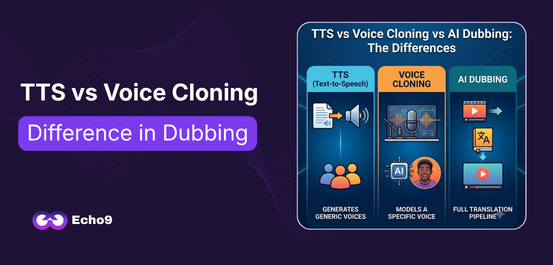
TTS vs Voice Cloning vs AI Dubbing, these three terms get used interchangeably in casual conversation, and that’s a problem, because they describe genuinely different technologies solving different problems. If you’re evaluating tools for translating and voicing video content, knowing the difference will save you from buying the wrong thing. Text-to-Speech: Text In, Generic Voice Out Text-to-speech converts written text into spoken audio using a synthetic voice. That voice can range from clearly robotic, in older TTS systems, to highly natural-sounding in modern neural TTS, but it’s a generic voice, not a recreation of any specific person. TTS powers screen readers, GPS navigation, and IVR phone systems. It’s built for clarity and consistency, not for sounding like a particular person. If you need audio narration and don’t care whose voice it is, TTS alone is often sufficient and is the cheapest, fastest option available. What it can’t do: make the output sound like your host, your brand’s voice actor, or the original speaker in a video you’re translating. Voice Cloning: A Specific Voice, On Demand Voice cloning takes a sample of a real person’s voice, sometimes just a few seconds to a few minutes of audio, and creates an AI model that can generate new speech in that same voice, saying things the person never actually said. This is a meaningfully different technology from generic TTS. Where TTS answers “how do I turn text into spoken audio,” voice cloning answers “how do I get a specific voice to say new things.” See our full explainer on how voice cloning works for the technical detail. Voice cloning is the piece that makes it possible for a character’s voice to stay the same across 50 episodes, or for a course instructor’s voice to narrate lessons they never personally recorded, in Spanish or Hindi. What it can’t do on its own: decide what to say, translate content, or time output to match a video. It generates the voice; something else has to generate the words and the timing. AI Dubbing: The Full Pipeline AI dubbing is the complete system that takes a video in one language and produces a version in another, using both of the technologies above as components rather than as substitutes for each other: Transcribe the original audio. Translate the transcript, adjusted for natural phrasing and timing rather than a literal word-for-word conversion. Generate the new-language audio, using voice cloning if the goal is to preserve the original speaker’s voice, or generic TTS if a stock voice is acceptable. Time-align the generated audio, and in advanced implementations adjust lip movement, to match the original video. See our AI lip sync dubbing for how that step works. So the relationship isn’t three competing options; it’s closer to ingredients versus the finished dish. AI dubbing is the dish. TTS and voice cloning are two different ingredients for the voice component, depending on whether preserving the original speaker’s identity matters. A Quick Look at How Each Is Actually Built The technical distinction matters because it explains why you can’t substitute one for another, not just that you shouldn’t. Generic TTS systems are trained on large datasets of many different speakers, which is exactly why the output sounds competent but generic. The model learns what speech in general sounds like, not what any one person specifically sounds like. Voice cloning systems work differently. They take that same general speech model and adapt it using a sample of one specific person’s voice, sometimes just seconds of audio, to shift the output toward that individual’s vocal characteristics: pitch, tone, accent, and speaking style. The better the reference sample and the more the system has been refined for this task, the closer the cloned output gets to the source voice. AI dubbing pipelines sit on top of both. They add speech recognition to transcribe the source audio, a translation layer that adjusts for length and phrasing rather than translating word for word, and a timing layer that fits whichever voice output, cloned or generic, into the original video’s pacing. None of these layers substitute for the others; a pipeline missing any one of them can’t produce a finished dubbed video on its own. When You Actually Need Which Your situation What you need Narrating a script with no specific voice requirement Generic TTS Getting a specific voice actor’s voice to narrate new content they didn’t record Voice cloning alone Translating an existing video while keeping the same speaker’s voice AI dubbing, using voice cloning as the voice component Translating an existing video where a generic voice is acceptable AI dubbing, using TTS as the voice component Localizing a 40-episode series where character voice must stay consistent AI dubbing with voice cloning plus series-level consistency management Why This Distinction Matters Most for Series Content A single translated video only needs the voice component to sound good once. A series needs it to sound the same, correctly, across every episode a character appears in, potentially for multiple seasons. That’s a different engineering problem than generating one clean line of dialogue, and it’s why Echo9 is built around Series Management rather than treating each episode as an independent job: each character’s voice profile is locked in once, and Terminology Control keeps names and phrasing from drifting as new episodes are added, so decisions made in episode 1 still hold in episode 40. What This Means for Your Budget Cost structures differ across these three categories in ways that matter once you’re planning at scale rather than testing a single clip. Generic TTS is typically the cheapest option because it doesn’t require building or maintaining a voice model tied to a specific person. Voice cloning adds cost for the modeling step itself, though that cost is usually paid once per voice rather than per use. Full AI dubbing pipelines price per minute of finished output because they’re doing the most work: transcription, translation, voice generation, and timing all happen for every minute of content processed. For a single video, these
AI Dubbing Quality: Evaluating Naturalness, Accuracy and Lip Sync
Mahnoor Shahid Content & Growth, Echo9.ai Last updated on September 2026. Quick answer AI dubbing quality comes down to three separate dimensions: naturalness (does the voice sound human), translation and terminology accuracy (is the meaning preserved and consistent), and lip sync/timing (does the audio match the video). A platform can score well on one dimension and poorly on another, so evaluate each independently, on a real dialogue scene, rather than judging from a single overall impression. “Does the AI dubbing sound good?” is the wrong question to start with, because “good” means different things depending on what’s being evaluated. A voice can sound completely natural and still mistranslate a joke. A translation can be accurate and still feel robotic. The audio can be timed perfectly to the video and still sound like nobody real. Evaluating AI dubbing quality means separating it into three distinct dimensions, testing each one deliberately, and only then forming a view on whether a platform is ready for your content. Dimension 1: Naturalness Naturalness is whether the voice sounds like a person, with the pacing, breath, and emotional texture of real speech. It has nothing to do with whether the translation is correct or the timing is right; it’s a separate axis entirely. What to listen for: Pacing and pauses. Does the voice breathe and pause the way a person would, or does it sound evenly metered in a way that reads as synthetic? Emotional range. Can the voice convincingly shift tone within a scene, calm to urgent, neutral to sarcastic, or does everything land at the same register regardless of content? Prosody at sentence boundaries. Does pitch rise and fall naturally at the end of questions and statements? The fastest way to test this is to listen to a longer passage, not a single line. Short clips can sound convincing in isolation and then reveal repetitive patterns, like the same rising intonation on every sentence, once you listen at length. This is close to the logic behind ITU-T Recommendation P.800, the long-standing methodology broadcasters and telecom providers use for subjective speech quality testing: structured listening over a meaningful sample, not a single impression. The score that process produces is what the industry calls a Mean Opinion Score (MOS), typically on a 1-to-5 scale — a well-established way to quantify voice naturalness specifically, even though no equivalent single score yet exists for AI dubbing quality as a whole. That same discipline, testing naturalness as its own pass rather than folding it into a general “does this sound okay” reaction, is what separates a real evaluation from a first impression. It’s easy to hear a clip that sounds impressive in isolation and assume it will hold up across a full scene; it often doesn’t, which is exactly why the three dimensions in this framework need to be scored separately rather than averaged into one gut call. Naturalness also covers speaker similarity when voice cloning is involved: does the synthetic voice actually sound like the original speaker, or just like a generic voice in the right language? Vendors increasingly quantify this with a speaker-similarity score, but the simplest test is still whether someone who knows the original voice would recognize it. Dimension 2: Translation and Terminology Accuracy This is the dimension most often skipped in a demo, and the one least related to “AI” in the way people usually mean it. A dub can sound flawless and still be wrong. What to check: Meaning preservation, not just literal accuracy. Does the translated line convey the same intent, especially for idioms, jokes, and culturally specific references? Terminology consistency. Does a character’s name, a brand name, or a technical term stay the same across the piece, or does it drift? This compounds fast in episodic content, where a small inconsistency in episode 3 becomes a credibility problem by episode 20. Register match. Does formal dialogue stay formal, and casual dialogue stay casual, in the target language? For a deeper look at what media localization requires beyond word-for-word translation, see our complete guide to media localization. Dimension 3: Lip Sync and Timing This is the dimension that’s most visually obvious when it fails and least noticed when it succeeds, which is exactly why it needs deliberate evaluation rather than a casual glance. Our explainer on AI lip sync dubbing covers how the underlying technology works. What to check: Duration match. Does the dubbed line end roughly when the original line ends, without the video cutting away mid-sentence or holding on a silent mouth? Mouth shape alignment on close-ups. If the platform offers visual re-timing. Consistency across cuts. A scene with quick back-and-forth dialogue is a harder test than a single uninterrupted monologue. Researchers increasingly quantify this dimension with an automated Lip Sync Error (LSE) score, measuring audio-visual alignment directly from the video frames, though most production teams still rely on the manual close-up and quick-cut checks above for anything client-facing. A Practical Scoring Framework Dimension What “good” looks like What “poor” looks like Naturalness Natural pauses, varied emotional tone, no repetitive intonation pattern Evenly metered delivery, flat emotional range, audible artifacts Accuracy Meaning and register preserved, terminology consistent across the full piece Literal but wrong-sounding phrasing, names or terms that drift Lip sync/timing Line duration matches the scene, mouth shape holds on close-ups Dialogue cuts off early, holds on silence, or drifts on quick cuts Score each dimension independently, on paper, before discussing the clip as a group. This avoids one strong dimension masking a weak one in overall impression. Then repeat with a second, harder scene, fast dialogue, background noise, or overlapping speech, since single-scene tests tend to overstate quality. Building a Repeatable Evaluation Process for Your Team A one-time quality test tells you how a platform performs on the day you tested it. A repeatable process tells you whether that quality holds up across the content you’ll actually produce, which is the number that matters when you’re committing a season rather than a single clip. Standardize your test
What Is AI Lip Sync Dubbing and How Does It Work?
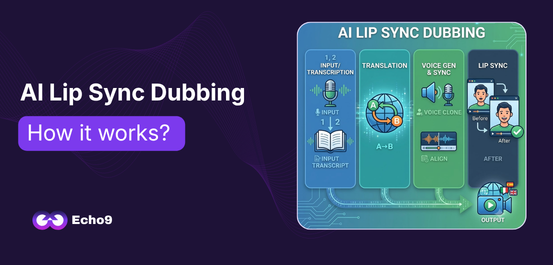
Dubbed content used to be easy to spot on sight. The audio didn’t match the mouth. Lines ran long after the actor stopped talking, or cut off mid-sentence while lips kept moving. That mismatch is called lip sync error, and for decades it was simply accepted as the cost of translating video into another language. AI lip sync dubbing is the technology built to close that gap. It’s the reason a growing share of dubbed content, from independent YouTube channels to full television seasons, is starting to look and sound native in every language it releases in. What AI Lip Sync Dubbing Actually Means AI lip sync dubbing generates translated, AI-voiced dialogue that is timed, and in some implementations visually adjusted, to match the original speaker’s mouth movements. It combines several systems working together: That last step is what separates true AI lip sync dubbing from standard AI dubbing. Standard dubbing replaces the audio track and times it closely to the original. Lip sync dubbing treats mouth movement as something that can also be adjusted. Why Timing Is the Hard Part Languages are not the same length. A sentence that takes four seconds to say in English might take five and a half seconds in Spanish, or three in Mandarin. Traditional dubbing studios solve this with script adaptation: a human translator rewrites the line so it fits the available time, sometimes adjusting the meaning slightly to preserve the rhythm. AI systems approach the same problem computationally. The platform generates multiple phrasings of a translated line, scores them against the target duration, and selects or blends the version that fits best. Many platforms also apply small speed adjustments to the generated audio itself, similar to how audiobook narration can be sped up without sounding unnatural as long as the adjustment stays within a narrow range. What Good Lip Sync Looks Like at Scale For a single video, the difference between good and bad lip sync dubbing is whether a viewer forgets they’re watching a dub at all. For episodic content, it’s a production requirement, not a nice-to-have. A 40-episode series with visible sync drift in every episode reads as low-budget regardless of how strong the translation is. Platforms also differ in what they optimize for. Some focus purely on audio-to-video timing, matching pause length and sentence boundaries. Others also apply visual lip re-timing frame by frame. The right choice depends on the content: a talking-head interview rarely needs visual adjustment, while a close-up dialogue scene in a drama benefits from it substantially. How Echo9’s Rephrase-Fit Engine Solves Lip Sync Without Speeding Up Audio Most AI dubbing platforms handle a timing mismatch the same way: they speed up or slow down the generated audio until it fits the original clip length. An estimated 75 to 80 percent of dubbing platforms rely on this shortcut, and it’s the kind of fix a viewer feels even when the adjustment is small, because sped-up speech carries a subtly different pitch and rhythm than natural delivery. Echo9’s Rephrase-Fit Engine takes a different approach: instead of stretching the audio, it rewrites the translated line itself so the spoken version fits the source duration exactly, with no speed change and no words cut to save time. A 3.2-second line in one language that would naturally run 4.8 seconds in another gets rephrased, not sped up, until it lands in the same window as the original. The system also removes the manual hunting that timing review normally requires. Every segment more than 200 milliseconds out of sync is flagged automatically, and for each flagged line Rephrase-Fit generates three separate timing-fit rewrites rather than committing to a single version, so an editor picks whichever option sounds most natural instead of accepting the platform’s one guess. It handles overlapping dialogue the same way, timing each speaker independently so a scene’s natural back-and-forth stays intact instead of getting flattened into non-overlapping lines. For episodic content, this matters at a different scale than a single video. A season can generate thousands of lines with a potential timing mismatch, and rewriting each one by hand is exactly the kind of script adaptation work that makes traditional dubbing studios slow and expensive per episode. Automating that rewrite decision, with a human still picking the final option, is what lets lip sync quality hold up across a full season instead of degrading as the episode count grows. Common Lip Sync Failure Patterns to Watch For Not every sync problem looks the same, and knowing the specific patterns helps you spot them faster in a review pass instead of relying on a vague sense that “something feels off.” Reviewing footage specifically for these five patterns, rather than watching for a general impression of quality, turns lip sync evaluation from a subjective judgment into a checklist a production team can apply consistently. Where AI Still Needs a Human Check AI lip sync dubbing has closed most of the gap with traditional dubbing, but it isn’t fully hands-off. The parts that still benefit from human review include: This is why the strongest production workflows pair AI generation with a structured human review pass rather than treating either AI-only or human-only dubbing as the default. Our breakdown of how AI is transforming video localization covers what that hybrid workflow looks like in practice. How Lip Sync Fits Into the Broader Dubbing Decision Lip sync quality doesn’t exist in isolation. It’s one of three things worth evaluating together whenever you’re choosing a dubbing approach: how natural the generated voice sounds, how accurate the translation and terminology are, and how well the timing holds up. A platform can excel at one of these and fall short on another, which is why it’s worth testing lip sync specifically rather than assuming a platform that translates well will automatically sync well too. If you’re building an evaluation process for your own content, our guide on evaluating AI dubbing quality walks through all three dimensions with a scoring framework you can apply directly. Budget
6 Effective Types of Video Localization for Global Growth
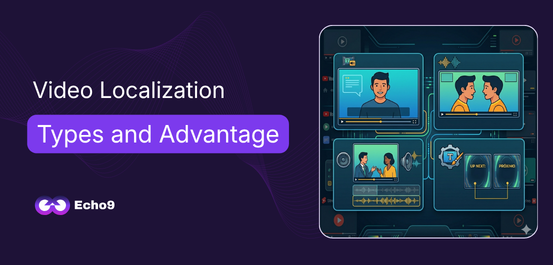
Video has become the world’s dominant digital habit. With 164.6 million live video viewers in 2024 in only US, the demand is exploding across LATAM, MENA, and Southeast Asia. For creators and studios, the message is clear: to scale, you must speak the audience’s language. Localization is no longer optional – it is a direct driver of ROI. It is evident that most consumers prefer content in their native tongue, even if it’s poor quality, because familiarity builds trust. But with so many options available, which types of video localization actually move the needle for your brand? This guide breaks down the essential types of video localization, comparing traditional dubbing with modern AI workflows. You’ll learn how to choose the right model for your strategy and how platforms like Echo9 make global expansion faster and more scalable than ever. What Is Video Localization? Video localization adapts content for global audiences as it goes beyond simple translation. Language is adjusted for regional relevance and cultural nuances are carefully considered. Messaging is aligned with local expectations and audio and subtitles are modified when needed. The goal is clarity and connection. Content should feel as if it was created for the audience rather than translated for them. When localization is done well, viewers engage naturally with the story, message, or learning material without feeling the barrier of language. Video localization ensures content resonates across languages and regions. It goes beyond translation. It includes linguistic accuracy, cultural context, timing, tone, and technical synchronization. Effective localization ensures: Beyond language, localization also considers how audiences consume content. Reading speed, subtitle length, and speech pacing may vary between regions. These adjustments help maintain viewer comfort and comprehension while preserving the original intent of the content. There are several video localization types, each suited for different use cases. Types of Video Localization Video localization is far more than just translating words; it’s about adapting the entire viewing experience to resonate with a specific culture. Depending on your budget, target audience, and the type of content (e.g., a corporate training video vs. a blockbuster movie), you’ll usually land on one or a combination of these methods. 1. Subtitling Subtitling is the most widely used localization method. It involves displaying translated text on screen while keeping the original audio intact. This allows viewers to understand the dialogue while still hearing the original voices, tone, and emotional delivery of the speakers. Subtitles provide a practical way to make content accessible to global audiences without altering the original production. By translating dialogue into multiple languages, creators can expand reach while maintaining the integrity of the original audio track. When Subtitling Works Best Instead of replacing the original audio, subtitles translate spoken dialogue into text that appears on the screen. This allows the original voices, tone, and performance of the speakers to remain intact while making the content understandable to viewers who speak different languages. Because subtitling does not require voice recording or audio replacement, it is typically faster and more cost-effective than dubbing. It also works well for content where the authenticity of the original speaker’s voice is important, such as interviews, speeches, or documentary storytelling. Subtitling works best for content such as: Subtitling is cost-effective and faster than dubbing. However, it requires viewers to read while watching, which can reduce emotional immersion. Challenges While subtitling is efficient and widely used, it also introduces several technical and linguistic constraints. Unlike dubbing, where dialogue can be adapted more freely through voice performance, subtitles must fit within strict visual and timing limits on screen. Translators must balance accuracy, readability, and synchronization with the original speech. Because viewers read subtitles while watching the visuals, text must remain concise and easy to process. This means sentences often need to be shortened without losing meaning. At the same time, subtitles must appear and disappear at the correct moment so that the viewer can comfortably follow the dialogue. Common challenges include: AI-powered subtitling tools now automate transcription, translation, and timing. Platforms like Echo9 support subtitles in over 100 languages. AI generates subtitles quickly and accurately. Multiple languages can be processed at once. Editors can refine phrasing directly within the platform. There is no need to export scattered files. All revisions happen inside a centralized workflow. Version control remains structured and traceable. Subtitle localization becomes faster and more scalable. For series or episodic content, consistency is critical. Character names must remain unchanged. Terminology should stay aligned across episodes. Fragmented workflows often create inconsistencies. Echo9’s Series Management solves this issue. Standards are defined once and reused. Voice and terminology stay consistent. Rework and corrections are significantly reduced. 2. Voice-Over Voice-over replaces the original dialogue with translated narration. The new narration becomes the primary audio. The original dialogue is not fully removed. Background audio remains at a lower volume. Ambient sound and music stay intact. This method preserves the original atmosphere. Voice-over is common in documentaries and interviews. It offers faster and more affordable localization. Unlike dubbing, it does not attempt lip synchronization. Common Use Cases Voice-over is another widely used method in video localization, particularly for informational and educational content. In this approach, the translated narration is recorded and layered over the original audio track, which is usually lowered in volume but still faintly audible in the background. This allows the audience to hear the translated explanation while maintaining some connection to the original speaker. Unlike full dubbing, voice-over does not attempt to match lip movements or recreate the exact performance of the original actor. Instead, the focus is on delivering clear and understandable narration in the target language. Because of this simpler production process, voice-over is often faster to produce and more cost-efficient. Voice-over is commonly used in content such as: Voice-over is faster and cheaper than full dubbing. It maintains clarity but sacrifices character immersion in narrative-driven content. Traditional voice-over requires studio recording and actor scheduling. AI voice-over reduces dependency on studios and shortens production cycles significantly. 3. Traditional Dubbing Traditional dubbing fully replaces the original dialogue.
How AI Is Transforming Video Localization in 2026
In 2026, AI video localization is no longer experimental. It has become the operational backbone of global content distribution. Streaming platforms, e-learning providers, and corporate teams are all scaling multilingual content faster than ever before. The reason is simple: AI has fundamentally changed how video is translated, dubbed, and distributed. Turnaround times are shorter. Costs are lower. Quality is no longer sacrificed for speed. This article breaks down what that shift looks like in practice, what is driving it, and how platforms like Echo9 are built to support it. Why Streaming Growth Is Making AI Localization Non-Negotiable The demand for localized content has surged over the last five years. According to reports from Statista, revenue in the Video Streaming (SVoD) market worldwide is projected to reach US$98.37bn in 2026. International markets are driving much of this growth. A significant share of new subscribers now comes from outside domestic markets. Global audiences are becoming the primary engine of streaming platform expansion. For media companies, international growth is no longer optional. It is essential for long-term success. Viewers increasingly prefer watching content in their native language. A CSA Research study found that 76% of consumers prefer purchasing or engaging with content in their own language. That preference extends directly to entertainment and education. In 2026, the challenge is no longer whether to localize. The challenge is how to do it efficiently at scale. This is where AI video localization becomes essential. AI Localization in 2026 Is a Continuous Pipeline, Not a One-Time Project AI video localization goes beyond basic translation. It combines: Unlike early AI tools that handled only single videos, modern systems can now manage entire content libraries. The biggest shift is operational: localization is no longer a project-by-project task. It is a continuous pipeline. How AI Dubbing Has Replaced Studio-Based Workflows at Scale Traditional dubbing requires studio recording, voice casting, multiple re-takes, and manual editing. A 40-minute episode could take days to complete, and a full season might require months. AI dubbing technology has changed this model. Modern neural TTS engines can: Instead of booking studio time for every episode, production workflows have evolved. Studios no longer need repeated recording sessions. Production teams can now train AI voices once. Or they can select pre-trained AI voice models. These voices remain consistent across episodes. The same AI voice can be deployed across an entire season. This reduces cost, time, and operational complexity. AI dubbing makes large-scale localization faster and more efficient. The impact is measurable: Series-Level Voice and Terminology Consistency Is Now a Production Standard One of the biggest problems in traditional workflows was inconsistency. Different translators used different terminology. Voice actors changed between episodes. Tone shifted from season to season. In long-form content, inconsistency damages viewer experience. This is where Echo9 introduces a critical advantage: Series Management. Echo9 does not treat videos as isolated files. It manages: For streaming platforms, scaling content has always been complex. E-learning providers face the same challenge. Production houses experience it too. The biggest obstacle? Fragmentation. Multiple vendors. Inconsistent voices. Disconnected workflows. Modern AI localization eliminates this fragmentation. It creates a unified, scalable production pipeline. How Streaming Platforms Hit Simultaneous Global Releases With AI Streaming platforms operate under pressure to release localized versions quickly. International markets often demand simultaneous releases. AI enables: Instead of waiting for full manual dubbing cycles, AI-driven pipelines accelerate go-to-market timelines. Echo9’s platform is built for large-scale series localization. It supports entire seasons, not just single videos. Voice consistency is maintained across every episode. Character tone and identity remain intact. Terminology stays aligned throughout the series. This makes Echo9 ideal for platforms expanding into LATAM. It is equally suited for growth in MENA. It supports localization across Southeast Asia. It enables seamless expansion into European markets. Echo9 helps global platforms scale with speed and consistency. How Training Teams Scale Multilingual Content Without Rebuilding Videos The growth of remote learning is accelerating worldwide. Corporate upskilling programs are expanding rapidly. Companies are investing more in digital training. Educational institutions are moving online. This shift has increased demand for multilingual course content. Organizations now need training materials in multiple languages. Localized learning is becoming essential for global teams. E-learning providers benefit from AI video localization by: Corporate training departments are under pressure to scale faster. Compliance videos must reach global teams. Onboarding content needs to be accessible across regions. Manual dubbing slows this process down. AI dubbing technology changes that. Training teams can localize videos more efficiently. Turnaround time is significantly reduced. Consistency and clarity are maintained across languages. Instead of recreating videos per region, they localize centrally. Inside the AI Dubbing Pipeline: From Voice Generation to Quality Control Modern AI dubbing is no longer just about generating translated audio. It is a structured production system designed to handle multilingual content at scale while maintaining quality and consistency. From voice identity management to automated workflows and integrated quality assurance, AI localization platforms now function as full production infrastructures rather than simple tools. This infrastructure combines automation with controlled review processes. AI accelerates tasks such as translation, voice generation, timing alignment, and terminology tracking, while human oversight ensures accuracy and contextual quality. The goal is not to replace creative control but to remove operational bottlenecks that traditionally slowed down localization. For studios, streaming platforms, and media teams, this shift changes how multilingual production is managed. Instead of fragmented workflows across multiple tools and vendors, modern AI dubbing systems centralize voice management, production speed, and quality validation within a single environment. Voice Cloning Keeps Character Identity Intact Across Every Episode Modern AI dubbing technology supports voice cloning for recurring characters. This ensures: For animated series, dramas, or branded content, voice continuity is crucial. Echo9 integrates voice consistency into its series management framework. Every character voice is standardized from the start. Tone and delivery remain aligned across episodes. Voice identity stays consistent throughout the season. There are no unexpected tonal shifts. Characters do not sound different midway through a series. This ensures a seamless and professional
Traditional Dubbing vs AI: A Cost and Speed Comparison
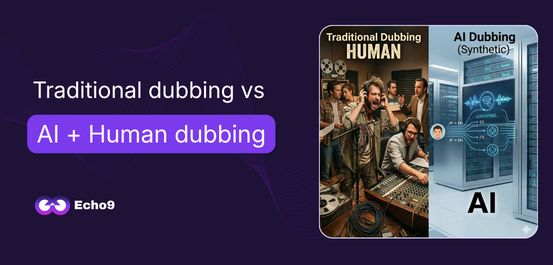
The debate around traditional dubbing vs AI is no longer theoretical – it’s operational.
Subtitling vs Dubbing: Which Is Right for Your Content?

Video is now the dominant medium for communication, entertainment, and education. Reaching global audiences is no longer optional.
What Is Media Localization? A Complete Guide for Content Creators

Today’s content doesn’t travel. It crosses borders, cultures, and audience expectations at lightning speed.