Why Episode-by-Episode Localization is Costing You More Money
The global content ecosystem has shifted toward serialized storytelling. Streaming platforms release full seasons in multiple languages. YouTube creators produce episodic content for international audiences. Corporate training is structured in modules that run across weeks or months. Yet many teams still treat localization as a one-off task. They process each episode separately, assign different vendors, and stitch everything together at the end. This approach does not scale. And for episodic content, it actively breaks things. Series localization is not the same as translating a single video. It requires consistency across time, coordination across teams, and systems that hold up across an entire season or multiple seasons. This article breaks down exactly why episodic localization demands a different strategy, what that strategy looks like in practice, and how platforms like Echo9 are built to handle it at scale. What is Episodic Localization? Episodic localization is the process of adapting multi-episode content into different languages while maintaining consistency across every episode. This includes TV series, training modules, web series, documentary seasons, and any content structured as a continuing narrative. The key word is consistency. It is not enough for each episode to be accurately translated in isolation. The voices, terminology, tone, and character identity must remain coherent from Episode 1 through to the finale. This is what separates series localization from standard video translation. A single corporate video needs accuracy. A 10-episode series needs accuracy plus continuity, and that continuity has to be managed deliberately, not left to chance. How Episodic Localization Differs from Single-Video Translation When you localize a single video, the workflow is relatively self-contained. A translator handles the script, a voice artist records the dub, a QA reviewer checks the output, and the file is delivered. Episodic content changes every variable. You are not localizing one script. You are localizing a connected narrative where characters evolve, terminology recurs, and audience expectations build over time. Consider how viewers engage with a series. They learn character voices. They notice when a name is pronounced differently in Episode 4 than it was in Episode 1. They catch inconsistencies in subtitle style because they have been reading them for hours. These inconsistencies are not minor annoyances. They actively disrupt the viewing experience and erode trust in the production. According to a dubbing and voice-over industry report, voice consistency issues arise in 21% of serialized content, and serialized productions require voice consistency across an average of 8 to 12 episodes per season. That is not a problem you can solve episode by episode. It requires a system. Why Traditional Localization Workflows Fail for Series Content Traditional localization was designed for isolated projects. Each asset is treated as its own job. The workflow resets with every new piece of content. This works fine for a single video. It fails for episodic content in four specific ways. Inconsistent terminology across episodes In a long-running series, specific terms, character names, product references, and branded language appear across every episode. When different translators work on different episodes without a shared glossary, the same concept gets translated differently depending on who handled that particular file. Viewers notice this more than production teams realize. In educational or corporate content, inconsistent terminology is not just a quality issue. It actively undermines the learning objectives the content was designed to achieve. A term introduced in Module 1 needs to appear identically in Module 7. When it does not, comprehension suffers and credibility takes a hit. The fix is not asking translators to be more careful. The fix is a centralized, versioned glossary that is embedded in the workflow and consulted automatically, not remembered manually. Voice and character drift between episodes In dubbing, character identity is built through the voice. Audiences associate specific vocal qualities, including tone, pacing, and emotional range, with specific characters. When those qualities shift between episodes, it pulls viewers out of the story. This happens more often than it should. Traditional workflows treat each episode as a separate dubbing job. Different recording sessions, different direction notes, sometimes different voice artists entirely. The result is character drift that accumulates across a season. Over 59% of TV series are dubbed into more than five languages, which means this problem multiplies across every market a production enters. Maintaining consistent voice identity across episodes and languages requires structured voice mapping, not ad hoc casting decisions made episode by episode. Fragmented workflows and rising costs When each episode is treated as a standalone project, every episode goes through its own briefing, scoping, and setup. Teams duplicate effort. Glossaries get recreated from scratch. Voice direction notes are not passed between sessions. This fragmentation adds time and cost at every stage. Turnaround timelines for individual episodes already average 7 to 10 days in traditional workflows. Without batch processing and shared project infrastructure, localizing a 10-episode season in five languages can stretch delivery timelines to months, well past any reasonable release window. The inefficiency compounds when corrections need to be made. A single terminology change in Episode 1 has to be manually propagated across every other episode in every other language. There is no centralized place to make the fix once and have it reflected everywhere. Quality control that does not scale Reviewing one episode for quality is manageable. Reviewing an entire season across multiple languages is not, at least not if QA is treated as a final manual check at the end of each asset. Traditional QA processes were not designed for volume. They slow down proportionally as the series grows. Quality control either becomes a bottleneck or gets compressed to meet deadlines. Both outcomes lead to errors reaching the final release. Effective series localization requires QA to be structured into the workflow itself, not added as a final step under time pressure. What Effective Series Localization Actually Requires Understanding what goes wrong in traditional workflows makes it easier to identify what a better system looks like. Effective series localization is built on four foundational elements. A centralized terminology system Every series needs a single,
Table of Contents
The global content ecosystem has shifted toward serialized storytelling. Streaming platforms release full seasons in multiple languages. YouTube creators produce episodic content for international audiences. Corporate training is structured in modules that run across weeks or months.
Yet many teams still treat localization as a one-off task. They process each episode separately, assign different vendors, and stitch everything together at the end.
This approach does not scale. And for episodic content, it actively breaks things.
Series localization is not the same as translating a single video. It requires consistency across time, coordination across teams, and systems that hold up across an entire season or multiple seasons.
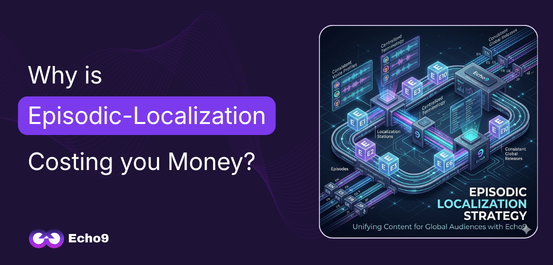
This article breaks down exactly why episodic localization demands a different strategy, what that strategy looks like in practice, and how platforms like Echo9 are built to handle it at scale.
What is Episodic Localization?
Episodic localization is the process of adapting multi-episode content into different languages while maintaining consistency across every episode. This includes TV series, training modules, web series, documentary seasons, and any content structured as a continuing narrative.
The key word is consistency. It is not enough for each episode to be accurately translated in isolation. The voices, terminology, tone, and character identity must remain coherent from Episode 1 through to the finale.
This is what separates series localization from standard video translation. A single corporate video needs accuracy. A 10-episode series needs accuracy plus continuity, and that continuity has to be managed deliberately, not left to chance.
How Episodic Localization Differs from Single-Video Translation
When you localize a single video, the workflow is relatively self-contained. A translator handles the script, a voice artist records the dub, a QA reviewer checks the output, and the file is delivered.
Episodic content changes every variable. You are not localizing one script. You are localizing a connected narrative where characters evolve, terminology recurs, and audience expectations build over time.
Consider how viewers engage with a series. They learn character voices. They notice when a name is pronounced differently in Episode 4 than it was in Episode 1. They catch inconsistencies in subtitle style because they have been reading them for hours. These inconsistencies are not minor annoyances. They actively disrupt the viewing experience and erode trust in the production.
According to a dubbing and voice-over industry report, voice consistency issues arise in 21% of serialized content, and serialized productions require voice consistency across an average of 8 to 12 episodes per season. That is not a problem you can solve episode by episode. It requires a system.
Why Traditional Localization Workflows Fail for Series Content
Traditional localization was designed for isolated projects. Each asset is treated as its own job. The workflow resets with every new piece of content.
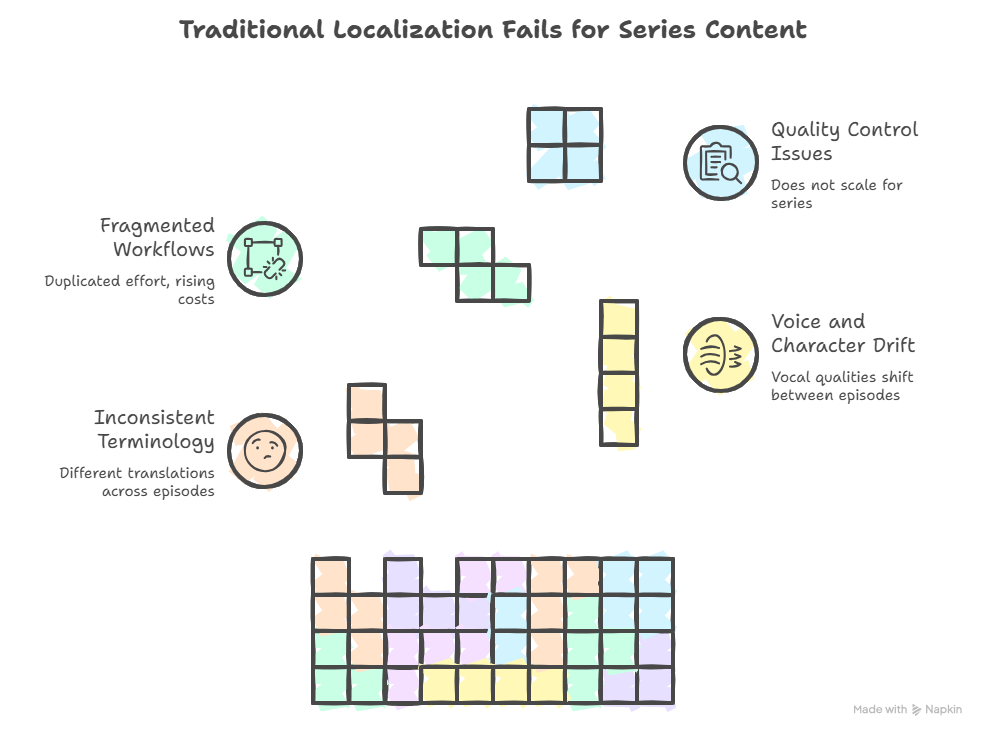
This works fine for a single video. It fails for episodic content in four specific ways.
Inconsistent terminology across episodes
In a long-running series, specific terms, character names, product references, and branded language appear across every episode. When different translators work on different episodes without a shared glossary, the same concept gets translated differently depending on who handled that particular file.
Viewers notice this more than production teams realize. In educational or corporate content, inconsistent terminology is not just a quality issue. It actively undermines the learning objectives the content was designed to achieve. A term introduced in Module 1 needs to appear identically in Module 7. When it does not, comprehension suffers and credibility takes a hit.
The fix is not asking translators to be more careful. The fix is a centralized, versioned glossary that is embedded in the workflow and consulted automatically, not remembered manually.
Voice and character drift between episodes
In dubbing, character identity is built through the voice. Audiences associate specific vocal qualities, including tone, pacing, and emotional range, with specific characters. When those qualities shift between episodes, it pulls viewers out of the story.
This happens more often than it should. Traditional workflows treat each episode as a separate dubbing job. Different recording sessions, different direction notes, sometimes different voice artists entirely. The result is character drift that accumulates across a season.
Over 59% of TV series are dubbed into more than five languages, which means this problem multiplies across every market a production enters. Maintaining consistent voice identity across episodes and languages requires structured voice mapping, not ad hoc casting decisions made episode by episode.
Fragmented workflows and rising costs
When each episode is treated as a standalone project, every episode goes through its own briefing, scoping, and setup. Teams duplicate effort. Glossaries get recreated from scratch. Voice direction notes are not passed between sessions.
This fragmentation adds time and cost at every stage. Turnaround timelines for individual episodes already average 7 to 10 days in traditional workflows. Without batch processing and shared project infrastructure, localizing a 10-episode season in five languages can stretch delivery timelines to months, well past any reasonable release window.
The inefficiency compounds when corrections need to be made. A single terminology change in Episode 1 has to be manually propagated across every other episode in every other language. There is no centralized place to make the fix once and have it reflected everywhere.
Quality control that does not scale
Reviewing one episode for quality is manageable. Reviewing an entire season across multiple languages is not, at least not if QA is treated as a final manual check at the end of each asset.
Traditional QA processes were not designed for volume. They slow down proportionally as the series grows. Quality control either becomes a bottleneck or gets compressed to meet deadlines. Both outcomes lead to errors reaching the final release.
Effective series localization requires QA to be structured into the workflow itself, not added as a final step under time pressure.
What Effective Series Localization Actually Requires
Understanding what goes wrong in traditional workflows makes it easier to identify what a better system looks like. Effective series localization is built on four foundational elements.
A centralized terminology system
Every series needs a single, versioned glossary that all translators and all AI translation tools reference across every episode. This glossary covers character names, branded terms, recurring concepts, and any language that appears more than once in the series.
The glossary should be built before Episode 1 enters the pipeline and updated as the series evolves. It should not live in someone’s email or a shared document that is easy to miss. It needs to be embedded directly in the localization workflow so it is applied automatically, not remembered manually.
This single element eliminates the most common source of inconsistency in episodic localization. Everything else builds on it.
Consistent voice mapping across all characters
Each character in a dubbed series needs an assigned voice profile that is documented and reused across every episode. This means defining not just the voice artist but also the tone, pacing, and emotional register that match the original performance.
In AI-powered workflows, this is handled through voice cloning. A persistent voice model is created for each character, which generates consistent output regardless of how many episodes are produced. This eliminates the casting drift that occurs when voice assignments are made informally, per session.
For productions expanding into multiple markets, this also means character voices stay consistent across languages, not just across episodes.
Batch processing for faster delivery
Processing episodes one at a time is inherently inefficient. Series localization should be structured so that multiple episodes move through the workflow simultaneously, whether that is AI transcription, translation, AI dubbing, or final review.
Batch processing reduces the per-episode cost and dramatically shortens overall delivery timelines. It also creates natural checkpoints where terminology consistency can be reviewed across multiple episodes at once rather than after each one individually.
For a platform releasing an entire season across five languages simultaneously, batch processing is not a nice-to-have. It is the only way the timeline works.
A QA layer built for volume
Quality assurance for episodic content cannot be a single pass at the end of each episode. It needs to operate across episodes, catching inconsistencies that only become visible when multiple episodes are reviewed together.
This includes cross-episode terminology checks, voice consistency review, and subtitle style audits. Human reviewers play a critical role here, particularly for cultural accuracy and emotional nuance that automated checks cannot evaluate.
The most effective approach combines AI-driven consistency checking with targeted human review focused on judgment calls that require cultural context. Speed is handled by automation. Quality is protected by the human layer.
How Echo9 Manages Series Localization at Scale
Echo9 is built for exactly this kind of workflow. Rather than treating each episode as a separate project, Echo9 enables teams to manage entire seasons as a unified pipeline, with consistency, speed, and quality control built in from the start.
AI dubbing and subtitling across 100+ languages
Echo9 automates transcription, translation, subtitle generation, and voice dubbing across more than 100 languages. This handles the volume that episodic content demands without proportionally increasing production time.
For a 10-episode series being localized into five languages, that is 50 separate localization jobs. Echo9’s automation reduces what would otherwise take months to a fraction of the time, and the structured workflow ensures quality does not degrade as volume increases.
The platform supports both AI dubbing and subtitling, giving teams flexibility depending on the content type and target market preferences.
Voice cloning for character consistency
Echo9 uses voice cloning to create persistent voice profiles for each character in a series. Once a voice is defined, it is stored and reused automatically across every subsequent episode, in every language.
This eliminates character drift entirely. The voice audiences hear in Episode 1 is the same voice they hear in Episode 10, whether the series is in English, Spanish, German, or Japanese. For productions dubbing into more than five languages, this level of consistency would be impossible to achieve manually at any reasonable cost.
Series Management: the core differentiator
Echo9’s Series Management feature is what separates it from general-purpose AI localization tools. Most platforms are designed around individual files. Echo9 is designed around series.
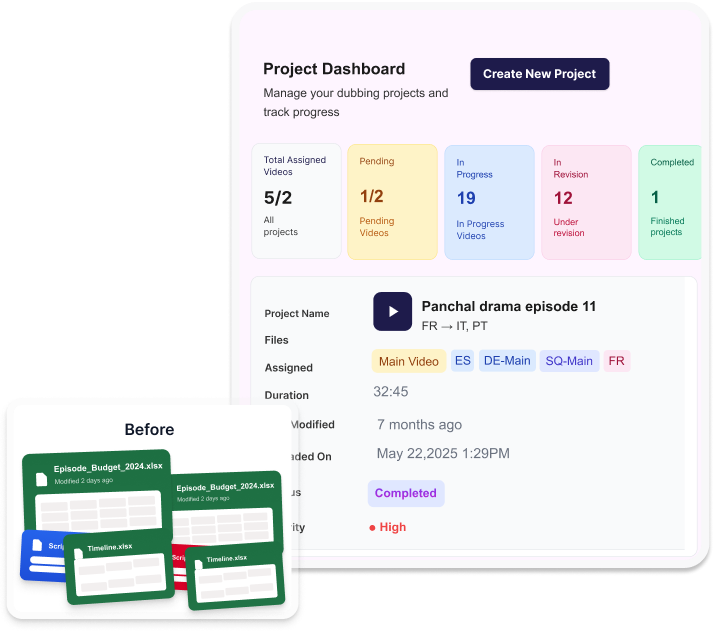
Series Management gives teams a single interface to manage the entire localization lifecycle across all episodes of a season. This includes a centralized terminology database that automatically applies across every episode, character voice assignments that persist throughout the series, batch processing controls for moving multiple episodes through the pipeline simultaneously, version control so changes can be tracked and reversed, and progress tracking across the full season rather than file by file.
This transforms series localization from a fragmented, episode-by-episode process into a scalable, repeatable system. Teams make decisions once, on terminology, on voice, on style, and those decisions propagate automatically across the entire series.
Hybrid AI and human QA
Echo9 does not treat AI automation as a replacement for human judgment. The platform is designed for a hybrid approach where AI handles volume and speed while human reviewers focus on nuanced decisions that require cultural expertise and editorial judgment.
AI handles initial transcription, translation, and voice generation. Human reviewers then assess cultural accuracy, emotional authenticity, and any dialogue that requires adaptation rather than direct translation. The result is localized content that is both fast and genuinely high quality.
The Business Case for Getting Episodic Localization Right
Series localization done well is not just a quality improvement. It has a direct impact on the metrics that matter to content businesses.
Faster global releases. With batch processing and a unified workflow, entire seasons can be released simultaneously across multiple regions rather than rolling out market by market weeks apart. Simultaneous global release is increasingly expected by international audiences and streaming platforms.
Lower production costs. Batch processing, voice reuse, and a shared terminology database eliminate the redundant work that makes traditional episodic localization expensive. Teams stop rebuilding the same assets from scratch for every episode.
Higher viewer engagement and retention. Consistent voices and terminology create a seamless viewing experience. Viewers who are not jarred by inconsistencies stay engaged longer. For subscription-based platforms and serialized training content, retention is directly tied to the quality of the localization experience.
Scalable international distribution. For content businesses expanding into new markets, series localization infrastructure is what makes scaling possible. Without it, every new market or new language adds proportional complexity. With it, each new season or new language adds incrementally less work than the last.
Real-World Scenario: Traditional Workflow vs. Echo9
Consider a streaming platform releasing a 10-episode drama series in five languages.
Using a traditional workflow, each episode is treated as a separate project. Different translators handle different episodes. Voice artists are cast informally per session. Terminology is not coordinated across episodes. QA happens at the end of each individual file. Total turnaround: 3 to 4 months, with inconsistencies that only become visible once the full season is reviewed together.
Now consider the same project managed through Echo9. The entire series is set up as a single project before Episode 1 enters the pipeline. Terminology is standardized upfront. Voice profiles are created once and reused automatically. Episodes move through transcription, translation, dubbing, and QA in batches. Human reviewers focus on cultural adaptation decisions rather than consistency checking, because consistency is handled by the system.
Total turnaround: weeks rather than months. And the output is consistent across every episode, in every language, from start to finish.
That gap, in time, cost, and quality, is what structured series localization is designed to close.
The Future of Series Localization
The demand for localized episodic content is growing rapidly. Global streaming subscription revenue reached over $157 billion in 2025, and the market is projected to reach $200 billion by 2030. International audiences are driving a significant portion of that growth, and content that is not localized well simply does not compete.
Streaming services already localize content into an average of six languages per title, with premium productions exceeding 12. Animation and episodic series alone account for nearly half of all global dubbing volume.
As this volume increases, localization cannot remain a manual or fragmented process. It has to evolve into infrastructure. The future of series localization will be defined by AI-driven automation, structured workflows, real-time collaboration, and scalable systems built for multi-language releases from the start.
Platforms that adopt this model now will be better positioned to expand globally without the growing pains that come from building localization infrastructure under pressure.
Conclusion
Episodic content has changed what localization needs to be. It is no longer a one-off task you hand off when a video is finished. It is an ongoing system that has to hold up across episodes, across seasons, and across languages.
Traditional workflows were not built for this. They treat every episode as a fresh start, which is exactly what causes the inconsistencies, delays, and rising costs that erode episodic localization quality over time.
Structured series localization, with centralized terminology, consistent voice mapping, batch processing, and scalable QA, is what makes global episodic distribution work.
Echo9 is built around this model. If you are managing serialized content and planning international distribution, it is time to stop treating localization as a one-off task and start treating it as the infrastructure it needs to be.
Ready to scale your series localization? Explore how Echo9’s Series Management handles episodic content from Episode 1 to season finale.
Frequently asked questions
1. What is episodic localization?
Episodic localization is the process of adapting multi-episode content, including TV series, training modules, web series, and documentary seasons, into different languages while maintaining consistency in terminology, voice, and tone across every episode in the series.
2. How is series localization different from translating a single video?
Single-video localization is a self-contained task. Series localization requires consistency across time: the same terminology, character voices, and style guidelines applied uniformly across every episode. Without structured systems, inconsistencies accumulate as the series grows.
3. Why do traditional localization workflows fail for episodic content?
Traditional workflows treat each asset as a separate project. This leads to inconsistent terminology when different translators work on different episodes, voice drift in dubbed characters, fragmented project management, and QA processes that cannot keep up with the volume of episodic content.
4. What does effective series localization require?
Effective series localization requires a centralized terminology database, consistent voice mapping for every character, batch processing to handle multiple episodes simultaneously, and a QA layer that checks consistency across episodes, not just within individual files.
5. What is Series Management in Echo9?
Series Management is Echo9’s core feature for episodic localization. It lets teams manage an entire season from a single interface, centralizing terminology, storing and reusing character voice profiles, batch processing episodes, and tracking progress across the full series rather than file by file.
6. Can AI handle large-scale series localization on its own?
AI handles volume, speed, and consistency tasks extremely well, including transcription, translation, voice generation, and terminology enforcement across episodes. The best results come from combining AI automation with human review for cultural accuracy and emotional nuance. This is the hybrid model Echo9 is built around.
7. How does consistent voice mapping improve viewer experience?
When audiences watch a series, they build familiarity with how characters sound. Voice inconsistency between episodes is jarring. It signals a production quality issue and reduces trust in the content. Consistent voice mapping means viewers hear the same character identity in Episode 10 that they heard in Episode 1, regardless of how many languages the series has been dubbed into.
8. What types of content benefit most from episodic localization?
Any content structured in episodes or modules benefits from series localization: streaming drama and comedy series, animated shows, documentary seasons, corporate training programs, online courses, and branded content series. The longer and more interconnected the content, the more important consistent series localization becomes.