Dubbed content used to be easy to spot on sight. The audio didn’t match the mouth. Lines ran long after the actor stopped talking, or cut off mid-sentence while lips kept moving. That mismatch is called lip sync error, and for decades it was simply accepted as the cost of translating video into another language. AI lip sync dubbing is the technology built to close that gap. It’s the reason a growing share of dubbed content, from independent YouTube channels to full television seasons, is starting to look and sound native in every language it releases in. What AI Lip Sync Dubbing Actually Means AI lip sync dubbing generates translated, AI-voiced dialogue that is timed, and in some implementations visually adjusted, to match the original speaker’s mouth movements. It combines several systems working together: That last step is what separates true AI lip sync dubbing from standard AI dubbing. Standard dubbing replaces the audio track and times it closely to the original. Lip sync dubbing treats mouth movement as something that can also be adjusted. Why Timing Is the Hard Part Languages are not the same length. A sentence that takes four seconds to say in English might take five and a half seconds in Spanish, or three in Mandarin. Traditional dubbing studios solve this with script adaptation: a human translator rewrites the line so it fits the available time, sometimes adjusting the meaning slightly to preserve the rhythm. AI systems approach the same problem computationally. The platform generates multiple phrasings of a translated line, scores them against the target duration, and selects or blends the version that fits best. Many platforms also apply small speed adjustments to the generated audio itself, similar to how audiobook narration can be sped up without sounding unnatural as long as the adjustment stays within a narrow range. What Good Lip Sync Looks Like at Scale For a single video, the difference between good and bad lip sync dubbing is whether a viewer forgets they’re watching a dub at all. For episodic content, it’s a production requirement, not a nice-to-have. A 40-episode series with visible sync drift in every episode reads as low-budget regardless of how strong the translation is. Platforms also differ in what they optimize for. Some focus purely on audio-to-video timing, matching pause length and sentence boundaries. Others also apply visual lip re-timing frame by frame. The right choice depends on the content: a talking-head interview rarely needs visual adjustment, while a close-up dialogue scene in a drama benefits from it substantially. How Echo9’s Rephrase-Fit Engine Solves Lip Sync Without Speeding Up Audio Most AI dubbing platforms handle a timing mismatch the same way: they speed up or slow down the generated audio until it fits the original clip length. An estimated 75 to 80 percent of dubbing platforms rely on this shortcut, and it’s the kind of fix a viewer feels even when the adjustment is small, because sped-up speech carries a subtly different pitch and rhythm than natural delivery. Echo9’s Rephrase-Fit Engine takes a different approach: instead of stretching the audio, it rewrites the translated line itself so the spoken version fits the source duration exactly, with no speed change and no words cut to save time. A 3.2-second line in one language that would naturally run 4.8 seconds in another gets rephrased, not sped up, until it lands in the same window as the original. The system also removes the manual hunting that timing review normally requires. Every segment more than 200 milliseconds out of sync is flagged automatically, and for each flagged line Rephrase-Fit generates three separate timing-fit rewrites rather than committing to a single version, so an editor picks whichever option sounds most natural instead of accepting the platform’s one guess. It handles overlapping dialogue the same way, timing each speaker independently so a scene’s natural back-and-forth stays intact instead of getting flattened into non-overlapping lines. For episodic content, this matters at a different scale than a single video. A season can generate thousands of lines with a potential timing mismatch, and rewriting each one by hand is exactly the kind of script adaptation work that makes traditional dubbing studios slow and expensive per episode. Automating that rewrite decision, with a human still picking the final option, is what lets lip sync quality hold up across a full season instead of degrading as the episode count grows. Common Lip Sync Failure Patterns to Watch For Not every sync problem looks the same, and knowing the specific patterns helps you spot them faster in a review pass instead of relying on a vague sense that “something feels off.” Reviewing footage specifically for these five patterns, rather than watching for a general impression of quality, turns lip sync evaluation from a subjective judgment into a checklist a production team can apply consistently. Where AI Still Needs a Human Check AI lip sync dubbing has closed most of the gap with traditional dubbing, but it isn’t fully hands-off. The parts that still benefit from human review include: This is why the strongest production workflows pair AI generation with a structured human review pass rather than treating either AI-only or human-only dubbing as the default. Our breakdown of how AI is transforming video localization covers what that hybrid workflow looks like in practice. How Lip Sync Fits Into the Broader Dubbing Decision Lip sync quality doesn’t exist in isolation. It’s one of three things worth evaluating together whenever you’re choosing a dubbing approach: how natural the generated voice sounds, how accurate the translation and terminology are, and how well the timing holds up. A platform can excel at one of these and fall short on another, which is why it’s worth testing lip sync specifically rather than assuming a platform that translates well will automatically sync well too. If you’re building an evaluation process for your own content, our guide on evaluating AI dubbing quality walks through all three dimensions with a scoring framework you can apply directly. Budget
Table of Contents
Dubbed content used to be easy to spot on sight. The audio didn’t match the mouth. Lines ran long after the actor stopped talking, or cut off mid-sentence while lips kept moving. That mismatch is called lip sync error, and for decades it was simply accepted as the cost of translating video into another language.
AI lip sync dubbing is the technology built to close that gap. It’s the reason a growing share of dubbed content, from independent YouTube channels to full television seasons, is starting to look and sound native in every language it releases in.
What AI Lip Sync Dubbing Actually Means
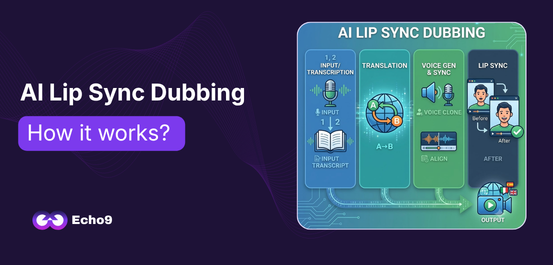
AI lip sync dubbing generates translated, AI-voiced dialogue that is timed, and in some implementations visually adjusted, to match the original speaker’s mouth movements. It combines several systems working together:
Speech recognition transcribes the original dialogue.
Translation converts that transcript into the target language, adjusted for length and phrasing rather than a literal word-for-word conversion.
Voice generation, using voice cloning when the goal is to preserve the original speaker’s identity, produces the new dialogue.
Time alignment stretches, compresses, or re-paces the generated audio so it fits the scene.
In more advanced systems, visual re-timing subtly adjusts the speaker’s mouth movements in the video itself, closing the gap from both directions instead of audio alone.
That last step is what separates true AI lip sync dubbing from standard AI dubbing. Standard dubbing replaces the audio track and times it closely to the original. Lip sync dubbing treats mouth movement as something that can also be adjusted.
Why Timing Is the Hard Part
Languages are not the same length. A sentence that takes four seconds to say in English might take five and a half seconds in Spanish, or three in Mandarin. Traditional dubbing studios solve this with script adaptation: a human translator rewrites the line so it fits the available time, sometimes adjusting the meaning slightly to preserve the rhythm.
AI systems approach the same problem computationally. The platform generates multiple phrasings of a translated line, scores them against the target duration, and selects or blends the version that fits best. Many platforms also apply small speed adjustments to the generated audio itself, similar to how audiobook narration can be sped up without sounding unnatural as long as the adjustment stays within a narrow range.
What Good Lip Sync Looks Like at Scale
For a single video, the difference between good and bad lip sync dubbing is whether a viewer forgets they’re watching a dub at all. For episodic content, it’s a production requirement, not a nice-to-have. A 40-episode series with visible sync drift in every episode reads as low-budget regardless of how strong the translation is.
Platforms also differ in what they optimize for. Some focus purely on audio-to-video timing, matching pause length and sentence boundaries. Others also apply visual lip re-timing frame by frame. The right choice depends on the content: a talking-head interview rarely needs visual adjustment, while a close-up dialogue scene in a drama benefits from it substantially.
How Echo9’s Rephrase-Fit Engine Solves Lip Sync Without Speeding Up Audio
Most AI dubbing platforms handle a timing mismatch the same way: they speed up or slow down the generated audio until it fits the original clip length. An estimated 75 to 80 percent of dubbing platforms rely on this shortcut, and it’s the kind of fix a viewer feels even when the adjustment is small, because sped-up speech carries a subtly different pitch and rhythm than natural delivery.
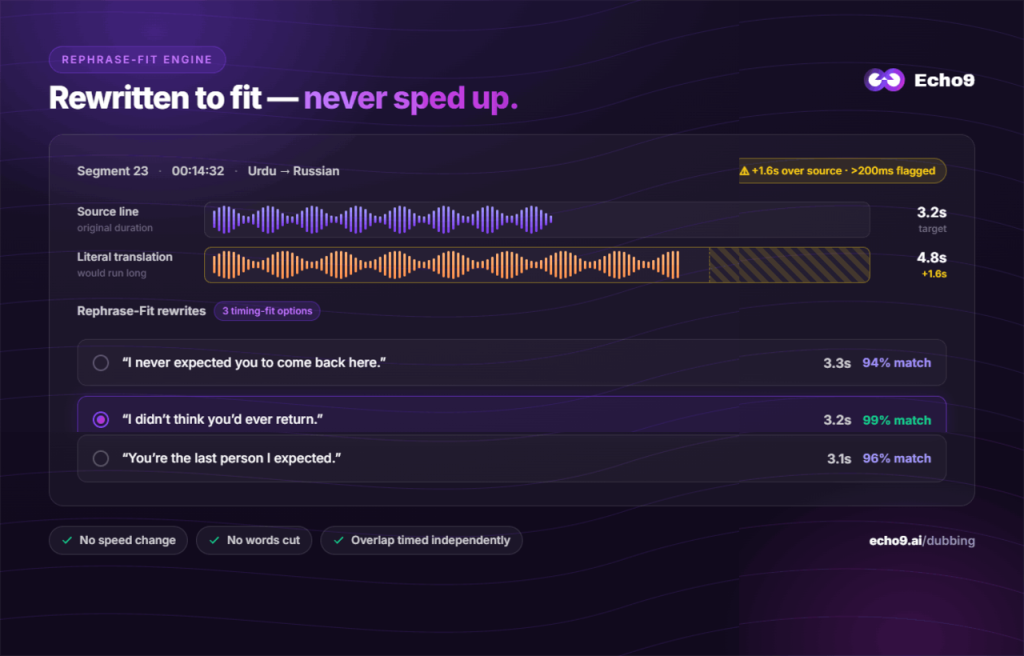
Echo9’s Rephrase-Fit Engine takes a different approach: instead of stretching the audio, it rewrites the translated line itself so the spoken version fits the source duration exactly, with no speed change and no words cut to save time. A 3.2-second line in one language that would naturally run 4.8 seconds in another gets rephrased, not sped up, until it lands in the same window as the original.
The system also removes the manual hunting that timing review normally requires. Every segment more than 200 milliseconds out of sync is flagged automatically, and for each flagged line Rephrase-Fit generates three separate timing-fit rewrites rather than committing to a single version, so an editor picks whichever option sounds most natural instead of accepting the platform’s one guess. It handles overlapping dialogue the same way, timing each speaker independently so a scene’s natural back-and-forth stays intact instead of getting flattened into non-overlapping lines.
For episodic content, this matters at a different scale than a single video. A season can generate thousands of lines with a potential timing mismatch, and rewriting each one by hand is exactly the kind of script adaptation work that makes traditional dubbing studios slow and expensive per episode. Automating that rewrite decision, with a human still picking the final option, is what lets lip sync quality hold up across a full season instead of degrading as the episode count grows.
Common Lip Sync Failure Patterns to Watch For
Not every sync problem looks the same, and knowing the specific patterns helps you spot them faster in a review pass instead of relying on a vague sense that “something feels off.”
Early cutoff. The dubbed line finishes talking while the on-screen mouth is still moving, usually because the translated phrasing was shorter than the original and nothing filled the gap.
Trailing overrun. The audio keeps going after the scene has already cut away, which happens when a translated line ran longer than the available time and wasn’t compressed enough.
Static-mouth syndrome. In platforms without visual re-timing, a close-up shot holds on a closed or unmoving mouth while dialogue plays, breaking immersion immediately even if the audio itself sounds natural.
Drift across a scene. Individual lines sync fine in isolation, but small timing errors accumulate across a long back-and-forth exchange until the last few lines feel noticeably off.
Inconsistent pacing between episodes. The same show syncs well in episode 3 and poorly in episode 4, usually a sign the platform is processing each episode independently rather than applying a consistent timing model across the series.
Reviewing footage specifically for these five patterns, rather than watching for a general impression of quality, turns lip sync evaluation from a subjective judgment into a checklist a production team can apply consistently.
Where AI Still Needs a Human Check
AI lip sync dubbing has closed most of the gap with traditional dubbing, but it isn’t fully hands-off. The parts that still benefit from human review include:
Emotional delivery. AI voice generation handles natural pacing well, but a line that needs to land as sarcastic, urgent, or grieving still benefits from a human listen-through.
Idiom and cultural adaptation. A literal translation can be perfectly timed and still sound wrong to a native speaker.
Character consistency across episodes. Making sure the same character sounds like themselves in episode 14 as they did in episode 1.
This is why the strongest production workflows pair AI generation with a structured human review pass rather than treating either AI-only or human-only dubbing as the default. Our breakdown of how AI is transforming video localization covers what that hybrid workflow looks like in practice.
How Lip Sync Fits Into the Broader Dubbing Decision
Lip sync quality doesn’t exist in isolation. It’s one of three things worth evaluating together whenever you’re choosing a dubbing approach: how natural the generated voice sounds, how accurate the translation and terminology are, and how well the timing holds up. A platform can excel at one of these and fall short on another, which is why it’s worth testing lip sync specifically rather than assuming a platform that translates well will automatically sync well too. If you’re building an evaluation process for your own content, our guide on evaluating AI dubbing quality walks through all three dimensions with a scoring framework you can apply directly.
Budget is the other variable that shapes which approach makes sense. Traditional studio dubbing solves timing through script adaptation done by a human translator, which is reliable but slow and expensive at scale. AI lip sync dubbing solves the same problem computationally, which is faster and dramatically cheaper per episode, but depends on the platform’s timing model actually holding up across a full series rather than just a demo clip.
Is AI Lip Sync Dubbing Good Enough Yet?
For most content types, YouTube, e-learning, corporate video, and increasingly broadcast and OTT series, yes, with human review built into the workflow. YouTube’s own data on multi-language audio makes the upside concrete: creators using the feature see over 25% of their total watch time come from viewers watching in a non-primary language, and creators like Mark Rober now publish dubs in more than 30 languages per video.
For content where a single frame of visible mismatch would get noticed by a large, attentive audience, a theatrical release or a flagship series premiere, most studios still budget for a closer human pass before final delivery. The practical test isn’t whether AI can do this alone. It’s whether AI plus lighter human review reaches the quality bar the traditional process met, at a fraction of the cost and time. For episodic content specifically, that math increasingly favors the AI-plus-review model, which is a large part of why OTT platforms are turning to AI dubbing at the rate they are.
Questions to Ask a Platform About Lip Sync Specifically
Most AI dubbing demos are built around a single clean clip, which makes it hard to tell from a sales call alone whether lip sync quality will hold up on your content. These five questions surface the gaps a demo won’t:
Does the platform re-time audio only, or does it also adjust mouth movement visually? Audio-only timing is cheaper and faster; visual re-timing is more immersive but not every platform offers it.
How does the platform handle a language pair where the translated line runs significantly longer or shorter than the original? Ask for an example, not just a description.
Does timing quality stay consistent from episode 1 to episode 40 of the same series, or does each episode get processed independently? This is the question that separates tools built for single videos from tools built for series.
What happens with fast, overlapping dialogue? Ask to see a scene with two speakers talking over each other, not just a clean monologue.
Can you test with your own footage before committing, rather than relying on a demo reel? A platform confident in its lip sync quality should have no problem with this.
Asking these five questions before signing a contract, rather than after the first batch of episodes comes back with visible sync issues, is the cheapest quality control step available.
FAQs
What is AI lip sync dubbing?
AI lip sync dubbing is AI-generated, translated dialogue that is timed, and in some platforms visually adjusted, to match the original speaker’s mouth movements, so the dubbed version looks and sounds native rather than obviously translated.
How is AI lip sync dubbing different from regular AI dubbing?
Standard AI dubbing replaces the audio track and times it closely to the original scene. Lip sync dubbing goes further by also adjusting how the speaker’s mouth moves in the video itself, closing the gap from both the audio and the visual side.
Why is timing harder than translation in dubbing?
Languages take different amounts of time to say the same idea. A line that’s four seconds in English might need five and a half seconds in Spanish. Fitting a translated line into the original’s timing without changing its meaning is the core technical challenge.
Does AI lip sync dubbing work for episodic content?
Yes, and it’s arguably where it matters most. A single video can hide minor sync issues; a 40-episode series can’t. Platforms built with series-level management, like Echo9, keep voice, timing, and terminology consistent across every episode rather than re-solving the problem per video.
Do I still need human reviewers with AI lip sync dubbing?
For most professional and broadcast-facing content, yes. AI handles pacing and timing very well, but emotional delivery, idiom adaptation, and cross-episode character consistency still benefit from a human review pass.
Can AI lip sync dubbing maintain the same voice across a full season?
Yes, when the platform defines voices at the project level rather than treating each upload as a fresh job. Echo9 sets each character’s voice once during project and season setup, and that choice applies automatically across every episode in the season.
Is AI lip sync dubbing good enough for a theatrical release?
For most digital-first content, current AI lip sync dubbing meets or exceeds the quality bar with human review included. For theatrical releases and flagship premieres where a single visible mismatch would be widely noticed, many studios still add a closer human pass before final delivery.