
Edit Template

TTS vs Voice Cloning vs AI Dubbing: What’s the Difference?

TTS vs Voice Cloning vs AI Dubbing, these three terms get used interchangeably in casual conversation, and that’s a problem, because they describe genuinely different technologies solving different problems. If you’re evaluating tools for translating and voicing video content, knowing the difference will save you from buying the wrong thing. Text-to-Speech: Text In, Generic Voice Out Text-to-speech converts written text into spoken audio using a synthetic voice. That voice can range from clearly robotic, in older TTS systems, to highly natural-sounding in modern neural TTS, but it’s a generic voice, not a recreation of any specific person. TTS powers screen readers, GPS navigation, and IVR phone systems. It’s built for clarity and consistency, not for sounding like a particular person. If you need audio narration and don’t care whose voice it is, TTS alone is often sufficient and is the cheapest, fastest option available. What it can’t do: make the output sound like your host, your brand’s voice actor, or the original speaker in a video you’re translating. Voice Cloning: A Specific Voice, On Demand Voice cloning takes a sample of a real person’s voice, sometimes just a few seconds to a few minutes of audio, and creates an AI model that can generate new speech in that same voice, saying things the person never actually said. This is a meaningfully different technology from generic TTS. Where TTS answers “how do I turn text into spoken audio,” voice cloning answers “how do I get a specific voice to say new things.” See our full explainer on how voice cloning works for the technical detail. Voice cloning is the piece that makes it possible for a character’s voice to stay the same across 50 episodes, or for a course instructor’s voice to narrate lessons they never personally recorded, in Spanish or Hindi. What it can’t do on its own: decide what to say, translate content, or time output to match a video. It generates the voice; something else has to generate the words and the timing. AI Dubbing: The Full Pipeline AI dubbing is the complete system that takes a video in one language and produces a version in another, using both of the technologies above as components rather than as substitutes for each other: So the relationship isn’t three competing options; it’s closer to ingredients versus the finished dish. AI dubbing is the dish. TTS and voice cloning are two different ingredients for the voice component, depending on whether preserving the original speaker’s identity matters. A Quick Look at How Each Is Actually Built The technical distinction matters because it explains why you can’t substitute one for another, not just that you shouldn’t. Generic TTS systems are trained on large datasets of many different speakers, which is exactly why the output sounds competent but generic. The model learns what speech in general sounds like, not what any one person specifically sounds like. Voice cloning systems work differently. They take that same general speech model and adapt it using a sample of one specific person’s voice, sometimes just seconds of audio, to shift the output toward that individual’s vocal characteristics: pitch, tone, accent, and speaking style. The better the reference sample and the more the system has been refined for this task, the closer the cloned output gets to the source voice. AI dubbing pipelines sit on top of both. They add speech recognition to transcribe the source audio, a translation layer that adjusts for length and phrasing rather than translating word for word, and a timing layer that fits whichever voice output, cloned or generic, into the original video’s pacing. None of these layers substitute for the others; a pipeline missing any one of them can’t produce a finished dubbed video on its own. When You Actually Need Which Your situation What you need Narrating a script with no specific voice requirement Generic TTS Getting a specific voice actor’s voice to narrate new content they didn’t record Voice cloning alone Translating an existing video while keeping the same speaker’s voice AI dubbing, using voice cloning as the voice component Translating an existing video where a generic voice is acceptable AI dubbing, using TTS as the voice component Localizing a 40-episode series where character voice must stay consistent AI dubbing with voice cloning plus series-level consistency management Why This Distinction Matters Most for Series Content A single translated video only needs the voice component to sound good once. A series needs it to sound the same, correctly, across every episode a character appears in, potentially for multiple seasons. That’s a different engineering problem than generating one clean line of dialogue, and it’s why Echo9 is built around Series Management rather than treating each episode as an independent job: each character’s voice profile is locked in once, and Terminology Control keeps names and phrasing from drifting as new episodes are added, so decisions made in episode 1 still hold in episode 40. What This Means for Your Budget Cost structures differ across these three categories in ways that matter once you’re planning at scale rather than testing a single clip. Generic TTS is typically the cheapest option because it doesn’t require building or maintaining a voice model tied to a specific person. Voice cloning adds cost for the modeling step itself, though that cost is usually paid once per voice rather than per use. Full AI dubbing pipelines price per minute of finished output because they’re doing the most work: transcription, translation, voice generation, and timing all happen for every minute of content processed. For a single video, these cost differences are often small enough not to matter much. For a content library measured in hundreds of episodes, understanding which layer you’re actually paying for helps you evaluate whether a platform’s pricing reflects the full pipeline or just one component of it, which is easy to miss when comparing headline per-minute rates across different tools. Why This Matters When Buying Software Some tools brand themselves primarily as “AI voice” or “text-to-speech”
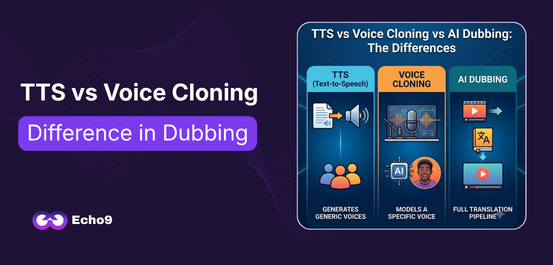
Table of Contents

TTS vs Voice Cloning vs AI Dubbing, these three terms get used interchangeably in casual conversation, and that’s a problem, because they describe genuinely different technologies solving different problems. If you’re evaluating tools for translating and voicing video content, knowing the difference will save you from buying the wrong thing.

Text-to-Speech: Text In, Generic Voice Out

Text-to-speech converts written text into spoken audio using a synthetic voice. That voice can range from clearly robotic, in older TTS systems, to highly natural-sounding in modern neural TTS, but it’s a generic voice, not a recreation of any specific person.

TTS powers screen readers, GPS navigation, and IVR phone systems. It’s built for clarity and consistency, not for sounding like a particular person. If you need audio narration and don’t care whose voice it is, TTS alone is often sufficient and is the cheapest, fastest option available.

What it can’t do: make the output sound like your host, your brand’s voice actor, or the original speaker in a video you’re translating.

Voice Cloning: A Specific Voice, On Demand

Voice cloning takes a sample of a real person’s voice, sometimes just a few seconds to a few minutes of audio, and creates an AI model that can generate new speech in that same voice, saying things the person never actually said.

This is a meaningfully different technology from generic TTS. Where TTS answers “how do I turn text into spoken audio,” voice cloning answers “how do I get a specific voice to say new things.” See our full explainer on how voice cloning works for the technical detail.

Voice cloning is the piece that makes it possible for a character’s voice to stay the same across 50 episodes, or for a course instructor’s voice to narrate lessons they never personally recorded, in Spanish or Hindi.

What it can’t do on its own: decide what to say, translate content, or time output to match a video. It generates the voice; something else has to generate the words and the timing.

AI Dubbing: The Full Pipeline

AI dubbing is the complete system that takes a video in one language and produces a version in another, using both of the technologies above as components rather than as substitutes for each other:

  1. Transcribe the original audio.
  2. Translate the transcript, adjusted for natural phrasing and timing rather than a literal word-for-word conversion.
  3. Generate the new-language audio, using voice cloning if the goal is to preserve the original speaker’s voice, or generic TTS if a stock voice is acceptable.
  4. Time-align the generated audio, and in advanced implementations adjust lip movement, to match the original video. See our breakdown of AI lip sync dubbing for how that step works.

So the relationship isn’t three competing options; it’s closer to ingredients versus the finished dish. AI dubbing is the dish. TTS and voice cloning are two different ingredients for the voice component, depending on whether preserving the original speaker’s identity matters.

A Quick Look at How Each Is Actually Built

The technical distinction matters because it explains why you can’t substitute one for another, not just that you shouldn’t.

Generic TTS systems are trained on large datasets of many different speakers, which is exactly why the output sounds competent but generic. The model learns what speech in general sounds like, not what any one person specifically sounds like.

Voice cloning systems work differently. They take that same general speech model and adapt it using a sample of one specific person’s voice, sometimes just seconds of audio, to shift the output toward that individual’s vocal characteristics: pitch, tone, accent, and speaking style. The better the reference sample and the more the system has been refined for this task, the closer the cloned output gets to the source voice.

AI dubbing pipelines sit on top of both. They add speech recognition to transcribe the source audio, a translation layer that adjusts for length and phrasing rather than translating word for word, and a timing layer that fits whichever voice output, cloned or generic, into the original video’s pacing. None of these layers substitute for the others; a pipeline missing any one of them can’t produce a finished dubbed video on its own.

When You Actually Need Which

Your situationWhat you need
Narrating a script with no specific voice requirementGeneric TTS
Getting a specific voice actor’s voice to narrate new content they didn’t recordVoice cloning alone
Translating an existing video while keeping the same speaker’s voiceAI dubbing, using voice cloning as the voice component
Translating an existing video where a generic voice is acceptableAI dubbing, using TTS as the voice component
Localizing a 40-episode series where character voice must stay consistentAI dubbing with voice cloning plus series-level consistency management

Why This Distinction Matters Most for Series Content

A single translated video only needs the voice component to sound good once. A series needs it to sound the same, correctly, across every episode a character appears in, potentially for multiple seasons. That’s a different engineering problem than generating one clean line of dialogue, and it’s why Echo9 is built around Series Management rather than treating each episode as an independent job: each character’s voice profile is locked in once, and Terminology Control keeps names and phrasing from drifting as new episodes are added, so decisions made in episode 1 still hold in episode 40.

What This Means for Your Budget

Cost structures differ across these three categories in ways that matter once you’re planning at scale rather than testing a single clip. Generic TTS is typically the cheapest option because it doesn’t require building or maintaining a voice model tied to a specific person. Voice cloning adds cost for the modeling step itself, though that cost is usually paid once per voice rather than per use. Full AI dubbing pipelines price per minute of finished output because they’re doing the most work: transcription, translation, voice generation, and timing all happen for every minute of content processed.

For a single video, these cost differences are often small enough not to matter much. For a content library measured in hundreds of episodes, understanding which layer you’re actually paying for helps you evaluate whether a platform’s pricing reflects the full pipeline or just one component of it, which is easy to miss when comparing headline per-minute rates across different tools.

Why This Matters When Buying Software

Some tools brand themselves primarily as “AI voice” or “text-to-speech” platforms and can technically be used for dubbing by combining them with separate translation and timing steps manually. Others are built as an end-to-end AI dubbing pipeline specifically for episodic content, where translation, voice cloning, timing, and terminology consistency across episodes are handled as one connected workflow rather than three separate tools stitched together by hand.

If you’re mainly comparing point solutions, it’s worth checking whether a tool does the full pipeline or just one piece of it; our types of video localization guide breaks down where each approach fits, and creators specifically localizing for YouTube can see this in practice in our guide to localizing YouTube content for global markets. YouTube’s own data shows creators using multi-language audio see over 25% of total watch time come from viewers in a non-primary language, which is the upside a complete pipeline is built to capture.

Product Spotlight

See the Full Pipeline Built for Series

Echo9 handles transcription, translation, and voice generation in one workflow, with Series Management keeping every character consistent.

See Echo9’s pricing and start today ↗
SM

A Simple Way to Decide Which You Need

If you’re still unsure which category fits your project, three questions in sequence usually settle it:

  1. Do I already have source video in another language that needs translating? If no, you don’t need AI dubbing at all; you need TTS or voice cloning alone, depending on question 2. If yes, move to AI dubbing, using either TTS or voice cloning as its voice component.
  2. Does it matter whose voice the audience hears? If no, generic TTS is enough. If yes, you need voice cloning, either alone or as part of an AI dubbing pipeline.
  3. Will this run across multiple episodes or a growing content library? If yes, the voice and terminology consistency requirements mean you need series-level management on top of voice cloning, not just a one-off cloned voice.

Most buying mistakes in this category come from skipping straight to a specific tool without answering these three questions first, then discovering the tool solves a different problem than the one that actually needs solving.

FAQs

What’s the difference between TTS and voice cloning?

TTS generates speech in a generic synthetic voice from text. Voice cloning creates an AI model of one specific real person’s voice so it can generate new speech that sounds like them. TTS answers “how do I get any spoken audio,” voice cloning answers “how do I get this specific voice to say something new.”

Is AI dubbing the same as voice cloning?

No. Voice cloning is one component AI dubbing can use for the voice output. AI dubbing is the full pipeline: transcription, translation, voice generation, and timing alignment to a video. Voice cloning alone doesn’t translate or time anything.

Can I use TTS for dubbing a video?

Only as one part of a larger process. TTS alone doesn’t translate the original dialogue or time the output to the video. Combined with translation and timing steps, either manually or inside an AI dubbing platform, TTS can serve as the voice component when a generic voice is acceptable.

Do I need voice cloning if I don’t care about preserving the original speaker’s voice?

No. If a generic voice is fine for your content, TTS-based AI dubbing is faster and cheaper. Voice cloning matters specifically when the audience needs to hear the same speaker or character, not just any competent voice.

Why does voice cloning matter more for series content than single videos?

A single video only needs its voice to sound good once. A series needs the same character to sound like themselves across every episode, sometimes across multiple seasons. Voice cloning tied to series-level management is what keeps that consistent instead of re-solving it per episode.

How do I know if a tool does full AI dubbing versus just one piece of it?

Check whether it handles translation and video timing natively, or whether you’d need to combine it with separate translation and syncing tools. Platforms built specifically for dubbing, rather than general-purpose AI voice tools, typically handle the full pipeline in one workflow.

Next Step

Get More Comparisons Like This in Your Inbox

Sign up for the Echo9 blog newsletter for more explainers on AI dubbing technology and terminology.

Subscribe to the Blog Newsletter →