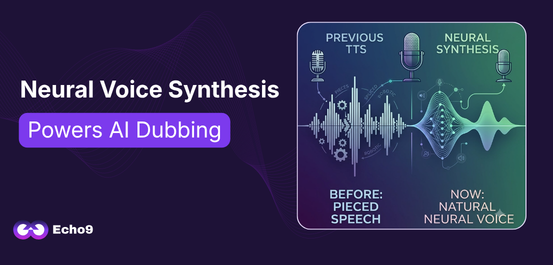
Every AI dubbing platform depends on one core technology to generate the voice you actually hear: neural voice synthesis. It’s the reason a dubbed voice today can sound like a real person pausing, breathing, and shifting tone mid-sentence, instead of the flat, evenly metered speech that used to be the giveaway sign of machine-generated audio. Understanding how neural voice synthesis actually works, rather than treating it as an unexplainable black box, makes it much easier to evaluate whether a given AI dubbing platform’s output will hold up on your content, not just on a polished demo clip. What Neural Voice Synthesis Actually Is Neural voice synthesis is speech generation powered by deep neural networks trained on large datasets of recorded human speech. Instead of playing back or recombining pre-recorded audio clips, the model learns statistical patterns in how humans produce sound, then generates new audio, sample by sample or frame by frame, that follows those learned patterns. This is a meaningfully different approach than voice cloning required a decade ago, when older systems recorded a voice actor saying thousands of short phrases, then reassembled new sentences by splicing those fragments together. The results were intelligible but often sounded stitched together, with audible seams where fragments joined. Neural synthesis removes that seam entirely because it isn’t assembling anything; it’s generating a continuous waveform from a learned model of speech itself. How the Technology Actually Works Neural voice synthesis breaks down into three connected stages, and understanding each one explains why some systems sound more natural than others. Each stage introduces its own quality ceiling. A weak acoustic model produces flat, monotone speech regardless of how good the vocoder is. A weak vocoder introduces buzzing or metallic artifacts even when the underlying prosody prediction is excellent. Evaluating a platform’s voice quality means recognizing that both stages have to perform well together, not just one of them. From Old TTS to Neural Synthesis: What Actually Changed Before neural approaches became standard, most commercial text-to-speech systems used one of two methods. Concatenative synthesis recorded a voice actor reading an enormous script covering nearly every sound combination in a language, then stitched together the closest matching fragments for new sentences. Formant synthesis generated speech algorithmically from acoustic rules without any recorded human voice at all, which made it flexible but distinctly robotic. Both approaches hit a hard ceiling on naturalness because neither one modeled speech as a continuous, learnable pattern. Concatenative systems could only sound as natural as their fragment library allowed, and any sentence structure the original recording script didn’t anticipate would produce awkward joins. Formant systems never sounded human because they weren’t built from human recordings in the first place. The shift became concrete with models like WaveNet, which showed a neural network generating raw audio waveforms directly could sound dramatically more natural than either older method. Neural models solve this differently. Because they learn statistical patterns directly from real speech data rather than working from a fixed fragment library or a fixed rule set, they can generate prosody, pacing, and pitch variation for sentence structures they’ve never seen before, extending naturally to new content rather than being limited to a pre-recorded phrase bank. That’s a structural difference, not just an incremental improvement in audio quality. How Echo9 Keeps Voice Delivery Consistent Across a Series Neural voice synthesis only solves half the problem for episodic content. Generating one natural-sounding line is one thing; making sure a character’s voice, pacing, and delivery stay consistent across dozens of episodes and multiple seasons is a separate engineering challenge, and it’s the one most single-video tools aren’t built to solve. Echo9’s Series Management locks each character’s chosen voice profile to the project once, so every batch-processed episode automatically pulls from the same locked profile instead of the platform re-generating a slightly different approximation from scratch each time. Combined with Terminology Control keeping names and phrasing consistent, the result is a character who sounds like themselves in episode 40 the same way they did in episode 1, which is a much harder engineering problem than generating one good line of dialogue. Book a Consultation Bring us your hardest scene. Send one episode and one target language. We walk you through the output, line by line, with your team on the call. Book a ConsultationStart a Free Trial 30 minutes · with an engineer, not a sales pitch On the call A real scene from your catalogue, dubbed end to end Timing, emotion and lip-sync reviewed against the source Cost and turnaround modelled on your episode volume Your QA checklist, run against the output Why This Matters More for Dubbing Than for Generic TTS A voice assistant or GPS narration only needs to sound clear and pleasant. Dubbing has a harder requirement: the generated voice has to convincingly stand in for a specific person’s performance, often carrying emotional weight, timing constraints tied to the original video, and consistency demands across hours of content. This is why the quality bar for AI dubbing sits above the quality bar for general-purpose TTS. A synthesis model that sounds perfectly natural reading a weather report can still fall short reproducing a specific actor’s cadence across an emotional scene, because the task has shifted from “sound like a competent generic speaker” to “sound like this exact person, under these exact circumstances.” Where Neural Synthesis Still Falls Short Neural voice synthesis has closed most of the gap with human speech, but it isn’t uniformly solved across every use case. The failure points worth knowing before evaluating a platform: None of these are reasons to dismiss neural synthesis as unreliable. They’re reasons to test a platform against your actual content, including the hard cases, rather than assuming a strong demo clip generalizes automatically. How This Fits Into Evaluating an AI Dubbing Platform Neural voice synthesis quality is one input into the broader question of whether an AI dubbing platform is ready for production use, alongside translation accuracy and timing. A model can generate a beautifully