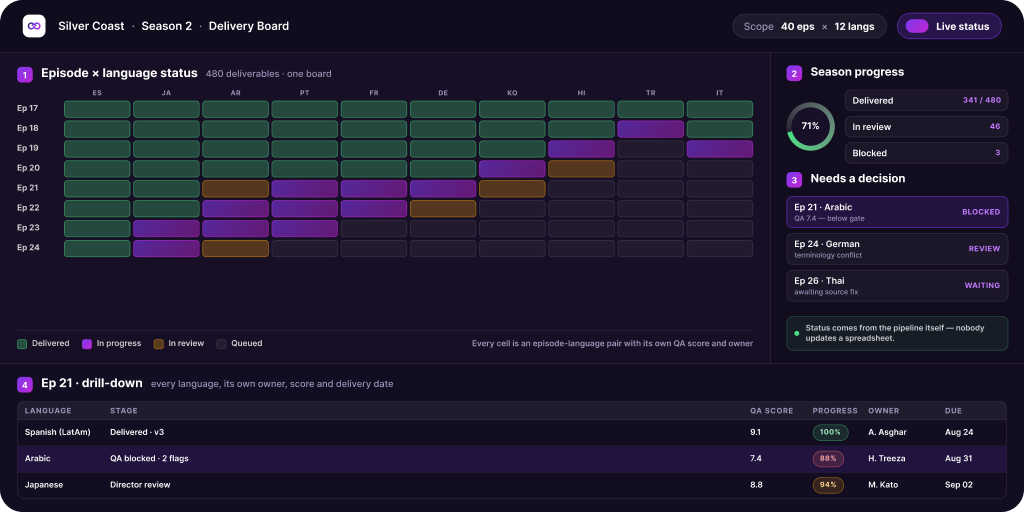
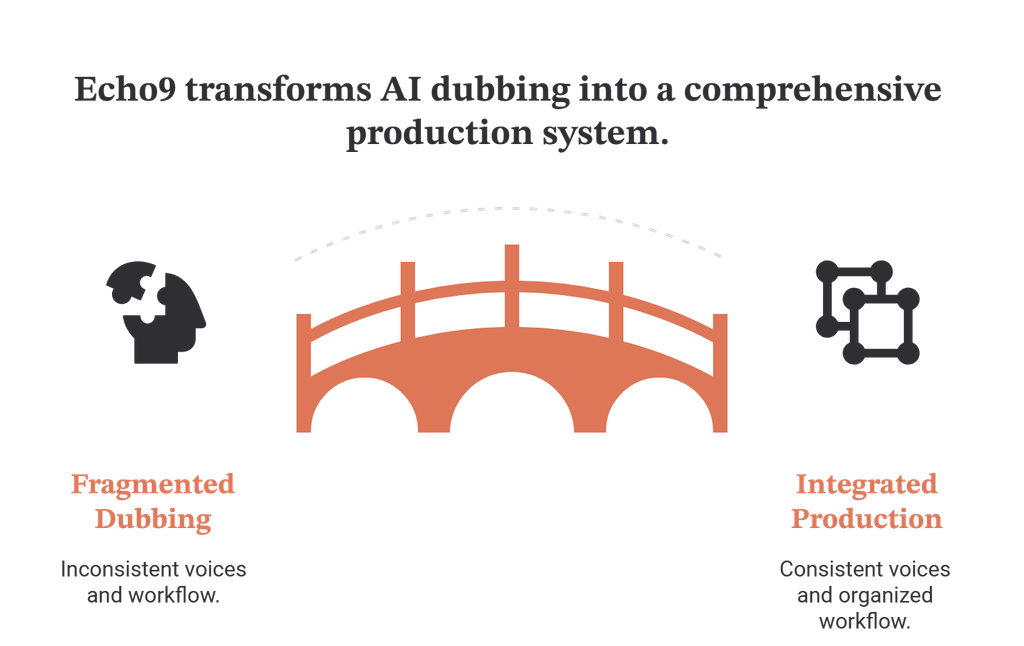
A hit series can travel across borders. Its localization often cannot move that fast. For OTT platforms, every new market means more dubbing, subtitles, reviews, versions, and delivery work. Multiply that across entire seasons and growing catalogs, and localization can quickly become a bottleneck. AI dubbing is changing that. It can accelerate the repetitive parts of localization while human teams focus on context, cultural accuracy, and quality. The bigger opportunity is not just faster voice production. It is building a scalable localization operation that can keep up with global content distribution. Localization Is Becoming an OTT Growth Lever For an OTT platform, localization determines how much of its catalog can actually reach international audiences. A platform may already have hundreds of hours of content that could perform well in another market. The challenge is preparing that content for local audiences without creating an equally large operational burden. Modern AI video localization can automate parts of transcription, translation, dubbing, subtitling, and quality control. The goal is not simply cheaper voice production. It is making localization repeatable. That matters when new episodes are released every week or an existing catalog needs to be opened up to new markets. Research around GenAI autolocalization is also highlighting how AI can make content localization more scalable. For OTT teams, that creates a shift from asking whether a title is affordable to localize toward asking which titles and markets should be prioritized. AI dubbing can help OTT teams localize more titles without adding another layer of manual operations. See how Echo9 fits your workflow AI Dubbing Changes the Economics of Global Content Traditional dubbing can involve translators, voice actors, studios, editors, reviewers, and delivery teams. That works for individual productions, but becomes harder to manage across hundreds of episodes and multiple languages. AI dubbing can automate much of the repetitive production work. Teams can generate initial dubbed versions quickly, then focus human attention on translation accuracy, cultural context, performance, and final quality. The difference becomes clearer when looking at traditional dubbing vs. AI dubbing. For OTT platforms, dubbing also should not exist in isolation. Subtitles are often part of the same release strategy, making subtitling and dubbing together increasingly important. This is where Echo9’s model fits naturally. It combines AI-powered localization with the project management, review, and delivery workflow needed to operate at scale. One Episode Is Easy. An Entire Season Is Different. Localizing one video is relatively straightforward. Localizing a 10-episode season into eight languages means managing 80 localized episodes. Add another season, more languages, and weekly releases, and the operational challenge grows quickly. That is why episodic localization requires a different approach from one-off video localization. Teams need consistent terminology, character voices, translations, approvals, versions, and quality standards across the entire series. Echo9’s Series Management is designed around this problem, helping teams manage localization as a series rather than treating every episode as an isolated project. A broader multilingual content strategy can then help determine which markets and titles should be prioritized. Keeping Character Voices and Terminology Consistent Consistency becomes harder as a series gets longer. A character should sound recognizable from episode one through the finale. Names, locations, brands, recurring phrases, and terminology should also remain consistent. Voice cloning can help maintain character identity across episodes. Understanding the difference between TTS, voice cloning, and AI dubbing is useful when evaluating the technology behind a localization workflow. But localization is more than voice generation. Relationships between characters, subtext, humor, emotional intensity, and cultural references can all change how dialogue should be adapted. That is why Echo9 goes beyond literal translation with localization capabilities designed around context, including relationship-aware and subtext-aware approaches. The objective is for the localized version to feel natural to the audience, not simply accurate word-for-word. The Localization Workflow Matters as Much as the AI A scalable OTT workflow needs to cover more than generating a voice track. It needs to handle: If those steps happen across different tools, teams can quickly end up managing spreadsheets, file versions, emails, vendors, and manual status updates. Echo9’s Project Management feature brings the operational layer into the localization workflow. Its OTT localization solution is designed around managing seasons, languages, reviews, and delivery status. For LSPs handling multiple clients and productions, Echo9 also provides a localization service provider workflow. The point is simple: the bottleneck is often everything surrounding the dub, not the generation of the audio itself. AI Can Scale the Work. Humans Still Protect the Quality. Faster localization only matters if audiences actually enjoy the result. AI dubbing needs to be evaluated for naturalness, translation accuracy, terminology, timing, pronunciation, and lip sync. Echo9’s guide to AI dubbing quality breaks down the areas teams should evaluate. For dialogue-heavy content, AI lip-sync dubbing can also make a major difference to the viewing experience. Human review remains important. AI can handle volume and repetitive production. Human reviewers can focus on cultural context, awkward phrasing, emotional delivery, and errors that automated systems may miss. Echo9’s managed localization service combines AI processing with human linguistic review, technical QC, and delivery. That gives OTT teams a way to increase localization capacity without having to build every part of the operation internally. Build an Internal Localization Operation or Use a Managed Service? Building localization internally can give a platform control, but it also means managing linguists, reviewers, project managers, voice resources, QA, technology, vendors, and delivery systems. At sufficient scale, that may make sense. But not every OTT platform needs to turn localization into another large internal department. A managed model lets the platform keep ownership of its content strategy while outsourcing much of the operational complexity. Echo9’s Managed Services model combines AI production with human review and technical delivery. The same workflow can support other content-heavy organizations, including TV broadcasters and localization service providers. For a platform trying to expand into several markets at once, that operational flexibility can be just as valuable as the underlying AI technology. OTT Localization See how your next season could localize at scale.