
Echo9 vs DeepDub: Which AI Dubbing Platform Fits Episodic Content?
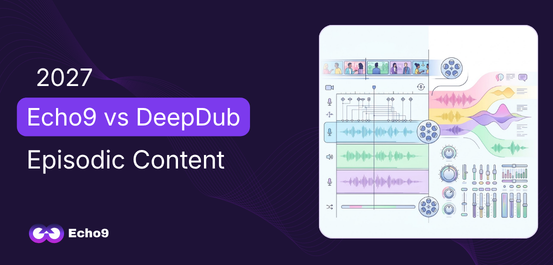
Echo9 vs DeepDub is one of the most common comparisons OTT platforms and broadcasters make when they shortlist AI dubbing software. Both platforms dub film and TV content rather than social clips, both care about emotional delivery, and both promise lip-synced dubs. On a feature list, they can look alike. The difference shows up in the hardest part of dubbing: what happens when a translated line runs longer than the original, when a story depends on relationships between characters, and when a season of 24 episodes has to ship in several languages on a weekly schedule. This guide explains why the two platforms get compared, where they overlap, where they differ, and exactly when Echo9 is the better choice. Why Echo9 Is Compared With DeepDub Most AI dubbing tools are built for creators: upload a clip, pick a language, download a dub. DeepDub and Echo9 sit in a different category. Both are aimed at media companies that dub scripted content where performance, emotion, and sync are judged by a paying audience. That shared focus is why the two land on the same shortlists. The demand behind those shortlists keeps growing. Netflix’s engagement report for the second half of 2025 found that non-English language titles accounted for over a third of all viewing, with Korean, Spanish, and Japanese shows and films among the most-watched. In the first half of 2025, 10 of the 25 most-watched series on Netflix were non-English, according to Variety. For streaming and broadcast teams, that means dubbing is no longer reserved for a few prestige titles. It is a full-season, multi-language operation, which is why OTT platforms are turning to AI dubbing in the first place. So the real question in Echo9 vs DeepDub is not “which one makes a good dub?” Both aim to. The question is which one keeps quality, meaning, and speed intact on episode 20 of a running series. If you are weighing more than two vendors, our ranking of the best AI dubbing software for OTT and streaming platforms covers the wider field. Where Echo9 and DeepDub Overlap It helps to start with what the two platforms share, because these are table stakes for any serious film and TV dubbing platform. According to the feature table on Echo9’s Echo9 vs DeepDub comparison page, both offer: If your evaluation stops here, the two look interchangeable. The differences sit in four areas: how sync is solved, how translation understands the story, how fast episodes ship, and how quality is checked before delivery. Echo9’s Post-Dubbing QA Agent watches the full episode, not just a line. See it on your last delivery Echo9 vs DeepDub: Feature-by-Feature Comparison Feature Echo9 DeepDub Lip sync and audio Lip-sync technology Yes Yes Rephrase-Fit (rewrite, not cut) Yes, Echo9 only No No word-cutting under compression Yes No Background music preservation Yes Yes Per-line speed, pitch, volume control Yes Yes Translation intelligence Narrative-aware localization Yes, Echo9 only No Auto emotion tagging (100K+ trained) Yes Manual only Audience demographic vocabulary Yes No Emotional voice synthesis Yes Yes Production operations Series / season management Yes, Echo9 only No Processing speed Under 60 minutes per episode 1-2 weeks Post-dubbing AI QA agent Yes, Echo9 only No QA logger with weighted scoring Yes No Multi-engine TTS flexibility Yes No Team collaboration and assignment Yes Yes 24/7 support Yes No Source: Echo9’s Echo9 vs DeepDub comparison page. Vendor features change often, so confirm current capabilities directly with each vendor before deciding. Difference 1: DeepDub Cuts Words, Echo9 Rewrites Sentences Lip sync is where most dubbing platforms compromise. Translated lines are often longer than the source: a 3.2-second Urdu line can become 4.8 seconds in Russian. Echo9’s dubbing page notes that 75-80% of dubbing platforms speed up, slow down, or cut the dubbed audio to force a fit, and viewers can feel it. According to Echo9’s comparison, DeepDub compresses translated audio by cutting words from the translated text. Echo9’s comparison page illustrates it this way: That is the core of the comparison. A dub that fits by cutting words sounds right but says less. A dub that fits by rewriting says everything and still lands on time. For background on how sync is measured across the industry, see our guide to what AI lip sync dubbing is and how it works, and use the free Lip-Sync Quality Test to score any vendor’s output before you buy. The step-by-step logic behind rewriting instead of cutting is laid out in the Rephrase-Fit Method guide. Difference 2: Line-by-Line Translation vs Full-Episode Understanding Scripted drama runs on context. A line between a mother and son, a boss and an employee, or two rivals carries different formality, subtext, and emotional weight. Translate it in isolation and it can be accurate but wrong. Echo9’s comparison describes DeepDub’s translation as dialogue-by-dialogue: good accuracy, but without plot or character awareness, so subtext, relationship registers, and emotional context can be missed or guessed. Echo9’s Localization Agent watches the entire episode before a single word is dubbed. Our guide Inside the Enrichment Agent explains why full-episode context beats line-by-line machine translation. It builds: Only then does translation begin, with the full story context built in. Idioms are adapted for the target culture rather than translated literally, formality is applied per relationship and per speaker, and Subtext-Aware Localization carries what characters mean, not just what they say. Echo9 also adds two things DeepDub’s table marks as missing or manual: auto emotion tagging trained on 100K+ dialogue-emotion pairs, part of Echo9’s Emotion-Based Localization, and audience demographic vocabulary, which lets the same story use different vocabulary for different audiences. Multi-Language Delivery Scale one episode into your next six markets. Give us one source upload and your target languages. We’ll show you the parallel output. Book a ConsultationStart a Free Trial Difference 3: 1-2 Weeks vs Under 60 Minutes Per Episode Speed is where the gap is widest. Echo9’s comparison lists DeepDub’s studio-grade process at 1-2 weeks per episode. That can work for a feature film with a long lead time.
Echo9 vs Synthesia: Avatar Video vs Series Localization
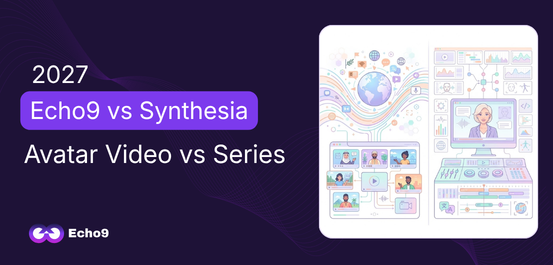
Choosing between Echo9 and Synthesia is not simply a question of which platform offers more AI video features. For enterprise and EdTech teams, the more important decision is whether the production workflow is built around creating presenter-led videos or localizing an existing library of content across languages. Synthesia is widely recognized for AI avatar video creation, while its capabilities also include translating and dubbing existing videos. Echo9 focuses on professional video localization, with particular relevance to recurring content, voice consistency, and terminology management across episodes. These overlapping capabilities make a direct comparison useful, but they do not make the platforms interchangeable for every production requirement. For teams evaluating a Synthesia alternative, this guide compares the platforms by workflow, features, business use case, and localization requirements. It also explains when Synthesia may be the better fit, when Echo9 deserves closer evaluation, and what to verify before committing to either solution. Echo9 vs Synthesia: Quick Comparison The most useful way to compare these platforms is to examine the job each one needs to perform. Both are relevant to multilingual video production, but their primary strengths and workflow considerations differ. Evaluation Criteria Echo9 Synthesia Primary focus Professional video localization AI avatar video creation and multilingual video production Video creation Focuses on adapting existing content Strong fit for creating videos with AI presenters Existing-video dubbing Core localization use case Supported through AI Dubbing Voice cloning Relevant to maintaining voice identity in localization workflows Supported in applicable dubbing and voice workflows Terminology consistency Series-level terminology and localization requirements Glossary support is documented for dubbing workflows Recurring content Series Management is designed for connected episodes and content libraries Batch dubbing and reusable settings support video workflows EdTech applications Localizing recorded courses and recurring educational content Creating presenter-led lessons and multilingual training videos Enterprise applications Localizing existing video libraries and recurring media Corporate communications, training, and avatar-led content Primary buying consideration Localization control, continuity, and review requirements Avatar creation, video translation, and workflow convenience This is a use-case comparison, not a standardized performance ranking. Confirm current features, plan availability, language support, and implementation requirements with each provider. What Is Echo9? Echo9 is a video localization platform for organizations that need to adapt existing audiovisual content for different language audiences. Its relevance extends beyond translating an individual video: recurring productions may require the same terminology, voice assignments, and localization standards to carry across multiple episodes, courses, or releases. That requirement changes the way localization should be managed. If every video is processed independently, teams may repeatedly recreate context, correct terminology inconsistencies, and review the same recurring decisions. As the library expands, these tasks can become a significant operational burden. Echo9’s Series Management approach is designed around connected content rather than treating every file as an isolated project. Key Capabilities of Echo9 Echo9 brings together localization capabilities that help teams maintain quality and consistency across multilingual video projects. These features are especially valuable when content includes recurring speakers, specialized terminology, or multiple episodes that need a consistent approach. By managing voice identity and language choices more effectively, teams can reduce repetitive adjustments during localization. The following capabilities highlight how Echo9 supports these requirements in practical workflows. Professional video localization Echo9 focuses on adapting existing video content for multilingual audiences. Depending on the production requirements, teams need to consider translation, dubbing, timing, quality assurance, and the preservation of the original message. Voice consistency through voice cloning Recurring speakers and fictional characters need recognizable voices across localized versions. Voice cloning can help reproduce a speaker’s vocal identity, while a structured workflow helps teams maintain the relevant voice decisions across related content. Terminology control Character names, technical vocabulary, product names, and recurring expressions need consistent treatment. Terminology management helps reduce the risk of introducing different translations for the same concept in separate episodes or modules. Series Management Echo9’s series-oriented workflow addresses the continuity requirements of episodic content. Teams can organize localization around a connected series and maintain important decisions across its episodes. Localization review and quality assurance Automated output still requires evaluation. Translation accuracy, pronunciation, cultural context, timing, and voice delivery all affect the final viewing experience. A professional workflow should provide a clear process for reviewing and correcting these issues. For a closer look at the operational side of localization, read How Series Management in Video Localization Works. What Is Synthesia? Synthesia is an AI video platform known for generating videos featuring digital presenters. Businesses use this type of workflow for structured content such as employee onboarding, product explanations, internal communications, and instructional presentations. Its capabilities also extend to existing-video localization. Synthesia’s official AI Dubbing documentation describes workflows for translating videos from supported sources, including videos created outside Synthesia. Its documentation also covers glossary support, voice options, and batch dubbing. This means the comparison should not be reduced to avatar creation versus dubbing alone. Buyers should consider whether they primarily need to generate new presenter-led content, localize existing videos, or manage recurring localization requirements across a larger library. Key Capabilities of Synthesia Synthesia combines AI presenter creation with tools for adapting video content for different audiences and languages. Its capabilities can support businesses producing training materials, instructional videos, and corporate communications at scale. For teams working with existing videos, dubbing and glossary features also provide options for multilingual delivery. The following capabilities explain how Synthesia can fit into different video production workflows. AI avatar video creation Digital presenters allow teams to produce structured videos without recording a presenter for every script or update. This is particularly relevant for organizations that create training materials and internal communications regularly. Multilingual video production Synthesia supports workflows for translating and adapting video content into supported languages. Buyers should verify language availability and functionality for their intended production workflow. AI Dubbing Synthesia can dub existing videos, including supported videos from external sources. Its documented workflow includes voice options, editing, and the ability to add languages or revisit a dub. Glossary support Synthesia documents glossary support for its dubbing workflow. This can help apply defined company
Best AI Subtitle Generators in 2027: Ranked and Compared
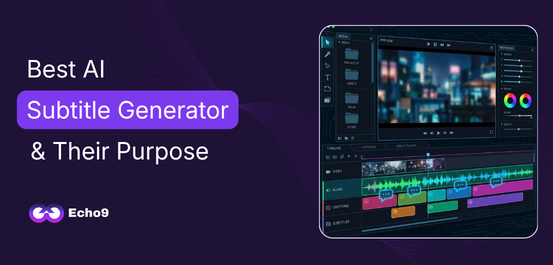
An AI subtitle generator can turn a 45-minute episode into a timed subtitle file in minutes. That speed is now table stakes. What separates the tools in 2027 is everything that happens after the first draft: how easily you can edit it, whether timing and line length meet broadcast and accessibility rules, and whether the same character names come out the same way in episode one and episode forty. This guide ranks the AI subtitle generators most often shortlisted by media teams and creators this year, including Echo9, VEED, Kapwing, Descript, Maestra, Rev, Happy Scribe, Subtitle Edit, and YouTube’s built-in automatic captions, by what each one is actually built to do. What Makes a Good AI Subtitle Generator in 2027? Speech recognition accuracy has improved enough that most tools land in a similar range on clean, single-speaker audio. The gaps show up with real production content: overlapping dialogue, music beds, accents, technical vocabulary, and long-running series. We ranked each AI subtitle generator against six criteria that matter for an actual buying decision: The Best AI Subtitle Generators Ranked The nine tools below are ranked against the six criteria above, starting with the strongest fit for media teams subtitling at scale and moving toward tools built for individual creators and single videos. Each entry follows the same format: what the tool is, its key features, who it suits best, and where it falls short, so you can compare them side by side and shortlist the ones that match your content type and volume. 1. Echo9: Best for Series, Broadcast, and Multi-Language Catalogs Echo9’s Subtitle Studio is built for teams subtitling ongoing, episodic content in many languages. Instead of translating line by line, it reads the full episode for context first, so subtitles carry the intended meaning rather than a word-for-word swap. 2. VEED: Best for Quick Subtitles Inside a Video Editor VEED is a browser-based video editor with automatic subtitles built in. You can generate, edit, style, and translate subtitles in the same place you trim and brand the video, then burn them in or download them as a file. See Echo9 vs VEED for a side-by-side breakdown. Multi-Language Delivery Scale one episode into your next six markets. Give us one source upload and your target languages. We’ll show you the parallel output. Book a ConsultationStart a Free Trial 3. Kapwing: Best for Short-Form and Social Clips Kapwing is a browser-based editor popular with social media teams. Auto-subtitles sit alongside resizing, clipping, and templates, which makes it quick to turn one video into several captioned social versions. 4. Descript: Best for Podcast and Text-Based Editing Workflows Descript edits audio and video through a transcript: delete a word in the text and it disappears from the recording. Because the transcript is the editing surface, captions come naturally out of the edit. 5. Maestra: Best for Transcription-First Teams Maestra started as a transcription and subtitling tool and has expanded into translation and voice features from that base. Its workflow suits teams whose process begins with an accurate transcript and ends with subtitles in several languages. 6. Rev: Best When You Want an AI or Human Option From One Vendor Rev is well known for transcription and captioning. Its main advantage is choice: an automated draft when speed matters most, or human-produced captions when accuracy has to be guaranteed. 7. Happy Scribe: Best for Multilingual Transcription and Subtitles Happy Scribe focuses on transcription and subtitles across many languages, with an online editor for cleanup. Like Rev, it offers both machine-generated and human-reviewed options. 8. Subtitle Edit: Best Free Desktop Editor for Hands-On Users Subtitle Edit is a free, open-source desktop subtitle editor used by many professional subtitlers. Recent versions can also generate a first draft with open-source speech recognition models, which you then correct by hand. 9. YouTube Automatic Captions: Best Free Starting Point for YouTube-Only Content YouTube generates automatic captions for many uploads at no cost, and creators can edit them in YouTube Studio. Our guide on how to localize YouTube content covers when to go beyond the built-in tools. AI Subtitle Generator Comparison Table Factor Echo9 VEED / Kapwing Descript Maestra / Happy Scribe / Rev Subtitle Edit YouTube Auto Captions Primary focus Series subtitling and dubbing Video editing with subtitles Text-based audio/video editing Transcription and subtitles Manual subtitle editing Platform-native captions Show / season / episode structure Built in No No Varies No No QA and review tracking Built-in QC checks, weighted QA scoring, per-line human sign-off Limited Limited Varies Manual tools No Best for OTT, broadcast, EdTech, LSPs Social and short-form Podcasts, interviews Training, agencies Hands-on editors YouTube-only creators Cost to start Paid plans Free tiers available Free tier available Paid, some free trials Free Free Pricing and free-tier limits change often, so confirm current details with each vendor before you decide. How Echo9 Enriches Subtitles Before Translating Standard machine translation works one line at a time, which is where pronoun mix-ups, broken callback jokes, terminology drift, and tone mismatches creep in. Echo9’s Enrichment Agent builds context across the whole episode before translating: With that context, lines are adapted for the audience rather than the dictionary. An idiom like “driving me up the wall” is carried over as the local expression for frustration, not translated literally. Echo9’s localization engine also accounts for relationships (how a character addresses a parent versus a rival, including honorifics), subtext such as sarcasm and irony, and audience-level vocabulary, so viewers in Lisbon and Sao Paulo each get a natural version of the same line. Quality is then proven, not assumed. An episode is “Ready” once the AI draft exists, and only “Completed” when a reviewer has ticked every line. A built-in QA Logger scores errors by category (diarization and translation 40 points each, timing 15, split and merge 5), and Echo9 reports 98% translation accuracy, independently verified. Finished files export as human-reviewed SRT or VTT, kept separate from AI drafts. See the full workflow on the Echo9 Subtitle Studio page. Accuracy and Accessibility: Why
How Series Management in Video Localization Works
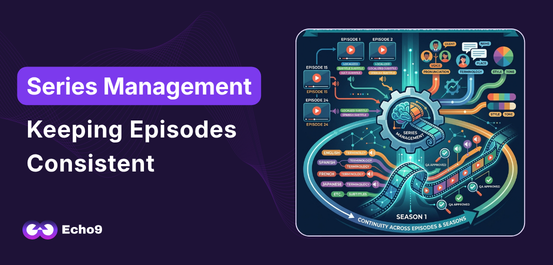
A single localized video only has to be right once. A 24-episode season has to be right 24 times, with the same character names, terminology, voices, pronunciation, tone, and style across every episode and every target language. That is the problem series management in video localization is designed to solve. Series management treats the show, rather than the individual video file, as the unit of localization. Decisions made in episode 1 remain available when episode 20 enters production, so teams do not have to recreate the same context every time. For OTT platforms, broadcasters, studios, and localization service providers working with recurring content, that distinction becomes increasingly important as episode counts, languages, and release schedules grow. Echo9’s approach to episodic localization is built around that continuity. What Is Series Management in Video Localization? Series management is the layer of a localization workflow that keeps terminology, voice, style, and QA decisions consistent across an entire series. Instead of treating every episode as a new project, a series-level workflow maintains a persistent record of: A term established in episode 1 can remain consistent in episode 40. A recurring character can retain the same voice profile without being re-briefed for every episode. Reviewers can identify patterns across a season instead of checking every file in isolation. This matters because episodic content behaves differently from standalone video. A single marketing video only needs to be internally consistent. Episode 7 needs to agree with episode 2, while season 3 may need to remain consistent with season 1 even if the original localization team has changed. Why Episodic Content Breaks Traditional Localization Workflows Most localization workflows were designed around one project going in and one finished file coming out. That works for a single video. It becomes difficult when the same workflow has to be repeated across dozens of connected episodes. Context gets lost A translator working on episode 15 may not know how a character’s nickname was translated in episode 4 unless someone has maintained and shared that information. This becomes even more important when localization has to preserve the identity of a series across markets. Netflix’s approach to dubbing K-content illustrates how localization involves more than translating dialogue, with voice casting, cultural adaptation, synchronization, and creative intent all forming part of the process. Without a living glossary, terminology starts to drift. The same applies to pronunciation, character descriptions, recurring phrases, and stylistic decisions. Echo9’s Voice Bank provides a persistent reference for recurring voices, while a structured series workflow keeps decisions connected across episodes. Teams change A season can take months to produce. The translator, reviewer, or vendor working on season 1 may not be available for season 2. If the show’s localization rules exist only in people’s memories, every new contributor has to reconstruct them. A documented workflow makes those decisions reusable rather than dependent on whoever happens to be working on the next episode. QA becomes harder to scale Checking one localized video is manageable. Checking 24 episodes across 12 languages means potentially hundreds of localized files. The question is no longer simply: It becomes: That requires season-level visibility. Echo9’s QA Director Review adds human oversight to an AI-assisted workflow, allowing reviewers to focus attention where judgment matters rather than repeatedly reconstructing context. Tool sprawl increases coordination Teams often patch the problem with spreadsheets, shared documents, translation tools, dubbing platforms, subtitle tools, and external QA processes. The more tools involved, the more opportunities there are for context and version information to disappear between handoffs. Echo9’s Project Management layer brings the operational side closer to localization production, helping teams organize recurring content, episodes, reviews, and delivery. OTT Localization See how your next season could localize at scale. Give us one episode and one language. We’ll show you how Echo9 handles dubbing, subtitling, review, and episode-level consistency in one workflow. Book a Consultation Start a Free Trial 2.4M+ episodes processed · 100+ languages · 50+ studios The Core Components of Series Management Series management is not a single feature. It combines several capabilities that become important once content is recurring. 1. Terminology consistency A series needs a centralized terminology system covering character names, brands, locations, recurring phrases, and technical terms. Once a term has been approved, future episodes should inherit that decision rather than asking translators to make it again. This becomes especially important in AI dubbing for OTT platforms, where terminology and pronunciation need to remain consistent alongside generated voices. For more complex localization, decisions may also involve how language is adapted to context, character relationships, or cultural expectations. Echo9’s relationship-aware localization and subtext-aware localization capabilities are examples of how localization can preserve more than literal wording. 2. Voice consistency A recurring character should sound like the same character throughout the series. That means maintaining the same voice profile, delivery characteristics, and vocal identity across episodes. Voice cloning can help establish that consistency, but the important part is that the voice decision needs to persist at the series level rather than being recreated for every file. For teams comparing approaches, Echo9’s TTS vs. voice cloning vs. AI dubbing comparison explains how these technologies differ. 3. Batch and episode-level workflows Running every episode as an isolated project creates repetitive setup work. A series-level workflow lets teams establish terminology, voice, style, and review requirements once and apply them across multiple episodes. This makes it easier to process episodes in parallel while keeping the underlying rules consistent. That becomes particularly important when a season is being localized into several languages simultaneously. Echo9’s multi-language workflow is designed around coordinating multilingual production rather than treating every language as a completely separate operation. 4. Centralized QA Single-video QA asks: Series-level QA asks: Automated checks can identify mechanical problems such as terminology drift or repeatable inconsistencies. Human reviewers can then focus on cultural adaptation, humor, emotional delivery, and whether dialogue sounds natural. That is the logic behind AI plus human video dubbing: AI provides production capacity while human review handles decisions that require judgment. 5. Documented style and tone Series