Echo9 vs Synthesia: Avatar Video vs Series Localization
Choosing between Echo9 and Synthesia is not simply a question of which platform offers more AI video features. For enterprise and EdTech teams, the more important decision is whether the production workflow is built around creating presenter-led videos or localizing an existing library of content across languages. Synthesia is widely recognized for AI avatar video creation, while its capabilities also include translating and dubbing existing videos. Echo9 focuses on professional video localization, with particular relevance to recurring content, voice consistency, and terminology management across episodes. These overlapping capabilities make a direct comparison useful, but they do not make the platforms interchangeable for every production requirement. For teams evaluating a Synthesia alternative, this guide compares the platforms by workflow, features, business use case, and localization requirements. It also explains when Synthesia may be the better fit, when Echo9 deserves closer evaluation, and what to verify before committing to either solution. Echo9 vs Synthesia: Quick Comparison The most useful way to compare these platforms is to examine the job each one needs to perform. Both are relevant to multilingual video production, but their primary strengths and workflow considerations differ. Evaluation Criteria Echo9 Synthesia Primary focus Professional video localization AI avatar video creation and multilingual video production Video creation Focuses on adapting existing content Strong fit for creating videos with AI presenters Existing-video dubbing Core localization use case Supported through AI Dubbing Voice cloning Relevant to maintaining voice identity in localization workflows Supported in applicable dubbing and voice workflows Terminology consistency Series-level terminology and localization requirements Glossary support is documented for dubbing workflows Recurring content Series Management is designed for connected episodes and content libraries Batch dubbing and reusable settings support video workflows EdTech applications Localizing recorded courses and recurring educational content Creating presenter-led lessons and multilingual training videos Enterprise applications Localizing existing video libraries and recurring media Corporate communications, training, and avatar-led content Primary buying consideration Localization control, continuity, and review requirements Avatar creation, video translation, and workflow convenience This is a use-case comparison, not a standardized performance ranking. Confirm current features, plan availability, language support, and implementation requirements with each provider. What Is Echo9? Echo9 is a video localization platform for organizations that need to adapt existing audiovisual content for different language audiences. Its relevance extends beyond translating an individual video: recurring productions may require the same terminology, voice assignments, and localization standards to carry across multiple episodes, courses, or releases. That requirement changes the way localization should be managed. If every video is processed independently, teams may repeatedly recreate context, correct terminology inconsistencies, and review the same recurring decisions. As the library expands, these tasks can become a significant operational burden. Echo9’s Series Management approach is designed around connected content rather than treating every file as an isolated project. Key Capabilities of Echo9 Echo9 brings together localization capabilities that help teams maintain quality and consistency across multilingual video projects. These features are especially valuable when content includes recurring speakers, specialized terminology, or multiple episodes that need a consistent approach. By managing voice identity and language choices more effectively, teams can reduce repetitive adjustments during localization. The following capabilities highlight how Echo9 supports these requirements in practical workflows. Professional video localization Echo9 focuses on adapting existing video content for multilingual audiences. Depending on the production requirements, teams need to consider translation, dubbing, timing, quality assurance, and the preservation of the original message. Voice consistency through voice cloning Recurring speakers and fictional characters need recognizable voices across localized versions. Voice cloning can help reproduce a speaker’s vocal identity, while a structured workflow helps teams maintain the relevant voice decisions across related content. Terminology control Character names, technical vocabulary, product names, and recurring expressions need consistent treatment. Terminology management helps reduce the risk of introducing different translations for the same concept in separate episodes or modules. Series Management Echo9’s series-oriented workflow addresses the continuity requirements of episodic content. Teams can organize localization around a connected series and maintain important decisions across its episodes. Localization review and quality assurance Automated output still requires evaluation. Translation accuracy, pronunciation, cultural context, timing, and voice delivery all affect the final viewing experience. A professional workflow should provide a clear process for reviewing and correcting these issues. For a closer look at the operational side of localization, read How Series Management in Video Localization Works. What Is Synthesia? Synthesia is an AI video platform known for generating videos featuring digital presenters. Businesses use this type of workflow for structured content such as employee onboarding, product explanations, internal communications, and instructional presentations. Its capabilities also extend to existing-video localization. Synthesia’s official AI Dubbing documentation describes workflows for translating videos from supported sources, including videos created outside Synthesia. Its documentation also covers glossary support, voice options, and batch dubbing. This means the comparison should not be reduced to avatar creation versus dubbing alone. Buyers should consider whether they primarily need to generate new presenter-led content, localize existing videos, or manage recurring localization requirements across a larger library. Key Capabilities of Synthesia Synthesia combines AI presenter creation with tools for adapting video content for different audiences and languages. Its capabilities can support businesses producing training materials, instructional videos, and corporate communications at scale. For teams working with existing videos, dubbing and glossary features also provide options for multilingual delivery. The following capabilities explain how Synthesia can fit into different video production workflows. AI avatar video creation Digital presenters allow teams to produce structured videos without recording a presenter for every script or update. This is particularly relevant for organizations that create training materials and internal communications regularly. Multilingual video production Synthesia supports workflows for translating and adapting video content into supported languages. Buyers should verify language availability and functionality for their intended production workflow. AI Dubbing Synthesia can dub existing videos, including supported videos from external sources. Its documented workflow includes voice options, editing, and the ability to add languages or revisit a dub. Glossary support Synthesia documents glossary support for its dubbing workflow. This can help apply defined company
Table of Contents
Choosing between Echo9 and Synthesia is not simply a question of which platform offers more AI video features. For enterprise and EdTech teams, the more important decision is whether the production workflow is built around creating presenter-led videos or localizing an existing library of content across languages.
Synthesia is widely recognized for AI avatar video creation, while its capabilities also include translating and dubbing existing videos. Echo9 focuses on professional video localization, with particular relevance to recurring content, voice consistency, and terminology management across episodes. These overlapping capabilities make a direct comparison useful, but they do not make the platforms interchangeable for every production requirement.
For teams evaluating a Synthesia alternative, this guide compares the platforms by workflow, features, business use case, and localization requirements. It also explains when Synthesia may be the better fit, when Echo9 deserves closer evaluation, and what to verify before committing to either solution.
Echo9 vs Synthesia: Quick Comparison
The most useful way to compare these platforms is to examine the job each one needs to perform. Both are relevant to multilingual video production, but their primary strengths and workflow considerations differ.
Evaluation Criteria
Echo9
Synthesia
Primary focus
Professional video localization
AI avatar video creation and multilingual video production
Video creation
Focuses on adapting existing content
Strong fit for creating videos with AI presenters
Existing-video dubbing
Core localization use case
Supported through AI Dubbing
Voice cloning
Relevant to maintaining voice identity in localization workflows
Supported in applicable dubbing and voice workflows
Terminology consistency
Series-level terminology and localization requirements
Glossary support is documented for dubbing workflows
Recurring content
Series Management is designed for connected episodes and content libraries
Batch dubbing and reusable settings support video workflows
EdTech applications
Localizing recorded courses and recurring educational content
Creating presenter-led lessons and multilingual training videos
Enterprise applications
Localizing existing video libraries and recurring media
Corporate communications, training, and avatar-led content
Primary buying consideration
Localization control, continuity, and review requirements
Avatar creation, video translation, and workflow convenience
This is a use-case comparison, not a standardized performance ranking. Confirm current features, plan availability, language support, and implementation requirements with each provider.
What Is Echo9?
Echo9 is a video localization platform for organizations that need to adapt existing audiovisual content for different language audiences. Its relevance extends beyond translating an individual video: recurring productions may require the same terminology, voice assignments, and localization standards to carry across multiple episodes, courses, or releases.
That requirement changes the way localization should be managed. If every video is processed independently, teams may repeatedly recreate context, correct terminology inconsistencies, and review the same recurring decisions. As the library expands, these tasks can become a significant operational burden.
Echo9’s Series Management approach is designed around connected content rather than treating every file as an isolated project.
Key Capabilities of Echo9
Echo9 brings together localization capabilities that help teams maintain quality and consistency across multilingual video projects. These features are especially valuable when content includes recurring speakers, specialized terminology, or multiple episodes that need a consistent approach. By managing voice identity and language choices more effectively, teams can reduce repetitive adjustments during localization. The following capabilities highlight how Echo9 supports these requirements in practical workflows.
Professional video localization
Echo9 focuses on adapting existing video content for multilingual audiences. Depending on the production requirements, teams need to consider translation, dubbing, timing, quality assurance, and the preservation of the original message.
Voice consistency through voice cloning
Recurring speakers and fictional characters need recognizable voices across localized versions. Voice cloning can help reproduce a speaker’s vocal identity, while a structured workflow helps teams maintain the relevant voice decisions across related content.
Terminology control
Character names, technical vocabulary, product names, and recurring expressions need consistent treatment. Terminology management helps reduce the risk of introducing different translations for the same concept in separate episodes or modules.
Series Management
Echo9’s series-oriented workflow addresses the continuity requirements of episodic content. Teams can organize localization around a connected series and maintain important decisions across its episodes.
Localization review and quality assurance
Automated output still requires evaluation. Translation accuracy, pronunciation, cultural context, timing, and voice delivery all affect the final viewing experience. A professional workflow should provide a clear process for reviewing and correcting these issues.
Synthesia is an AI video platform known for generating videos featuring digital presenters. Businesses use this type of workflow for structured content such as employee onboarding, product explanations, internal communications, and instructional presentations.
Its capabilities also extend to existing-video localization. Synthesia’s official AI Dubbing documentation describes workflows for translating videos from supported sources, including videos created outside Synthesia. Its documentation also covers glossary support, voice options, and batch dubbing.
This means the comparison should not be reduced to avatar creation versus dubbing alone. Buyers should consider whether they primarily need to generate new presenter-led content, localize existing videos, or manage recurring localization requirements across a larger library.
Key Capabilities of Synthesia
Synthesia combines AI presenter creation with tools for adapting video content for different audiences and languages. Its capabilities can support businesses producing training materials, instructional videos, and corporate communications at scale. For teams working with existing videos, dubbing and glossary features also provide options for multilingual delivery. The following capabilities explain how Synthesia can fit into different video production workflows.
AI avatar video creation
Digital presenters allow teams to produce structured videos without recording a presenter for every script or update. This is particularly relevant for organizations that create training materials and internal communications regularly.
Multilingual video production
Synthesia supports workflows for translating and adapting video content into supported languages. Buyers should verify language availability and functionality for their intended production workflow.
AI Dubbing
Synthesia can dub existing videos, including supported videos from external sources. Its documented workflow includes voice options, editing, and the ability to add languages or revisit a dub.
Glossary support
Synthesia documents glossary support for its dubbing workflow. This can help apply defined company names, product terms, and other terminology consistently, subject to the platform’s documented functionality.
Batch processing
Synthesia’s documentation describes batch dubbing for multiple videos. This can be useful when organizations need to process several assets together, although batch processing and series-level localization are not necessarily the same requirement.
For organizations that need both presenter-led content and multilingual video production, Synthesia is a relevant platform to evaluate. Its suitability for a particular localization project depends on the level of control, continuity, and review the project requires.
Free Trial
Run one episode through the full pipeline.
All eight stages on your own content — upload to broadcast-ready audio. No credit card, no managed-service queue.
The distinction between the platforms becomes clearer when they are evaluated against real production requirements rather than broad feature categories.
1. Creating New Videos vs Localizing Existing Content
Synthesia’s avatar-based workflow is useful when the objective is to turn a script into a new presenter-led video. A company can use this approach to prepare onboarding materials, explain product changes, or create structured lessons.
Echo9 is relevant when the original video already exists and needs to be adapted for additional language audiences. This includes recorded courses, interviews, episodic productions, and other content where the existing audiovisual material remains central to the final result.
Consider an EdTech company with two projects: producing a new introductory lesson and localizing an established course library. The first project may benefit from an avatar-based creation workflow. The second requires careful consideration of how existing recordings, terminology, voice assignments, and review decisions will be managed across the library.
The right choice therefore depends on the starting point of the production process, not simply whether a platform offers AI-generated speech.
2. Individual Video Processing vs Series-Level Continuity
Batch processing can reduce repetitive work by allowing several videos to be handled together. However, processing multiple files in one batch does not automatically resolve the continuity requirements of a series.
A recurring production may contain character names, technical expressions, brand terminology, and voice assignments that need to remain stable across episodes. Decisions made during the localization of one episode can affect how later episodes should be handled.
Echo9’s Series Management is designed around these connected requirements. Synthesia’s batch dubbing and glossary features are relevant capabilities to assess, but buyers should establish whether the available workflow covers their particular needs for persistent series-level decisions.
This distinction matters most when content is updated over time, several languages are involved, or different reviewers and localization contributors work on the same library.
3. Voice Cloning vs Voice Management
Voice cloning and voice management solve related but different problems.
Voice cloning helps generate speech that resembles a particular speaker. Voice management concerns how the selected voice is assigned, reused, and maintained across a larger production.
For a standalone video, a suitable cloned voice may be sufficient. For a series with recurring characters, teams also need to know whether the same voice profile and delivery expectations will be applied consistently across later episodes and languages.
Echo9’s series-oriented approach makes this a relevant evaluation criterion for recurring content. Synthesia also documents cloned voice options in its dubbing workflow, so the comparison should focus on how each platform supports the complete project rather than treating voice cloning as exclusive to one product.
A glossary can help standardize approved translations of company names, product terms, and technical vocabulary. However, terminology is only one part of localization quality.
Dialogue may also contain humor, implied meaning, cultural references, and relationships between characters. These elements can require context-sensitive adaptation rather than a direct word-for-word translation.
For enterprise training, an inconsistent technical term can confuse learners. For episodic entertainment, a changed character name or phrase can disrupt continuity and make the localized version feel less coherent.
Synthesia’s documented glossary support is relevant to terminology consistency in supported dubbing workflows. Echo9’s localization approach also emphasizes maintaining terminology and context across recurring content.
Buyers should test both the glossary controls and the wider review process using real project material, particularly when the content includes specialized vocabulary or recurring narrative elements.
5. Quality Assurance and Revision Management
Generating a dubbed video is not the same as approving a production-ready localized version.
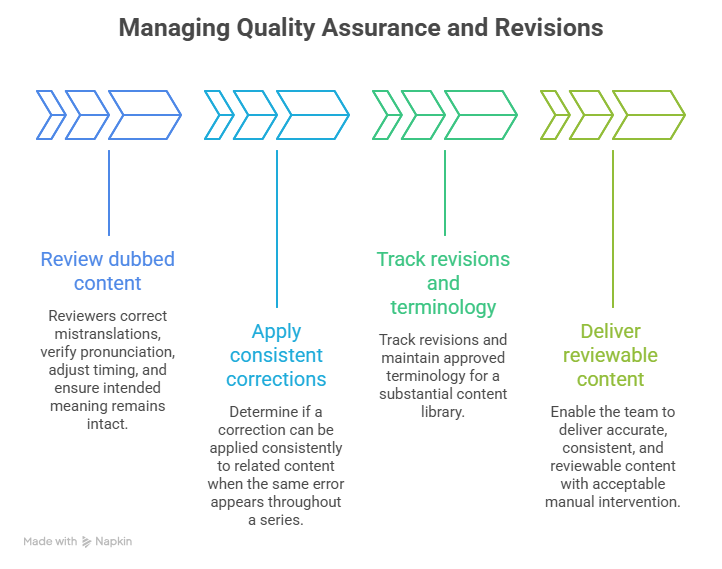
Reviewers may need to correct mistranslations, verify pronunciation, adjust timing, or ensure that the intended meaning remains intact. If the same error appears throughout a series, the team also needs to understand whether a correction can be applied consistently to related content.
For a single video, a straightforward editing workflow may be sufficient. For a substantial content library, the effort required to track revisions and maintain approved terminology becomes an important purchasing consideration.
Echo9 is relevant to teams prioritizing professional localization and series-level coordination. Synthesia’s editing, glossary, and dubbing workflows should also be assessed against the specific review requirements of the project.
The practical question is not which platform claims to automate more work. It is which workflow enables your team to deliver accurate, consistent, and reviewable content with an acceptable amount of manual intervention.
Which Platform Is Right for EdTech and Enterprise?
The following matrix maps common business requirements to the platform worth evaluating first. It is intended to guide product evaluation, not establish a universal ranking.
Business Requirement
Platform to Evaluate First
What to Validate
New presenter-led training videos
Synthesia
Avatar options, script editing, and language support
Structured instructional presentations
Synthesia
Production speed, revision workflow, and output quality
Multilingual versions of existing recordings
Echo9 or Synthesia
Source-video support, target languages, and review controls
Terminology consistency across a course library
Echo9
Series-level terminology management and revision handling
Recurring characters across episodes
Echo9
Persistent voice assignments and continuity workflows
Several videos requiring batch dubbing
Both
Batch limits, shared settings, and individual correction controls
A combination of new videos and existing-content localization
Both
Workflow fit, integration, and total operating cost
For EdTech Teams
Education providers should prioritize accuracy, clarity, and consistency. A mistranslated technical term can change the meaning of a lesson, while inconsistent terminology across modules can make a course harder to follow.
Synthesia is a relevant candidate when new lessons need to be created around digital presenters. Echo9 is worth evaluating when the provider’s main challenge is localizing existing recordings or maintaining consistency across an established course library.
For Enterprise Teams
Enterprise requirements often include brand terminology, review responsibilities, repeated updates, and coordination between teams. The importance of these factors depends on the type and volume of content being produced.
Synthesia can suit presenter-led internal communications and training. Echo9 may be more directly relevant to organizations with substantial existing video libraries or recurring localization requirements.
Before selecting either solution, define the approval process, target languages, content volume, and requirements for maintaining terminology over time.
Pricing, Scalability, and Workflow Considerations
A platform’s subscription price is only one part of the cost of multilingual video production. The operational effort required to prepare, review, correct, and maintain localized content can also affect the total investment.
Current pricing and plan entitlements should be confirmed directly with each provider because features, usage limits, and enterprise arrangements may change.
Cost Per Video and Language
Estimate the number of videos, average duration, and target languages involved in the project. Check how usage is calculated, whether additional language versions incur additional charges, and which features require a particular plan.
Manual Review and Rework
Assess how much time your team spends correcting terminology, pronunciation, timing, and translation issues. A lower subscription price does not necessarily result in a lower total cost if the workflow creates substantial manual work.
Content Growth
A process suitable for ten videos may become difficult to maintain across hundreds of assets. Evaluate whether the workflow can support recurring releases, future updates, and the number of languages your organization expects to add.
Team and Approval Requirements
Determine who prepares the content, who reviews translations, who approves the final version, and how corrections are communicated. The more contributors involved, the more important a clear review and revision process becomes.
Before booking a demonstration or committing to a subscription, use the following process to evaluate the actual workflow.
1. Define the Primary Production Goal
Decide whether you are creating new avatar-led videos, localizing existing content, or managing recurring multilingual productions. This determines which capabilities deserve the greatest weight in the evaluation.
2. Prepare a Representative Sample
Choose a real video that reflects the difficulty of your content. Include technical terminology, multiple speakers, recurring names, or other elements that are important to the production.
3. Test Your Required Languages
Confirm that the source and target languages you need are supported by the specific workflow and plan. Review the output rather than relying on the advertised number of languages.
4. Check Voice and Terminology Consistency
For recurring content, examine how the same speaker, character, or technical term is handled across multiple videos. Determine whether approved decisions can be reused where required.
5. Evaluate Review and Correction Controls
Ask reviewers to identify errors in the translated script, pronunciation, timing, and delivery. Measure how easily those issues can be corrected before the final video is approved.
6. Compare Total Workflow Effort
Consider subscription costs, usage limits, manual corrections, reviewer time, and the work involved in maintaining future updates. The objective is to find a workflow that meets the quality standard without introducing unnecessary operational overhead.
7. Confirm the Fit Before Committing
Use a demonstration to address the requirements identified during testing. Ask specific questions about language coverage, glossary behavior, voice controls, batch processing, and series-level continuity rather than relying on a general product overview.
Final Verdict
Echo9 and Synthesia are relevant to multilingual video production, but the right choice depends on where the greatest production challenge lies.
Synthesia deserves consideration when the priority is creating new videos with AI presenters or using its supported dubbing capabilities within a presenter-focused workflow. Echo9 is worth evaluating when the central requirement is localizing existing content and maintaining continuity across a recurring library, particularly where voice identity, terminology, and series-level review matter.
For EdTech and enterprise teams, the decision should be based on a representative project rather than a feature checklist. Test the target languages, assess the quality of the output, and measure the effort required to correct and maintain localized versions as the library grows.
If you are researching a Synthesia alternative, start by identifying whether you need avatar-based creation, existing-video dubbing, or a structured approach to series localization. Matching the platform to that requirement will provide a more reliable basis for the purchasing decision.
Book a Consultation
Bring us your hardest scene.
Send one episode and one target language. We walk you through the output, line by line, with your team on the call.
A real scene from your catalogue, dubbed end to end
Timing, emotion and lip-sync reviewed against the source
Cost and turnaround modelled on your episode volume
Your QA checklist, run against the output
Frequently Asked Questions
Is Echo9 a Synthesia alternative?
Yes. Echo9 can be a Synthesia alternative for organizations whose primary requirement is professional video localization, especially when recurring content, voice consistency, and terminology management are important. Synthesia is particularly relevant to AI avatar video creation and also supports existing-video dubbing. The best fit depends on the workflow the business needs.
What is the main difference between Echo9 and Synthesia?
Synthesia is known for creating videos with AI presenters and also offers multilingual video translation and dubbing. Echo9 focuses on professional video localization, with an emphasis on connected content and series-level requirements. Buyers should compare their actual capabilities against the project’s language, review, and continuity needs.
Can Synthesia dub existing videos?
Yes. Synthesia’s official documentation describes AI Dubbing for existing videos, including supported external video sources. Its workflow includes voice options and glossary support, with functionality and limits depending on the applicable plan.
What should businesses prepare before booking a demo?
Prepare a representative video, a list of target languages, recurring terminology, expected content volume, and any voice or review requirements. Ask how the platform handles corrections, repeated terminology, additional language versions, and future updates. This makes it easier to judge whether the workflow fits the business.
Is Echo9 better for series localization?
Echo9 is specifically relevant to series-level localization because its Series Management approach addresses recurring voice, terminology, and workflow requirements across episodes. Whether it is the right choice for a particular production depends on the required languages, quality standards, content volume, and budget.
Which platform should EdTech companies choose?
Synthesia is worth evaluating for new presenter-led lessons and training videos. Echo9 is worth evaluating when an education provider needs to localize existing recordings and maintain consistency across a course library. Teams with both requirements should compare the platforms using separate representative projects.
Does voice cloning guarantee consistent dubbing?
No. Voice cloning can help reproduce aspects of a speaker’s vocal identity, but it does not independently guarantee translation accuracy, natural delivery, timing, or consistency across an entire production. Those outcomes also depend on the localization workflow, review process, and how voice decisions are managed.