A single localized video only has to be right once. A 24-episode season has to be right 24 times, with the same character names, terminology, voices, pronunciation, tone, and style across every episode and every target language. That is the problem series management in video localization is designed to solve. Series management treats the show, rather than the individual video file, as the unit of localization. Decisions made in episode 1 remain available when episode 20 enters production, so teams do not have to recreate the same context every time. For OTT platforms, broadcasters, studios, and localization service providers working with recurring content, that distinction becomes increasingly important as episode counts, languages, and release schedules grow. Echo9’s approach to episodic localization is built around that continuity. What Is Series Management in Video Localization? Series management is the layer of a localization workflow that keeps terminology, voice, style, and QA decisions consistent across an entire series. Instead of treating every episode as a new project, a series-level workflow maintains a persistent record of: A term established in episode 1 can remain consistent in episode 40. A recurring character can retain the same voice profile without being re-briefed for every episode. Reviewers can identify patterns across a season instead of checking every file in isolation. This matters because episodic content behaves differently from standalone video. A single marketing video only needs to be internally consistent. Episode 7 needs to agree with episode 2, while season 3 may need to remain consistent with season 1 even if the original localization team has changed. Why Episodic Content Breaks Traditional Localization Workflows Most localization workflows were designed around one project going in and one finished file coming out. That works for a single video. It becomes difficult when the same workflow has to be repeated across dozens of connected episodes. Context gets lost A translator working on episode 15 may not know how a character’s nickname was translated in episode 4 unless someone has maintained and shared that information. This becomes even more important when localization has to preserve the identity of a series across markets. Netflix’s approach to dubbing K-content illustrates how localization involves more than translating dialogue, with voice casting, cultural adaptation, synchronization, and creative intent all forming part of the process. Without a living glossary, terminology starts to drift. The same applies to pronunciation, character descriptions, recurring phrases, and stylistic decisions. Echo9’s Voice Bank provides a persistent reference for recurring voices, while a structured series workflow keeps decisions connected across episodes. Teams change A season can take months to produce. The translator, reviewer, or vendor working on season 1 may not be available for season 2. If the show’s localization rules exist only in people’s memories, every new contributor has to reconstruct them. A documented workflow makes those decisions reusable rather than dependent on whoever happens to be working on the next episode. QA becomes harder to scale Checking one localized video is manageable. Checking 24 episodes across 12 languages means potentially hundreds of localized files. The question is no longer simply: It becomes: That requires season-level visibility. Echo9’s QA Director Review adds human oversight to an AI-assisted workflow, allowing reviewers to focus attention where judgment matters rather than repeatedly reconstructing context. Tool sprawl increases coordination Teams often patch the problem with spreadsheets, shared documents, translation tools, dubbing platforms, subtitle tools, and external QA processes. The more tools involved, the more opportunities there are for context and version information to disappear between handoffs. Echo9’s Project Management layer brings the operational side closer to localization production, helping teams organize recurring content, episodes, reviews, and delivery. OTT Localization See how your next season could localize at scale. Give us one episode and one language. We’ll show you how Echo9 handles dubbing, subtitling, review, and episode-level consistency in one workflow. Book a Consultation Start a Free Trial 2.4M+ episodes processed · 100+ languages · 50+ studios The Core Components of Series Management Series management is not a single feature. It combines several capabilities that become important once content is recurring. 1. Terminology consistency A series needs a centralized terminology system covering character names, brands, locations, recurring phrases, and technical terms. Once a term has been approved, future episodes should inherit that decision rather than asking translators to make it again. This becomes especially important in AI dubbing for OTT platforms, where terminology and pronunciation need to remain consistent alongside generated voices. For more complex localization, decisions may also involve how language is adapted to context, character relationships, or cultural expectations. Echo9’s relationship-aware localization and subtext-aware localization capabilities are examples of how localization can preserve more than literal wording. 2. Voice consistency A recurring character should sound like the same character throughout the series. That means maintaining the same voice profile, delivery characteristics, and vocal identity across episodes. Voice cloning can help establish that consistency, but the important part is that the voice decision needs to persist at the series level rather than being recreated for every file. For teams comparing approaches, Echo9’s TTS vs. voice cloning vs. AI dubbing comparison explains how these technologies differ. 3. Batch and episode-level workflows Running every episode as an isolated project creates repetitive setup work. A series-level workflow lets teams establish terminology, voice, style, and review requirements once and apply them across multiple episodes. This makes it easier to process episodes in parallel while keeping the underlying rules consistent. That becomes particularly important when a season is being localized into several languages simultaneously. Echo9’s multi-language workflow is designed around coordinating multilingual production rather than treating every language as a completely separate operation. 4. Centralized QA Single-video QA asks: Series-level QA asks: Automated checks can identify mechanical problems such as terminology drift or repeatable inconsistencies. Human reviewers can then focus on cultural adaptation, humor, emotional delivery, and whether dialogue sounds natural. That is the logic behind AI plus human video dubbing: AI provides production capacity while human review handles decisions that require judgment. 5. Documented style and tone Series
Table of Contents
A single localized video only has to be right once.
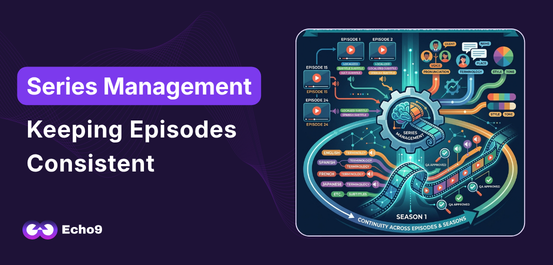
A 24-episode season has to be right 24 times, with the same character names, terminology, voices, pronunciation, tone, and style across every episode and every target language.
That is the problem series management in video localization is designed to solve.
Series management treats the show, rather than the individual video file, as the unit of localization. Decisions made in episode 1 remain available when episode 20 enters production, so teams do not have to recreate the same context every time.
For OTT platforms, broadcasters, studios, and localization service providers working with recurring content, that distinction becomes increasingly important as episode counts, languages, and release schedules grow. Echo9’s approach to episodic localization is built around that continuity.
What Is Series Management in Video Localization?
Series management is the layer of a localization workflow that keeps terminology, voice, style, and QA decisions consistent across an entire series.
Instead of treating every episode as a new project, a series-level workflow maintains a persistent record of:
Character and brand names
Recurring terminology
Voice assignments
Pronunciation choices
Style and tone
Translation preferences
QA decisions
A term established in episode 1 can remain consistent in episode 40. A recurring character can retain the same voice profile without being re-briefed for every episode. Reviewers can identify patterns across a season instead of checking every file in isolation.
This matters because episodic content behaves differently from standalone video. A single marketing video only needs to be internally consistent. Episode 7 needs to agree with episode 2, while season 3 may need to remain consistent with season 1 even if the original localization team has changed.
Why Episodic Content Breaks Traditional Localization Workflows
Most localization workflows were designed around one project going in and one finished file coming out.
That works for a single video. It becomes difficult when the same workflow has to be repeated across dozens of connected episodes.
Context gets lost
A translator working on episode 15 may not know how a character’s nickname was translated in episode 4 unless someone has maintained and shared that information. This becomes even more important when localization has to preserve the identity of a series across markets.
Netflix’s approach to dubbing K-content illustrates how localization involves more than translating dialogue, with voice casting, cultural adaptation, synchronization, and creative intent all forming part of the process.
Without a living glossary, terminology starts to drift.
The same applies to pronunciation, character descriptions, recurring phrases, and stylistic decisions. Echo9’s Voice Bank provides a persistent reference for recurring voices, while a structured series workflow keeps decisions connected across episodes.
Teams change
A season can take months to produce. The translator, reviewer, or vendor working on season 1 may not be available for season 2.
If the show’s localization rules exist only in people’s memories, every new contributor has to reconstruct them.
A documented workflow makes those decisions reusable rather than dependent on whoever happens to be working on the next episode.
QA becomes harder to scale
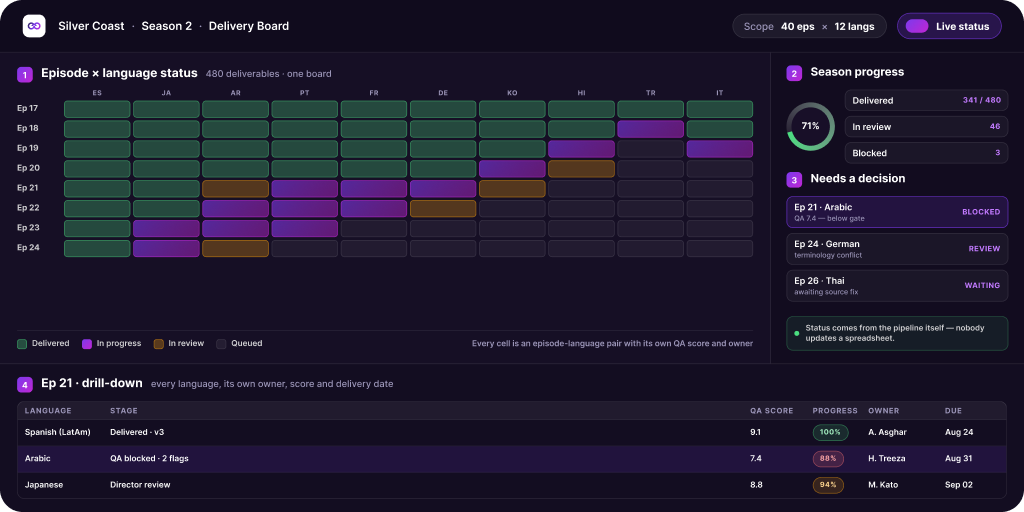
Checking one localized video is manageable. Checking 24 episodes across 12 languages means potentially hundreds of localized files.
The question is no longer simply:
Is this episode correct?
It becomes:
Is this episode correct and consistent with everything that came before it?
That requires season-level visibility.
Echo9’s QA Director Review adds human oversight to an AI-assisted workflow, allowing reviewers to focus attention where judgment matters rather than repeatedly reconstructing context.
Tool sprawl increases coordination
Teams often patch the problem with spreadsheets, shared documents, translation tools, dubbing platforms, subtitle tools, and external QA processes.
The more tools involved, the more opportunities there are for context and version information to disappear between handoffs.
Echo9’s Project Management layer brings the operational side closer to localization production, helping teams organize recurring content, episodes, reviews, and delivery.
OTT Localization
See how your next season could localize at scale.
Give us one episode and one language. We’ll show you how Echo9 handles dubbing, subtitling, review, and episode-level consistency in one workflow.
2.4M+ episodes processed · 100+ languages · 50+ studios
The Core Components of Series Management
Series management is not a single feature. It combines several capabilities that become important once content is recurring.
1. Terminology consistency
A series needs a centralized terminology system covering character names, brands, locations, recurring phrases, and technical terms.
Once a term has been approved, future episodes should inherit that decision rather than asking translators to make it again.
This becomes especially important in AI dubbing for OTT platforms, where terminology and pronunciation need to remain consistent alongside generated voices.
For more complex localization, decisions may also involve how language is adapted to context, character relationships, or cultural expectations. Echo9’s relationship-aware localization and subtext-aware localization capabilities are examples of how localization can preserve more than literal wording.
2. Voice consistency
A recurring character should sound like the same character throughout the series.
That means maintaining the same voice profile, delivery characteristics, and vocal identity across episodes.
Voice cloning can help establish that consistency, but the important part is that the voice decision needs to persist at the series level rather than being recreated for every file.
Running every episode as an isolated project creates repetitive setup work.
A series-level workflow lets teams establish terminology, voice, style, and review requirements once and apply them across multiple episodes. This makes it easier to process episodes in parallel while keeping the underlying rules consistent.
That becomes particularly important when a season is being localized into several languages simultaneously. Echo9’s multi-language workflow is designed around coordinating multilingual production rather than treating every language as a completely separate operation.
4. Centralized QA
Single-video QA asks:
Is this file correct?
Series-level QA asks:
Is this file correct and consistent with the rest of the series?
Automated checks can identify mechanical problems such as terminology drift or repeatable inconsistencies. Human reviewers can then focus on cultural adaptation, humor, emotional delivery, and whether dialogue sounds natural.
That is the logic behind AI plus human video dubbing: AI provides production capacity while human review handles decisions that require judgment.
5. Documented style and tone
Series continuity extends beyond terminology and voices.
A show can accumulate decisions about formality, idioms, recurring jokes, on-screen text, and character behavior. Those decisions need somewhere permanent to live.
Otherwise, a new translator or reviewer has to infer the show’s style from previous episodes.
Features such as emotion-based localization can help preserve the intended emotional character of dialogue rather than treating every line as a simple translation problem.
Echo9’s Post-Dubbing QA Agent watches the full episode, not just a line.
A single-video tool can produce a good localized episode. A series-management workflow is designed to produce good episodes that also remain consistent with one another.
What Happens Without Series Management?
Consider a streaming platform localizing a 20-episode animated series into eight languages.
Episode 1 establishes the name of a recurring gadget. The translation is approved by the production team.
By episode 9, a new translator joins and translates the same name slightly differently.
Episode 9 can still pass individual QA because the translation is technically correct. The problem only becomes obvious when someone compares it with earlier episodes.
Now the team may have to identify every occurrence and potentially re-review or re-record affected content across multiple languages.
The problem was not necessarily a bad translation.
It was the absence of a system connecting episode 9 to everything that came before it.
Why OTT and Broadcast Teams Feel This Most
OTT platforms and broadcasters are particularly exposed because their content is continuous and requires localization at scale.
An OTT localization operation may involve entire seasons, multiple languages, parallel episode processing, and tight release windows. Echo9’s OTT localization workflow is built around managing seasons, languages, reviews, and delivery inside one workflow.
Broadcasters face a similar problem with long-running programming. A show can accumulate hundreds of episodes over several years while translators, vendors, and internal teams change. Echo9’s TV broadcaster solution is designed for recurring production where episodes need clear ownership, review, status, and sign-off.
For localization companies handling multiple clients, the problem becomes broader. Echo9’s LSP workflow supports multiple series, languages, reviewers, and client deliveries in parallel.
News organizations face a different version of the same operational challenge when multilingual content needs rapid review and delivery. Echo9’s news broadcaster workflow is built for high-frequency multilingual production.
Guide
Free Guide
The State of AI Video Localization in 2026.
Explore how AI is changing video localization, from dubbing and translation to the workflows powering global content at scale.
Echo9 is built around the idea that episodic localization should not start from a blank file every time.
The workflow changes from:
Episode → localize → review → deliver → start again
to:
Series → establish rules → localize episodes → review → reuse the context
The benefit is less repeated coordination.
A producer does not need to re-explain terminology to every contributor. A reviewer does not have to remember how a character’s name was handled five episodes earlier. A new season does not have to begin by reconstructing decisions made during the previous one.
Echo9 combines this series-level approach with AI video localization, subtitling, dubbing, QA, and project management so teams can manage the production operation rather than simply generate translated files.
For teams that want the technology and review operation handled for them, Echo9 also offers managed localization, combining AI processing with human linguistic review and QA.
What Happens When a Series Gets Renewed?
Renewals are where series management becomes particularly valuable.
Season 2 may begin months or years after season 1. Original translators may have moved on, the QA team may have changed, and the people who remember the show’s terminology may no longer be involved.
Without persistent series-level information, the new season becomes a rediscovery exercise.
With a documented system, season 2 can build on the same foundation.
The setup work for terminology, voices, and style therefore does not need to be recreated every season. Its value compounds as the series grows.
Does Series Management Replace Human Review?
No. It changes what human reviewers spend their time doing.
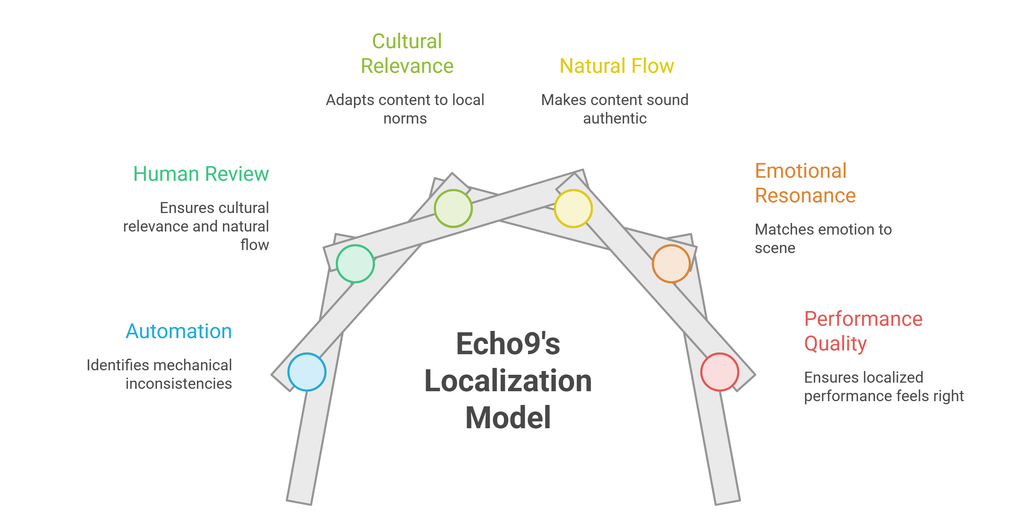
Automation is well suited to identifying mechanical inconsistencies such as terminology changes and repeatable patterns.
Human reviewers remain essential for questions such as:
Does the joke work culturally?
Does the line sound natural?
Does the emotion match the scene?
Does the localized performance feel right?
This is why Echo9’s localization model combines automation with structured human review rather than treating AI as a replacement for editorial judgment. Its AI dubbing quality approach focuses on factors such as naturalness, accuracy, and performance quality.
How to Evaluate a Series Management Solution
Before choosing a platform, ask:
Does terminology carry forward automatically?
Can new episodes inherit previous decisions without manual re-briefing?
Can QA identify patterns across a season?
Are decisions documented independently of individual translators?
Can multiple episodes and languages be processed in parallel?
Does the workflow continue into a new season?
Can human reviewers still make cultural and editorial decisions?
If the answer to most of these is no, you may still be looking at a single-video workflow rather than true series management.
The Bottom Line
Series localization is different from localizing a collection of unrelated videos.
The challenge is not simply translating or dubbing more files. It is preserving the decisions that make those files belong to the same series.
Terminology, voices, style, QA, and production context need to carry forward from episode to episode and season to season.
That is where series management becomes valuable.
Echo9 brings that series-level approach together with AI dubbing, subtitling, QA, project management, and human review. Instead of rebuilding localization context for every episode, teams can establish the rules once and keep building on them as the series grows.
Q&A: Series Management in Video Localization
What is the difference between series management and regular video localization?
Regular localization treats each video as an independent project. Series management maintains terminology, voice, style, and QA decisions at the show level so new episodes inherit what has already been established.
Do I need series management for every localization project?
Not necessarily. It becomes more valuable as episode counts grow, multiple languages are involved, or a show continues into additional seasons. For a handful of unrelated videos, a standard project workflow may be enough.
Does series management replace human localization reviewers?
No. It helps automate consistency checks and preserve previous decisions, allowing human reviewers to spend more time on cultural fit, humor, tone, and performance.
How does series management help when a show gets renewed?
A series-level system preserves terminology, voice, and style decisions after a season ends. When a new season begins, the localization team can continue from the established foundation rather than reconstructing it.
What if earlier episodes already contain inconsistencies?
Those inconsistencies need to be reconciled against the centralized rules. After that, the series-level system can help prevent the same problems from recurring.
Can series management support multiple languages?
Yes. The purpose is to maintain continuity across different language versions of the same series, while allowing each language to have its own approved terminology and localization decisions.
Multi-Language Delivery
Scale one episode into your next six markets.
Give us one source upload and your target languages. We’ll show you the parallel output.