Why the Future of Video Localization Depends on AI Plus Human Video Dubbing
For the past few years, the localization industry has treated AI dubbing and human dubbing as competing approaches. One promised speed and scale. The other promised quality and judgment. But as AI dubbing has matured, the more useful question is no longer which one should win. It is where each one should be used. AI can now transcribe dialogue, translate scripts, generate voices, adjust timing, and produce dubbed tracks across multiple languages at a fraction of the time required by a traditional dubbing workflow. That changes what is possible for platforms, studios, broadcasters, and content owners with large catalogs. It does not remove the need for human judgment. A technically correct translation can still sound unnatural. A perfectly timed voice can still deliver the wrong emotion. A character’s name can change halfway through a season without anyone noticing until viewers do. That is why AI Plus Human Video Dubbing is becoming a more practical model for scalable localization. AI handles the volume. Automated QA identifies potential problems. Humans focus on the decisions that still require context, cultural understanding, and editorial judgment. What does AI Plus Human Video Dubbing actually mean? AI Plus Human Video Dubbing is not simply a process where AI creates a draft and a human rewrites everything afterward. That approach would give up much of the efficiency AI is supposed to provide. The better model is a division of labor. AI handles the repetitive parts of localization that benefit from speed and consistency. This can include transcription, first-pass translation, voice generation, timing, and other production tasks. Human reviewers then focus on the parts that require judgment. They can check whether an idiom works in the target language, whether a character still sounds like themselves, whether an emotional moment feels right, and whether terminology remains consistent across episodes. This makes AI Plus Human Video Dubbing different from both traditional dubbing and fully automated dubbing. Humans are not expected to redo the entire production. They are there to make sure the parts that matter most are right. For teams managing larger catalogs, this distinction becomes particularly important. The challenge is not simply generating a dubbed track. It is managing the workflow around that track, from production and QA through review, correction, and final delivery. This is where a managed localization workflow such as Echo9.ai can become useful, combining AI-powered localization with human review rather than leaving teams to coordinate separate tools and processes themselves. Why can AI produce a dub quickly but still miss important problems? AI dubbing is very good at processing large amounts of predictable information. A system can take a finished video, identify dialogue, translate it, generate voices, and create a new audio track far faster than a traditional studio pipeline. The problem is that localization is not only a technical process. Meaning often depends on context. An idiom may have no direct equivalent in another language. A joke may need to be rewritten rather than translated. A character may be sarcastic in one scene and vulnerable in the next. The same word may also need to be translated differently depending on who is speaking and what is happening on screen. If AI can handle the production work, what does the human reviewer actually add? The human reviewer provides the judgment layer. Consider a character who uses the same fictional title throughout a 20-episode series. An AI system might translate that title differently in different episodes because the surrounding sentence changes. Each individual translation could appear reasonable. Together, however, they create an inconsistency that damages the world of the series. The same applies to emotion. A generated voice can pronounce every word correctly while still sounding too calm, too excited, too angry, or simply disconnected from what is happening on screen. The value of human review is therefore not that humans are better at every task. It is that some localization decisions are difficult to evaluate without understanding the scene. This is also why the review layer should be part of the localization workflow from the beginning rather than added as a final manual check. Echo9.ai, for example, combines AI production with QA and human review so that potential issues can be surfaced before localized content reaches delivery. What actually makes an AI dub sound natural? A good dub has to do more than reproduce the original words in another language. Viewers experience the entire performance. They notice whether the dialogue sounds natural, whether the voice fits the character, whether the timing works, and whether anything feels out of place. That means AI Plus Human Video Dubbing needs to evaluate several quality signals rather than treating translation accuracy as the only measure of success. Does accurate translation always mean accurate meaning? Not necessarily. Literal translation can preserve the words while losing the intent behind them. This is especially common with humor, sarcasm, cultural references, slang, and dialogue that depends on a particular social context. Human review is useful here because the reviewer can judge the line against the scene rather than evaluating it as isolated text. The goal is not to make the translation identical to the source. The goal is to make the target-language dialogue communicate the same idea naturally. Can an AI voice really match the emotion of the original scene? Voice generation has improved significantly, but emotion remains highly dependent on context. A short line can be delivered as anger, fear, sarcasm, excitement, or sadness depending on the scene. The words alone do not contain all of that information. Reviewers should therefore listen to the dubbed line as part of the scene. They should ask whether the performance feels appropriate for the character and whether the emotional intensity matches the original. What happens when a character’s voice changes across a series? Consistency becomes increasingly important as content becomes episodic. A viewer may accept a slightly different voice in a short marketing video. They are less likely to accept unexplained changes in a character they have been following for twenty episodes. Voice identity,
Table of Contents
For the past few years, the localization industry has treated AI dubbing and human dubbing as competing approaches. One promised speed and scale. The other promised quality and judgment. But as AI dubbing has matured, the more useful question is no longer which one should win. It is where each one should be used.
AI can now transcribe dialogue, translate scripts, generate voices, adjust timing, and produce dubbed tracks across multiple languages at a fraction of the time required by a traditional dubbing workflow. That changes what is possible for platforms, studios, broadcasters, and content owners with large catalogs.
It does not remove the need for human judgment. A technically correct translation can still sound unnatural. A perfectly timed voice can still deliver the wrong emotion. A character’s name can change halfway through a season without anyone noticing until viewers do.
That is why AI Plus Human Video Dubbing is becoming a more practical model for scalable localization. AI handles the volume. Automated QA identifies potential problems. Humans focus on the decisions that still require context, cultural understanding, and editorial judgment.
What does AI Plus Human Video Dubbing actually mean?
AI Plus Human Video Dubbing is not simply a process where AI creates a draft and a human rewrites everything afterward. That approach would give up much of the efficiency AI is supposed to provide.
The better model is a division of labor. AI handles the repetitive parts of localization that benefit from speed and consistency. This can include transcription, first-pass translation, voice generation, timing, and other production tasks.
Human reviewers then focus on the parts that require judgment. They can check whether an idiom works in the target language, whether a character still sounds like themselves, whether an emotional moment feels right, and whether terminology remains consistent across episodes.
This makes AI Plus Human Video Dubbing different from both traditional dubbing and fully automated dubbing. Humans are not expected to redo the entire production. They are there to make sure the parts that matter most are right.
For teams managing larger catalogs, this distinction becomes particularly important. The challenge is not simply generating a dubbed track. It is managing the workflow around that track, from production and QA through review, correction, and final delivery. This is where a managed localization workflow such as Echo9.ai can become useful, combining AI-powered localization with human review rather than leaving teams to coordinate separate tools and processes themselves.
Why can AI produce a dub quickly but still miss important problems?
AI dubbing is very good at processing large amounts of predictable information. A system can take a finished video, identify dialogue, translate it, generate voices, and create a new audio track far faster than a traditional studio pipeline.
The problem is that localization is not only a technical process. Meaning often depends on context.
An idiom may have no direct equivalent in another language. A joke may need to be rewritten rather than translated. A character may be sarcastic in one scene and vulnerable in the next. The same word may also need to be translated differently depending on who is speaking and what is happening on screen.
If AI can handle the production work, what does the human reviewer actually add?
The human reviewer provides the judgment layer.
Consider a character who uses the same fictional title throughout a 20-episode series. An AI system might translate that title differently in different episodes because the surrounding sentence changes. Each individual translation could appear reasonable. Together, however, they create an inconsistency that damages the world of the series.
The same applies to emotion. A generated voice can pronounce every word correctly while still sounding too calm, too excited, too angry, or simply disconnected from what is happening on screen.
The value of human review is therefore not that humans are better at every task. It is that some localization decisions are difficult to evaluate without understanding the scene.
This is also why the review layer should be part of the localization workflow from the beginning rather than added as a final manual check. Echo9.ai, for example, combines AI production with QA and human review so that potential issues can be surfaced before localized content reaches delivery.
What actually makes an AI dub sound natural?
A good dub has to do more than reproduce the original words in another language. Viewers experience the entire performance. They notice whether the dialogue sounds natural, whether the voice fits the character, whether the timing works, and whether anything feels out of place.
That means AI Plus Human Video Dubbing needs to evaluate several quality signals rather than treating translation accuracy as the only measure of success.
Does accurate translation always mean accurate meaning?
Not necessarily.
Literal translation can preserve the words while losing the intent behind them. This is especially common with humor, sarcasm, cultural references, slang, and dialogue that depends on a particular social context.
Human review is useful here because the reviewer can judge the line against the scene rather than evaluating it as isolated text. The goal is not to make the translation identical to the source. The goal is to make the target-language dialogue communicate the same idea naturally.
Can an AI voice really match the emotion of the original scene?
Voice generation has improved significantly, but emotion remains highly dependent on context.
A short line can be delivered as anger, fear, sarcasm, excitement, or sadness depending on the scene. The words alone do not contain all of that information.
Reviewers should therefore listen to the dubbed line as part of the scene. They should ask whether the performance feels appropriate for the character and whether the emotional intensity matches the original.
What happens when a character’s voice changes across a series?
Consistency becomes increasingly important as content becomes episodic.
A viewer may accept a slightly different voice in a short marketing video. They are less likely to accept unexplained changes in a character they have been following for twenty episodes.
Voice identity, speaking style, pronunciation, and recurring character traits should therefore be monitored across the entire series. A hybrid workflow can use automated checks and reference information to reduce the amount of manual searching required.
This is one of the areas where Echo9 focus on serialized localization becomes particularly relevant. When localization is managed across a series rather than episode by episode, information such as character details, terminology, pronunciation decisions, and previous QA findings can be carried forward instead of being recreated for every new file.
Not Claims. Results.
Verified against real productions.
2.4M+Episodes processed
70+Languages delivered
<2%Word Error Rate
8–9/10Human review score
Run the same benchmarks on your own catalogue and compare the output yourself.
How much do terminology and pronunciation matter to the viewer?
More than teams often realize.
Names, places, brands, fictional locations, technical terms, and recurring phrases can become part of a show’s identity. If the same term is translated or pronounced differently from one episode to another, the inconsistency becomes noticeable.
A series-level terminology reference helps prevent this. It should be established early and checked throughout production rather than recreated from memory during every episode.
For a managed workflow, this reference can become part of the production process itself. Echo9.ai uses terminology and QA controls as part of its approach to localization, helping teams identify terminology drift rather than relying entirely on reviewers to remember how a term was handled in an earlier episode.
Is lip sync enough if the dialogue still feels unnatural?
Lip sync is important, but it is only one part of the experience.
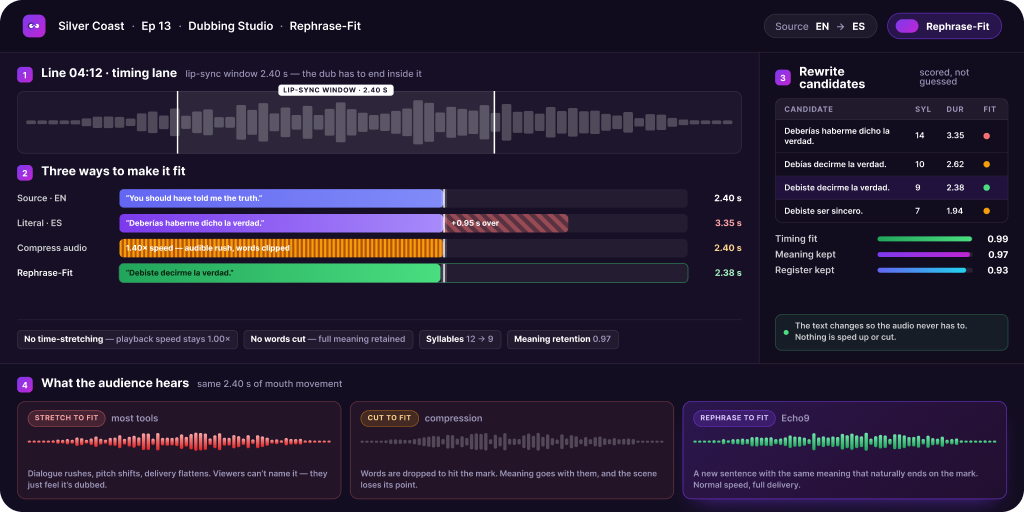
A technically aligned voice can still feel wrong if the translated sentence is too long, the pauses are unnatural, or the delivery does not match the actor’s performance. Timing needs to work at the level of the complete scene.
This is why timing, speech rate, pauses, pronunciation, and lip movement should be evaluated together rather than treated as independent technical checks.
What happens to the original audio mix and on-screen text?
These are two areas that can easily be overlooked when the focus is placed entirely on the generated dialogue.
A good localized version still needs to feel like the same production. Background music and sound effects should remain balanced against the new dialogue. On-screen text, subtitles, signs, graphics, and other visible language may also need localization or review.
The result should not feel like a new voice track placed on top of an otherwise untouched video. It should feel like a finished version intended for the target market.
This is an important distinction between simply generating dubbed audio and managing video localization as a complete production process. For teams using Echo9.ai, dubbing sits within a broader localization workflow rather than being treated as an isolated voice-generation step.
Why do small dubbing errors become bigger problems across a series?
A single mistake is usually easy to correct. The problem starts when the same mistake appears repeatedly.
Imagine a character whose name is slightly different in every few episodes. Or a fictional organization that has three different translations. Or a recurring phrase that changes depending on which episode was processed.
Each error might seem minor in isolation. Across an entire season, they create a pattern.
This is one of the strongest arguments for AI Plus Human Video Dubbing. The workflow needs to look beyond individual files. It needs to maintain consistency across the entire series.
That also changes how QA should work. A reviewer should not have to remember what happened in episode one when reviewing episode fourteen. The system should carry that information forward.
This is where a platform such as Echo9.ai can add value beyond the underlying AI generation technology. The focus is not only on producing each localized episode, but on managing the consistency and quality of the localization across the full series.
Where should AI end and human review begin?
The most effective workflows do not ask humans to inspect everything equally. They use automation to identify where human attention is most valuable.
Which parts of the dubbing workflow should AI handle?
AI should handle tasks where speed, repetition, and scale provide the biggest advantage.
That includes transcription, first-pass translation, voice generation, timing adjustments, and other mechanical production steps. These tasks can be processed across large catalogs without requiring a separate studio workflow for every language.
The result is a first-pass dub that gives the human reviewer something concrete to evaluate.
Which problems are better left to a human reviewer?
Human review is most valuable when the question is not simply whether something is technically correct, but whether it is appropriate.
Reviewers should focus on idioms, cultural references, emotional delivery, character consistency, terminology, pronunciation, and high-risk scenes. They should also evaluate moments where the relationship between dialogue and picture matters.
This is where AI Plus Human Video Dubbing becomes more than an AI production workflow. It becomes a quality-control system.
For Echo9.ai, this human layer is part of the managed service rather than something a content team has to build around an AI tool themselves. That allows AI to handle production at scale while human reviewers concentrate on the decisions that can materially affect the final localized experience.
Echo9’s Post-Dubbing QA Agent watches the full episode, not just a line.
Can automated QA make human review faster instead of slower?
Yes, if QA is designed to prioritize rather than simply score.
Instead of asking a reviewer to watch every second of every episode, automated QA can identify potential timing issues, terminology drift, unusually long or short dialogue, pronunciation concerns, or other outliers.
The reviewer can then investigate the areas most likely to contain problems.
This changes the role of human review from a bottleneck into a quality gate.
That principle is central to a scalable AI Plus Human Video Dubbing workflow. Echo9.ai uses automated QA alongside human review so that the review process can focus attention where it is needed instead of treating every line and every episode as requiring the same level of manual intervention.
Can the workflow learn from the mistakes it keeps finding?
It should.
If the same terminology issue appears repeatedly, the solution should not be to fix that term manually in every episode. The underlying reference, glossary, translation instruction, or workflow configuration should be updated.
Over time, the goal is to reduce repeated errors rather than repeatedly review the same errors.
For a series, this creates a feedback loop. Review findings can improve the localization process for the next episode instead of remaining isolated corrections. That is an important part of turning AI Plus Human Video Dubbing into a scalable production model.
How can AI Plus Human Video Dubbing scale without creating another bottleneck?
The answer is not simply to hire more reviewers.
A scalable localization operation needs to decide where full human review is necessary and where targeted review is sufficient. A flagship series premiere may justify a deeper review than a low-risk catalog title. A high-visibility market launch may require more scrutiny than internal content.
This creates a risk-based model.
AI processes the full volume. Automated QA identifies potential problems. Human reviewers spend more time on high-risk content and less time on routine material.
That approach allows AI Plus Human Video Dubbing to preserve much of the speed advantage of AI without accepting the quality risks of completely automated output.
It also highlights an important operational challenge. Scaling localization is not simply a matter of generating more dubbed tracks. Teams still need to coordinate languages, reviewers, corrections, terminology, QA, delivery, and release schedules.
This is where a managed partner can become more valuable than another standalone AI tool. Echo9.ai is built to manage the localization process around AI, combining automated production with QA and human review so content teams can scale multilingual releases without having to coordinate every part of the workflow themselves.
Is AI Plus Human Video Dubbing becoming the new standard?
The debate between AI and humans is becoming less useful as localization volumes increase.
Pure human dubbing remains valuable, particularly when performance, creative direction, and maximum control justify the additional time and cost. Fully automated AI dubbing can also be appropriate for certain low-risk content.
But large-scale video localization sits somewhere between those extremes.
Content owners need to move faster. They need more languages. They need consistent releases across markets. At the same time, they cannot afford to let obvious translation, performance, or continuity errors reach viewers.
That is the space AI Plus Human Video Dubbing is designed to address.
The future is unlikely to be about choosing AI or humans. It will be about designing a workflow where each handles the work it is best equipped to do.
For content teams, that can mean moving beyond the question of which AI dubbing technology to use and asking how the entire localization operation should be managed. Echo9.ai is built around that broader need, bringing AI-powered localization, QA, and human review together into a managed workflow for serialized and high-volume content.
What should teams know before adopting a hybrid dubbing workflow?
The strongest hybrid workflows share a few principles.
First, AI should produce the initial work at scale rather than being treated as a novelty layered onto an existing manual process.
Second, QA should happen before delivery, not after a viewer discovers an error.
Third, human review should be targeted toward areas where context and judgment matter.
Fourth, terminology, character information, pronunciation, and other series-level references should carry forward from episode to episode.
Finally, review findings should feed back into the production system. The goal is not simply to catch errors. It is to make the next episode less likely to contain the same error.
That is ultimately what makes AI Plus Human Video Dubbing different from simply adding a human checkpoint to an AI tool. It is a different way of organizing the localization workflow around speed, consistency, and judgment.
For teams that do not want to build and manage that infrastructure internally, a managed localization partner can provide another path. Echo9.ai brings together the AI production layer, automated QA, and human review needed to manage that process across languages and episodes.
The goal is not to remove humans from dubbing, but to use them where they matter most.
AI has changed how quickly video can be localized. The next challenge is making sure quality can scale at the same speed.
AI Plus Human Video Dubbing offers a practical way to do that. AI provides the production capacity. Automated QA finds where attention is needed. Human reviewers make the decisions that technology still cannot reliably make on its own.
For a single video, that distinction may be difficult to see.
Across an entire catalog or a 20-episode series, it becomes the difference between simply generating dubbed content and actually delivering localization that viewers can trust.
For teams looking to make that model operational, Echo9 provides a managed approach to AI-powered video localization, combining automation, QA, and human review to help content teams scale dubbing across languages without sacrificing the quality and consistency of the final release.
Free Trial
Run one episode through the full pipeline.
All eight stages on your own content — upload to broadcast-ready audio. No credit card, no managed-service queue.
What does AI Plus Human Video Dubbing actually mean?
It is a localization workflow where AI handles high-volume production tasks such as transcription, translation, voice generation, and timing, while human reviewers focus on quality decisions that require context, cultural understanding, and editorial judgment.
Can AI dubbing be published without human review?
For simple, low-risk content, fully automated dubbing may be sufficient. For high-visibility, client-facing, or episodic content, human review provides an additional quality layer for areas such as emotion, terminology, cultural adaptation, and continuity.
What should a human reviewer check in an AI dub?
A reviewer should evaluate naturalness, meaning, emotional delivery, character consistency, terminology, pronunciation, timing, lip sync, and the relationship between the dialogue and the scene.
Does human review make AI dubbing too slow?
Not when the review is targeted. Automated QA can identify likely problem areas before the reviewer begins, allowing human attention to be concentrated on the moments that actually need judgment.
Why is human review especially important for episodic content?
Because errors can compound. A terminology or character inconsistency that appears once may become a recurring problem across an entire season if it is not caught early.
What should a strong dubbing QA process measure?
A strong process should look beyond translation accuracy. Naturalness, emotional performance, terminology consistency, pronunciation, timing, lip sync, audio balance, on-screen text, and cross-episode consistency can all affect the final viewing experience.
How is hybrid dubbing different from traditional human-only dubbing?
Traditional dubbing relies on people across most stages of the process. A hybrid workflow uses AI for high-volume production while preserving human judgment where it has the greatest impact on quality.