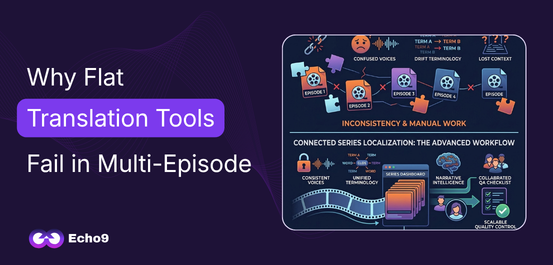
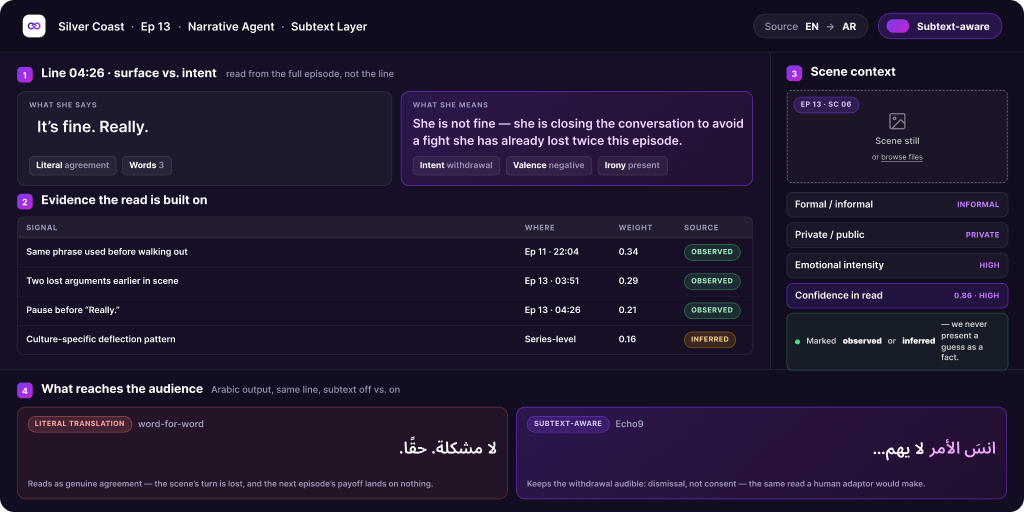
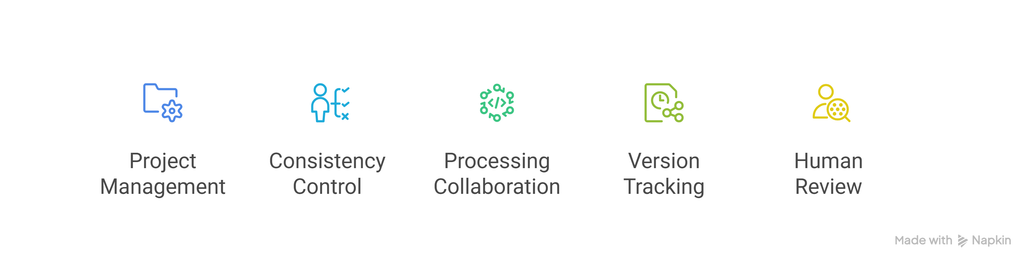
Translating a single video can be a simple task. Translating an entire series is a different challenge for flat translation tools. For one video, a tool may only need to understand the dialogue, translate it, and create subtitles or a dubbed version. But when content includes multiple episodes, the same characters, terms, storylines, and production rules need to remain consistent from one episode to the next. This is where flat translation tools can start to create problems. Most basic translation workflows are designed around individual files. Each episode is treated as a separate project, which can lead to repeated setup, inconsistent terminology, changing character voices, disconnected reviews, and more manual work. For OTT platforms, broadcasters, and teams managing large content libraries, the challenge is no longer simply translating a video. It is maintaining quality and consistency across the entire series. This article explains why flat translation tools struggle with multi-episode content and what teams can do to build a more scalable localization workflow. What are Flat Translation Tools Flat translation tools are built for projects, not catalogs. They operate on a simple, isolated workflow: you upload a single video file, translate the dialogue, burn in subtitles or generate an AI dub, and export the final asset. For a single standalone video, like a one-off product demo, a quick marketing clip, or an individual YouTube upload, this linear approach works perfectly fine. But the workflow completely breaks down when you need to scale across 10, 50, or hundreds of episodic videos. An entire series or course library is not just a fragmented collection of separate files; it is a unified ecosystem. Throughout a series, key elements must remain completely synchronous: When a translation tool lacks an intelligent memory system or a dedicated Series Management Dashboard, your team is forced to reinvent the wheel with every single episode. This creates an endless cycle of manual coordination overhead, massive workflow fragmentation, and glaring content inconsistencies. See this on your own episode. One scene, one language, 30 minutes with an engineer. Book a Consultation Why Single-Video Translation is Different from Series Localization Translating a single video is straightforward: you translate the dialogue, burn in subtitles or generate an AI dub, and export. But when you scale to an entire series, this file-by-file approach breaks down completely. True media localization demands absolute production consistency across dozens of connected files. When you treat a series like a collection of isolated videos, five critical elements break: Character Voices: Viewers build emotional connections with how a character sounds. If a voice shifts its pitch, tone, or emotional depth between Episode 1 and Episode 8, it instantly breaks audience immersion. Series localization requires locked, persistent speaker profiles that sound identical across full seasons. Echo9 solves this by locking character voice profiles across your entire catalog, ensuring absolute vocal consistency from the pilot to the finale. Centralized Terminology: Fictional locations, product names, titles, and technical vocabulary must remain uniform. While flat tools force teams to manually cross-reference past files, an episodic framework utilizes automated glossaries to apply the exact same translations from the first episode to the last. Echo9 handles this seamlessly by auto-applying your centralized glossary across all episodes, guaranteeing 100% brand and story uniformity. Narrative Intelligence: Dialogues do not exist in a vacuum; a line in Episode 10 often depends heavily on context established in Episode 2. Instead of translating line-by-line, an advanced series workflow retains full-season context to ensure that cultural adaptations and humor translate perfectly. Echo9 delivers this by using narrative intelligence to track story context across all episodes, ensuring every joke and cultural adaptation lands exactly as intended. Automated Quality Control (QA): Reviewing a single video for lip-sync and timing is easy. Manually tracking emotional delivery, pronunciation, and formatting across a 50-episode, multi-language run is a logistical nightmare. Episodic localization introduces centralized, automated QA to flag cross-episode errors instantly before a director reviews its results. Connected Workflows: Managing multiple languages, revisions, and translation teams across separate video files leads to massive coordination overhead. True series localization unifies your entire catalog into a single, connected pipeline, cutting delivery timelines from weeks to hours. Echo9 provides this structural backbone by syncing your entire production team and seasonal assets into one intuitive dashboard, eliminating manual management entirely. Amazon’s Prime Video Subtitling Guidelines make the same point: subtitlers must keep terminology, character names and recurring phrases consistent “to help viewers build understanding cumulatively.” What a Series-based Localization Workflow Should Include A professional media production doesn’t need another isolated file translator; it needs a repeatable, automated production line. To scale a catalog without losing quality, a true series-based localization workflow must integrate these core capabilities: Centralized Project and Workflow Management: Instead of managing scattered files across separate cloud folders, the entire series, seasons, and multi-language requirements must live in one workspace. This gives teams absolute visibility to assign tasks, track real-time progress, and eliminate coordination overhead. Character and Terminology Consistency: The system must lock in shared glossaries and character voice profiles across the entire asset library. By enforcing these global rules at the series level, translators and voice teams can ensure that specialized terms and vocal identities remain completely uniform from the pilot to the finale. Efficient Processing and Team Collaboration: Localizing a full series requires a balance between batch processing and frame-level control. The workflow must automate repetitive tasks like transcription, translation, and subtitle creation, while providing a collaborative pipeline where editors, managers, and reviewers can seamlessly communicate without delays. Version Tracking and Quality Control: Episodic content undergoes constant revisions. A scalable system must automatically track file versions, review states, and timeline adjustments. It pairs an automated Post-Dubbing QA Engine with native timeline tools to quickly identify errors in lip-sync, timing, and pronunciation before final delivery. Human Quality Review: While automated engines handle the bulk of translation, dubbing, and technical checks, the workflow must integrate human linguistic reviewers. Human judgment remains irreplaceable for locking in precise emotional delivery, cultural context, and storytelling nuances. How Echo9 Helps With Multi-Episode