
Multilingual Voice AI for Global Content in 2027
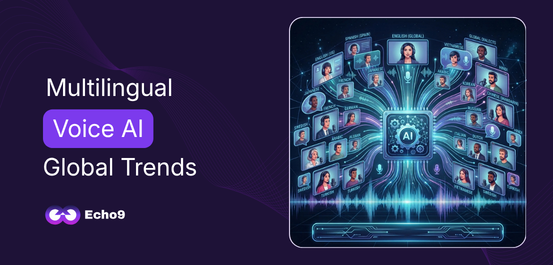
Global content is becoming more multilingual, but simply translating words is no longer enough. Audiences expect videos, courses, campaigns, and entertainment to sound natural in their own language while still preserving the voice, emotion, and meaning of the original. That shift is putting multilingual voice AI at the center of modern content localization. Advances in AI dubbing, voice cloning, neural voice synthesis, and context-aware localization are making it easier to create voice content for multiple markets without rebuilding the entire production process for every language. For creators, streaming platforms, studios, and global brands, the bigger question is no longer whether voice AI can generate another language. The focus is moving toward how naturally, consistently, and efficiently that content can reach audiences around the world. What Is Multilingual Voice AI? Multilingual voice AI refers to AI-powered technology that can generate, translate, adapt, or transform spoken content across multiple languages. It can include text-to-speech, voice cloning, speech translation, AI dubbing, and other voice technologies used to create localized audio. While voice cloning can preserve the characteristics of a particular speaker, text-to-speech can generate spoken audio from written text. AI dubbing brings several parts of the workflow together by translating dialogue, generating the target-language voice, and aligning the result with the original video. The difference becomes especially important when content needs to work across many languages. A translated script may communicate the basic meaning, but the final voice also needs to match the speaker, scene, emotion, timing, and audience. For a deeper look at how these technologies differ, see Echo9’s guide to TTS vs Voice Cloning vs AI Dubbing. Multi-Language Delivery Scale one episode into your next six markets. Give us one source upload and your target languages. We’ll show you the parallel output. Book a ConsultationStart a Free Trial Why Multilingual Voice AI Matters in 2026 Global distribution has changed the way content is produced. A single video can now be released across several markets, creating demand for localized versions without adding a completely separate production process for every language. AI is helping teams respond to that demand by shortening parts of the localization workflow. Current industry research tracking professional dubbing projects shows activity across dozens of target languages, while advances in speech synthesis are improving multilingual pronunciation and expressiveness. Still, speed alone does not define successful localization. Viewers can notice when a voice sounds unnatural, a character’s personality changes, or a translated line loses its intended meaning. That is why modern multilingual voice workflows are increasingly focused on context, consistency, quality, and human review alongside automation. 6 Multilingual Voice AI Trends Shaping Global Content The latest multilingual voice AI trends are not limited to generating speech in another language. They are also influencing how teams handle voice identity, context, emotion, production scale, and quality. 1. Voice AI Is Moving Beyond Basic Text-to-Speech Text-to-speech remains one of the foundations of synthetic voice technology, but the expectations around AI-generated speech are becoming much higher. Earlier use cases often focused on converting written text into understandable audio. Today’s systems are increasingly expected to produce speech with natural pacing, pronunciation, tone, and expressive delivery across different languages. That development matters for global content because a technically correct voice can still feel unnatural to its audience. A successful localized version needs to sound appropriate for the language and the situation in which it is being used. Echo9’s AI dubbing workflow reflects this broader shift by treating voice generation as part of a larger localization process rather than as an isolated audio task. 2. Voice Identity Is Becoming More Important When audiences move from one language to another, the voice itself can be part of what makes a character, narrator, or brand recognizable. Voice cloning is helping address this challenge by allowing a particular speaker’s vocal characteristics to be carried into localized dialogue. For episodic content, that can help maintain a recognizable character voice across multiple episodes and languages instead of creating a completely different vocal identity for every version. The value becomes clearer in long-form content. A character who sounds consistent throughout a season creates a stronger sense of continuity, while changing voices between episodes can make the localized version feel disconnected. Echo9’s Series Management is designed around this type of recurring content workflow, where voice consistency and terminology need to remain stable as localization expands across episodes. 3. Context and Emotion Are Shaping Better Localization A sentence does not exist in isolation. Who is speaking, who they are speaking to, what happened before the scene, and how the line is delivered can all change the way it should be localized. That is why context-aware localization is becoming a major part of multilingual voice AI. Modern systems are moving toward understanding relationships, emotional intent, cultural references, and scene-level meaning instead of treating every dialogue line as an independent translation task. Echo9 specifically describes its localization workflow around episode-level context, relationship, cultural adaptation, and emotion. Consider a character speaking respectfully to a senior family member. A direct translation may communicate the words correctly, yet the target-language version could sound too casual or too formal if the relationship is ignored. Anger, sarcasm, excitement, fear, or hesitation can also completely change how a line should sound. Echo9’s approach to context-aware localization connects these elements before the final voice is generated. 4. Multilingual Content Is Moving Toward Greater Scale Producing one localized video is very different from managing an entire multilingual content library. A streaming platform may need several languages for every episode in a season. A creator may want to expand a large video archive into new markets. An enterprise could have hundreds of training videos that need localization over time. In each case, repeating the same process manually can create delays and consistency problems. AI is making larger localization operations more practical by automating parts of transcription, translation, voice generation, timing, and quality workflows. Deloitte’s research on Generative AI autolocalization highlights the potential for AI-powered localization to reduce scalability problems and support content across languages and regions.
Closed Captions vs Subtitles vs Dubbing Explained
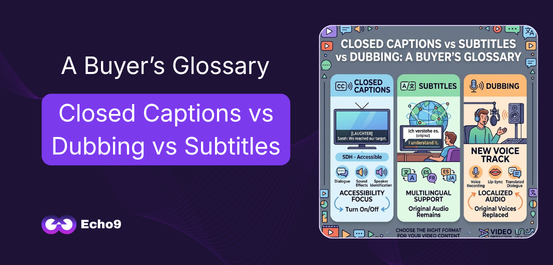
When a video needs to reach more viewers, the first question is often: Should you use closed captions, subtitles, or dubbing? The three options may look similar from a localization perspective, but they solve different problems. Closed captions focus on accessibility and audio information, subtitles primarily help viewers understand dialogue in another language, while dubbing replaces the original spoken audio with a new-language voice track. For broadcasters, OTT platforms, publishers, and media teams, choosing the right format affects accessibility, viewer experience, production effort, localization costs, and delivery requirements. Closed Captions, Subtitles, and Dubbing: What Is the Difference? The easiest way to understand the three formats is to look at what they change and who they are designed to help. Closed captions provide text for spoken dialogue as well as important non-speech audio, such as music, laughter, or meaningful sound effects. They can usually be turned on or off by the viewer. Subtitles primarily present spoken dialogue as text, often translating it into another language for viewers who can hear the original audio but do not understand the language being spoken. Dubbing takes a different approach. Instead of asking viewers to read the translated dialogue, the original spoken track is replaced with a new voice track in the target language. So, the choice is not simply about language. It is about the viewer, content type, accessibility requirement, platform, and desired viewing experience. Echo9’s Post-Dubbing QA Agent watches the full episode, not just a line. See it on your last delivery What Are Closed Captions? Closed captions, commonly written as CC, are timed text that represents the audio information viewers need to understand a video. Unlike dialogue-only subtitles, captions can include: For example: «[APPLAUSE]»«Sarah: We have reached our target.» The first line communicates information that a viewer would otherwise hear but may not be able to access. This makes closed captions particularly important for Deaf and hard-of-hearing viewers. They are also useful when viewers are watching content in environments where audio is difficult to hear. The FCC’s closed-captioning requirements make accessibility an important consideration for media organizations. What Are Subtitles? Subtitles are timed text that primarily communicates spoken dialogue to viewers who may not understand the original language. For example, imagine a documentary recorded in English that is being distributed to Spanish-speaking viewers. The original English audio remains, while Spanish dialogue appears on screen. That is a subtitle workflow. Subtitles generally focus on the spoken message, rather than describing every meaningful sound in the video. This distinction matters because a viewer who can hear the original audio may only need a language translation, while a viewer who cannot hear the audio may need additional information through captions. Subtitles for Global Video Distribution Subtitles are widely used for: They can also be produced in multiple languages without replacing the original performance. For content teams working across many markets, this makes subtitles a practical way to expand language coverage while keeping the original audio intact. What Is Dubbing? Dubbing replaces the original dialogue with a new spoken performance in another language. Instead of reading translated text, the viewer listens to the content in their preferred language. A professional dubbing workflow may involve: High-quality dubbing therefore requires more than translation. The translated dialogue may need to fit the timing of the original scene, match the speaker’s delivery, and work naturally with the visuals. For premium content, lip-sync can add another layer of complexity. When Dubbing Makes More Sense Dubbing can be useful when: Closed Captions vs Subtitles vs Dubbing: Quick Comparison Feature Closed Captions Subtitles Dubbing Main purpose Accessibility Language support Audio localization Dialogue included Yes Yes Replaced with translated dialogue Sound effects included Yes, when meaningful Usually no Original sound mix may remain Original voice Usually remains Remains Replaced Viewer reads text Yes Yes No Useful for accessibility Strong Depends on format Not a replacement for captions Best for Accessibility, broadcast, online video Multilingual audiences Fully localized viewing Production complexity Low to medium Medium Medium to high The important point is that these formats are not interchangeable. A dubbed video can still need captions. A subtitled video can still need an accessibility-focused caption track. A broadcast may require captions even when subtitles are not part of the localization plan. When Should You Use Each Format? Choose Closed Captions When Accessibility Is the Priority Use closed captions when viewers need access to dialogue and meaningful audio information. This is especially relevant for: WCAG 2.2 Success Criterion 1.2.2 requires captions for prerecorded audio content in synchronized media, with defined exceptions. W3C also notes that captions should include dialogue and meaningful non-speech information needed to understand the content. Choose Subtitles When Language Is the Main Barrier Subtitles are usually the better choice when viewers can hear the original audio but need the dialogue translated. They work well for: One source video can therefore be adapted for several markets without creating a completely new audio version for every language. Choose Dubbing When the Viewing Experience Should Feel Fully Localized. Dubbing is worth considering when the audience should be able to watch without reading. It can be especially useful for: Worksheet Free Worksheet Model your real per-episode localization cost. A fillable worksheet that puts studio, vendor and Echo9 costs side by side for one season. Get the Worksheet Conclusion Understanding closed captions vs subtitles vs dubbing is more than learning three definitions. For broadcasters, OTT platforms, and content teams, each format serves a different audience and production goal. Closed captions help make audio content accessible. Subtitles remove language barriers while preserving the original audio. Dubbing creates a more immersive localized experience by replacing the spoken dialogue. The best choice depends on the video’s audience, platform, language requirements, accessibility needs, production timeline, and distribution strategy. For teams producing video at scale, the strongest workflow is one that treats captioning, subtitling, dubbing, timing, terminology, and quality control as connected parts of video localization. When those decisions are made early, content becomes easier to distribute, easier to localize, and more useful
Subtitle File Format Guide SRT vs VTT vs CSV
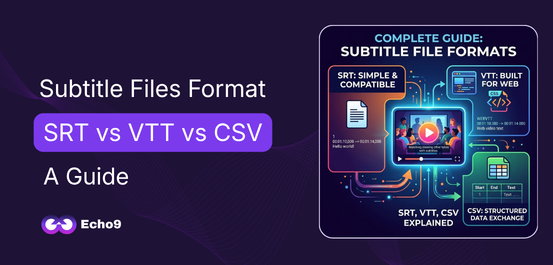
A subtitle file may look like a simple text document, but it contains the information a video player needs to display dialogue at the right moment. For localization teams, broadcasters, content creators, and streaming platforms, choosing the right subtitle file format can make the difference between a smooth delivery and unnecessary technical issues. Among the most commonly encountered formats are SRT, VTT, and CSV. Each one serves a different purpose. SRT is widely used for basic subtitle delivery, VTT is designed for web-based video and supports richer cue features, while CSV is better understood as a structured data format that can be used to exchange subtitle-related information rather than a standard subtitle format itself. Understanding these differences helps teams prepare files correctly, avoid compatibility problems, and build more reliable localization workflows. What Is a Subtitle File? A subtitle file contains timed text that tells a video player what to display and when to display it. Instead of permanently adding text to the video itself, subtitles are normally stored separately and synchronized with the video’s timeline. A typical subtitle file contains three important elements: the text, the timing information, and the structure required by the selected format. Timing tells the player when a subtitle should appear and disappear, while the text provides the dialogue or other relevant information viewers need. For localization teams, subtitle files are especially important because the same video may need to be delivered in several languages. Each language version can have its own subtitle file while using the same source video. The format becomes important at the delivery stage. A file that works perfectly in one platform may need to be converted or adjusted before it can be used somewhere else. That is why knowing the differences between SRT, VTT, and CSV is useful for anyone working with multilingual video content. See this on your own episode. One scene, one language, 30 minutes with an engineer. Book a Consultation SRT: The Most Common Subtitle Format SRT, short for SubRip Subtitle, is one of the most widely recognized subtitle formats. Its simple structure makes it easy to create, edit, and process across many subtitle tools and video workflows. An SRT file normally contains a sequence number, a start and end time, and the subtitle text. Each subtitle entry is separated from the next one by a blank line. A simplified SRT entry looks like this: The comma used in the timecode is one of the familiar characteristics of SRT files. Because the structure is straightforward, SRT remains a practical choice for many basic subtitling and localization tasks. Why Teams Still Use SRT SRT works well when the primary requirement is accurate, timed subtitle text without complex positioning or web-specific styling. Its biggest advantage is simplicity. Editors can open an SRT file in a text editor, subtitle software, or localization platform and quickly understand how the file is structured. For a single video, training material, interview, or basic localized version, that simplicity can make production easier. The format is also widely supported, which reduces compatibility concerns across many common video workflows. However, SRT has limitations. It does not provide the same range of web-focused features available in WebVTT. When teams need more control over subtitle positioning, styling, or browser-based video behavior, another format may be more appropriate. VTT: Built for Web Video VTT, or WebVTT (Web Video Text Tracks), was designed for displaying timed text alongside web video. The format is closely associated with HTML5 video and the <track> element, making it particularly useful for browser-based video experiences. A WebVTT file begins with the WEBVTT header and then contains timed cues. According to the official W3C WebVTT Specification, its structure can support subtitles, captions, chapters, and other time-aligned metadata blocks. A basic VTT example looks like this: Notice the difference in the time format. VTT commonly uses a period before the milliseconds, while the example SRT structure uses a comma. Beyond timing, WebVTT can support additional cue information and presentation-related features. That flexibility makes it useful for websites, online learning platforms, streaming experiences, and other browser-based video environments. CSV: Useful for Subtitle Data and Workflows CSV, or Comma-Separated Values, is different from SRT and VTT. CSV is not primarily a subtitle playback format. Instead, it is a structured way of storing information in rows and columns. Subtitle teams may use CSV files to organize or exchange subtitle-related data such as timestamps, speaker information, language versions, or translation content. For example, a CSV workflow might contain columns such as: This structure can be useful when subtitle data needs to move between spreadsheets, databases, localization systems, or custom processing tools. The important distinction is that a CSV file usually needs another system or process to interpret its information as subtitles. You generally would not upload an ordinary CSV file to a video player and expect it to behave like an SRT or VTT file. That makes CSV particularly useful for data management and workflow exchange, while SRT and VTT are intended for timed-text delivery. SRT vs VTT vs CSV: Key Differences Feature SRT VTT CSV Main purpose Subtitle delivery Web video text tracks Structured data exchange Common use Video subtitles Web video and captions Subtitle data/workflows Timecodes Yes Yes Can store them as data Web-focused Limited Yes No Easy to edit manually Yes Yes Yes Browser video support Depends on platform Strong Requires processing Rich cue features Limited More flexible Depends on workflow The simplest way to remember the distinction is this: SRT is a practical subtitle format, VTT is a web-oriented timed-text format, and CSV is a data format that can organize subtitle information. For a deeper understanding of how subtitles fit into localization, explore Types of Video Localization and What Is Media Localization. Which Subtitle Format Should You Choose? Selecting a format should start with the delivery environment, not simply the file extension. If a client specifically requests an SRT file, delivering a VTT file instead may create an unnecessary compatibility problem. Likewise, a web development workflow may
Why Flat Translation Tools Fail at Multi-Episode Content
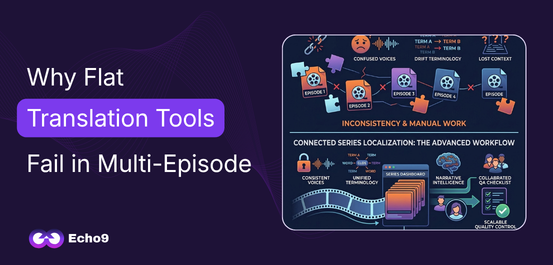
Translating a single video can be a simple task. Translating an entire series is a different challenge for flat translation tools. For one video, a tool may only need to understand the dialogue, translate it, and create subtitles or a dubbed version. But when content includes multiple episodes, the same characters, terms, storylines, and production rules need to remain consistent from one episode to the next. This is where flat translation tools can start to create problems. Most basic translation workflows are designed around individual files. Each episode is treated as a separate project, which can lead to repeated setup, inconsistent terminology, changing character voices, disconnected reviews, and more manual work. For OTT platforms, broadcasters, and teams managing large content libraries, the challenge is no longer simply translating a video. It is maintaining quality and consistency across the entire series. This article explains why flat translation tools struggle with multi-episode content and what teams can do to build a more scalable localization workflow. What are Flat Translation Tools Flat translation tools are built for projects, not catalogs. They operate on a simple, isolated workflow: you upload a single video file, translate the dialogue, burn in subtitles or generate an AI dub, and export the final asset. For a single standalone video, like a one-off product demo, a quick marketing clip, or an individual YouTube upload, this linear approach works perfectly fine. But the workflow completely breaks down when you need to scale across 10, 50, or hundreds of episodic videos. An entire series or course library is not just a fragmented collection of separate files; it is a unified ecosystem. Throughout a series, key elements must remain completely synchronous: When a translation tool lacks an intelligent memory system or a dedicated Series Management Dashboard, your team is forced to reinvent the wheel with every single episode. This creates an endless cycle of manual coordination overhead, massive workflow fragmentation, and glaring content inconsistencies. See this on your own episode. One scene, one language, 30 minutes with an engineer. Book a Consultation Why Single-Video Translation is Different from Series Localization Translating a single video is straightforward: you translate the dialogue, burn in subtitles or generate an AI dub, and export. But when you scale to an entire series, this file-by-file approach breaks down completely. True media localization demands absolute production consistency across dozens of connected files. When you treat a series like a collection of isolated videos, five critical elements break: Character Voices: Viewers build emotional connections with how a character sounds. If a voice shifts its pitch, tone, or emotional depth between Episode 1 and Episode 8, it instantly breaks audience immersion. Series localization requires locked, persistent speaker profiles that sound identical across full seasons. Echo9 solves this by locking character voice profiles across your entire catalog, ensuring absolute vocal consistency from the pilot to the finale. Centralized Terminology: Fictional locations, product names, titles, and technical vocabulary must remain uniform. While flat tools force teams to manually cross-reference past files, an episodic framework utilizes automated glossaries to apply the exact same translations from the first episode to the last. Echo9 handles this seamlessly by auto-applying your centralized glossary across all episodes, guaranteeing 100% brand and story uniformity. Narrative Intelligence: Dialogues do not exist in a vacuum; a line in Episode 10 often depends heavily on context established in Episode 2. Instead of translating line-by-line, an advanced series workflow retains full-season context to ensure that cultural adaptations and humor translate perfectly. Echo9 delivers this by using narrative intelligence to track story context across all episodes, ensuring every joke and cultural adaptation lands exactly as intended. Automated Quality Control (QA): Reviewing a single video for lip-sync and timing is easy. Manually tracking emotional delivery, pronunciation, and formatting across a 50-episode, multi-language run is a logistical nightmare. Episodic localization introduces centralized, automated QA to flag cross-episode errors instantly before a director reviews its results. Connected Workflows: Managing multiple languages, revisions, and translation teams across separate video files leads to massive coordination overhead. True series localization unifies your entire catalog into a single, connected pipeline, cutting delivery timelines from weeks to hours. Echo9 provides this structural backbone by syncing your entire production team and seasonal assets into one intuitive dashboard, eliminating manual management entirely. Amazon’s Prime Video Subtitling Guidelines make the same point: subtitlers must keep terminology, character names and recurring phrases consistent “to help viewers build understanding cumulatively.” What a Series-based Localization Workflow Should Include A professional media production doesn’t need another isolated file translator; it needs a repeatable, automated production line. To scale a catalog without losing quality, a true series-based localization workflow must integrate these core capabilities: Centralized Project and Workflow Management: Instead of managing scattered files across separate cloud folders, the entire series, seasons, and multi-language requirements must live in one workspace. This gives teams absolute visibility to assign tasks, track real-time progress, and eliminate coordination overhead. Character and Terminology Consistency: The system must lock in shared glossaries and character voice profiles across the entire asset library. By enforcing these global rules at the series level, translators and voice teams can ensure that specialized terms and vocal identities remain completely uniform from the pilot to the finale. Efficient Processing and Team Collaboration: Localizing a full series requires a balance between batch processing and frame-level control. The workflow must automate repetitive tasks like transcription, translation, and subtitle creation, while providing a collaborative pipeline where editors, managers, and reviewers can seamlessly communicate without delays. Version Tracking and Quality Control: Episodic content undergoes constant revisions. A scalable system must automatically track file versions, review states, and timeline adjustments. It pairs an automated Post-Dubbing QA Engine with native timeline tools to quickly identify errors in lip-sync, timing, and pronunciation before final delivery. Human Quality Review: While automated engines handle the bulk of translation, dubbing, and technical checks, the workflow must integrate human linguistic reviewers. Human judgment remains irreplaceable for locking in precise emotional delivery, cultural context, and storytelling nuances. How Echo9 Helps With Multi-Episode
How Series Management in Video Localization Works
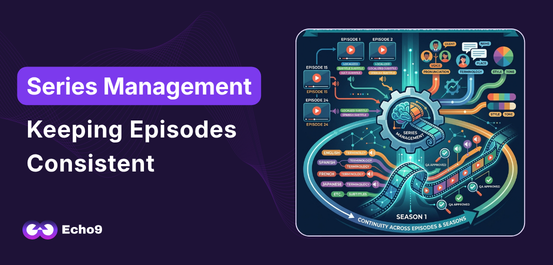
A single localized video only has to be right once. A 24-episode season has to be right 24 times, with the same character names, terminology, voices, pronunciation, tone, and style across every episode and every target language. That is the problem series management in video localization is designed to solve. Series management treats the show, rather than the individual video file, as the unit of localization. Decisions made in episode 1 remain available when episode 20 enters production, so teams do not have to recreate the same context every time. For OTT platforms, broadcasters, studios, and localization service providers working with recurring content, that distinction becomes increasingly important as episode counts, languages, and release schedules grow. Echo9’s approach to episodic localization is built around that continuity. What Is Series Management in Video Localization? Series management is the layer of a localization workflow that keeps terminology, voice, style, and QA decisions consistent across an entire series. Instead of treating every episode as a new project, a series-level workflow maintains a persistent record of: A term established in episode 1 can remain consistent in episode 40. A recurring character can retain the same voice profile without being re-briefed for every episode. Reviewers can identify patterns across a season instead of checking every file in isolation. This matters because episodic content behaves differently from standalone video. A single marketing video only needs to be internally consistent. Episode 7 needs to agree with episode 2, while season 3 may need to remain consistent with season 1 even if the original localization team has changed. Why Episodic Content Breaks Traditional Localization Workflows Most localization workflows were designed around one project going in and one finished file coming out. That works for a single video. It becomes difficult when the same workflow has to be repeated across dozens of connected episodes. Context gets lost A translator working on episode 15 may not know how a character’s nickname was translated in episode 4 unless someone has maintained and shared that information. This becomes even more important when localization has to preserve the identity of a series across markets. Netflix’s approach to dubbing K-content illustrates how localization involves more than translating dialogue, with voice casting, cultural adaptation, synchronization, and creative intent all forming part of the process. Without a living glossary, terminology starts to drift. The same applies to pronunciation, character descriptions, recurring phrases, and stylistic decisions. Echo9’s Voice Bank provides a persistent reference for recurring voices, while a structured series workflow keeps decisions connected across episodes. Teams change A season can take months to produce. The translator, reviewer, or vendor working on season 1 may not be available for season 2. If the show’s localization rules exist only in people’s memories, every new contributor has to reconstruct them. A documented workflow makes those decisions reusable rather than dependent on whoever happens to be working on the next episode. QA becomes harder to scale Checking one localized video is manageable. Checking 24 episodes across 12 languages means potentially hundreds of localized files. The question is no longer simply: It becomes: That requires season-level visibility. Echo9’s QA Director Review adds human oversight to an AI-assisted workflow, allowing reviewers to focus attention where judgment matters rather than repeatedly reconstructing context. Tool sprawl increases coordination Teams often patch the problem with spreadsheets, shared documents, translation tools, dubbing platforms, subtitle tools, and external QA processes. The more tools involved, the more opportunities there are for context and version information to disappear between handoffs. Echo9’s Project Management layer brings the operational side closer to localization production, helping teams organize recurring content, episodes, reviews, and delivery. OTT Localization See how your next season could localize at scale. Give us one episode and one language. We’ll show you how Echo9 handles dubbing, subtitling, review, and episode-level consistency in one workflow. Book a Consultation Start a Free Trial 2.4M+ episodes processed · 100+ languages · 50+ studios The Core Components of Series Management Series management is not a single feature. It combines several capabilities that become important once content is recurring. 1. Terminology consistency A series needs a centralized terminology system covering character names, brands, locations, recurring phrases, and technical terms. Once a term has been approved, future episodes should inherit that decision rather than asking translators to make it again. This becomes especially important in AI dubbing for OTT platforms, where terminology and pronunciation need to remain consistent alongside generated voices. For more complex localization, decisions may also involve how language is adapted to context, character relationships, or cultural expectations. Echo9’s relationship-aware localization and subtext-aware localization capabilities are examples of how localization can preserve more than literal wording. 2. Voice consistency A recurring character should sound like the same character throughout the series. That means maintaining the same voice profile, delivery characteristics, and vocal identity across episodes. Voice cloning can help establish that consistency, but the important part is that the voice decision needs to persist at the series level rather than being recreated for every file. For teams comparing approaches, Echo9’s TTS vs. voice cloning vs. AI dubbing comparison explains how these technologies differ. 3. Batch and episode-level workflows Running every episode as an isolated project creates repetitive setup work. A series-level workflow lets teams establish terminology, voice, style, and review requirements once and apply them across multiple episodes. This makes it easier to process episodes in parallel while keeping the underlying rules consistent. That becomes particularly important when a season is being localized into several languages simultaneously. Echo9’s multi-language workflow is designed around coordinating multilingual production rather than treating every language as a completely separate operation. 4. Centralized QA Single-video QA asks: Series-level QA asks: Automated checks can identify mechanical problems such as terminology drift or repeatable inconsistencies. Human reviewers can then focus on cultural adaptation, humor, emotional delivery, and whether dialogue sounds natural. That is the logic behind AI plus human video dubbing: AI provides production capacity while human review handles decisions that require judgment. 5. Documented style and tone Series
Why the Future of Video Localization Depends on AI Plus Human Video Dubbing
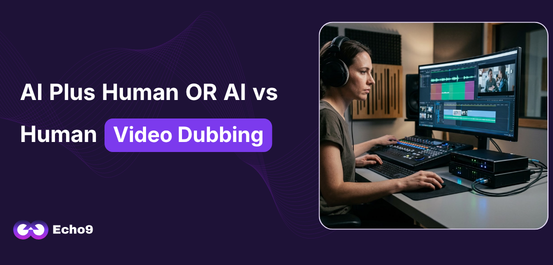
For the past few years, the localization industry has treated AI dubbing and human dubbing as competing approaches. One promised speed and scale. The other promised quality and judgment. But as AI dubbing has matured, the more useful question is no longer which one should win. It is where each one should be used. AI can now transcribe dialogue, translate scripts, generate voices, adjust timing, and produce dubbed tracks across multiple languages at a fraction of the time required by a traditional dubbing workflow. That changes what is possible for platforms, studios, broadcasters, and content owners with large catalogs. It does not remove the need for human judgment. A technically correct translation can still sound unnatural. A perfectly timed voice can still deliver the wrong emotion. A character’s name can change halfway through a season without anyone noticing until viewers do. That is why AI Plus Human Video Dubbing is becoming a more practical model for scalable localization. AI handles the volume. Automated QA identifies potential problems. Humans focus on the decisions that still require context, cultural understanding, and editorial judgment. What does AI Plus Human Video Dubbing actually mean? AI Plus Human Video Dubbing is not simply a process where AI creates a draft and a human rewrites everything afterward. That approach would give up much of the efficiency AI is supposed to provide. The better model is a division of labor. AI handles the repetitive parts of localization that benefit from speed and consistency. This can include transcription, first-pass translation, voice generation, timing, and other production tasks. Human reviewers then focus on the parts that require judgment. They can check whether an idiom works in the target language, whether a character still sounds like themselves, whether an emotional moment feels right, and whether terminology remains consistent across episodes. This makes AI Plus Human Video Dubbing different from both traditional dubbing and fully automated dubbing. Humans are not expected to redo the entire production. They are there to make sure the parts that matter most are right. For teams managing larger catalogs, this distinction becomes particularly important. The challenge is not simply generating a dubbed track. It is managing the workflow around that track, from production and QA through review, correction, and final delivery. This is where a managed localization workflow such as Echo9.ai can become useful, combining AI-powered localization with human review rather than leaving teams to coordinate separate tools and processes themselves. Why can AI produce a dub quickly but still miss important problems? AI dubbing is very good at processing large amounts of predictable information. A system can take a finished video, identify dialogue, translate it, generate voices, and create a new audio track far faster than a traditional studio pipeline. The problem is that localization is not only a technical process. Meaning often depends on context. An idiom may have no direct equivalent in another language. A joke may need to be rewritten rather than translated. A character may be sarcastic in one scene and vulnerable in the next. The same word may also need to be translated differently depending on who is speaking and what is happening on screen. If AI can handle the production work, what does the human reviewer actually add? The human reviewer provides the judgment layer. Consider a character who uses the same fictional title throughout a 20-episode series. An AI system might translate that title differently in different episodes because the surrounding sentence changes. Each individual translation could appear reasonable. Together, however, they create an inconsistency that damages the world of the series. The same applies to emotion. A generated voice can pronounce every word correctly while still sounding too calm, too excited, too angry, or simply disconnected from what is happening on screen. The value of human review is therefore not that humans are better at every task. It is that some localization decisions are difficult to evaluate without understanding the scene. This is also why the review layer should be part of the localization workflow from the beginning rather than added as a final manual check. Echo9.ai, for example, combines AI production with QA and human review so that potential issues can be surfaced before localized content reaches delivery. What actually makes an AI dub sound natural? A good dub has to do more than reproduce the original words in another language. Viewers experience the entire performance. They notice whether the dialogue sounds natural, whether the voice fits the character, whether the timing works, and whether anything feels out of place. That means AI Plus Human Video Dubbing needs to evaluate several quality signals rather than treating translation accuracy as the only measure of success. Does accurate translation always mean accurate meaning? Not necessarily. Literal translation can preserve the words while losing the intent behind them. This is especially common with humor, sarcasm, cultural references, slang, and dialogue that depends on a particular social context. Human review is useful here because the reviewer can judge the line against the scene rather than evaluating it as isolated text. The goal is not to make the translation identical to the source. The goal is to make the target-language dialogue communicate the same idea naturally. Can an AI voice really match the emotion of the original scene? Voice generation has improved significantly, but emotion remains highly dependent on context. A short line can be delivered as anger, fear, sarcasm, excitement, or sadness depending on the scene. The words alone do not contain all of that information. Reviewers should therefore listen to the dubbed line as part of the scene. They should ask whether the performance feels appropriate for the character and whether the emotional intensity matches the original. What happens when a character’s voice changes across a series? Consistency becomes increasingly important as content becomes episodic. A viewer may accept a slightly different voice in a short marketing video. They are less likely to accept unexplained changes in a character they have been following for twenty episodes. Voice identity,